

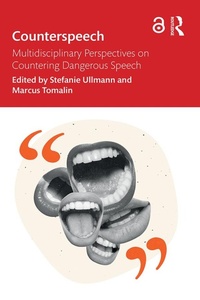
Counterspeech
Multidisciplinary Perspectives on Countering Dangerous Speech
1st Edition
Published on 22. December 2023
224 pages
978-1-003-81740-6 (ISBN)
Description

This volume looks at the forms and functions of counterspeech as well as what determines its effectiveness and success from multidisciplinary perspectives. Counterspeech is in line with international human rights and freedom of speech, and it can be a much more powerful tool against dangerous and toxic speech than blocking and censorship.
In the face of online hate speech and disinformation, counterspeech is a tremendously important and timely topic. The book uniquely brings together expertise from a variety of disciplines. It explores linguistic, ethical and legal aspects of counterspeech, looks at the functions and effectiveness of counterspeech from anthropological, practical and sociological perspectives and addresses the question of how we can use modern technological advances to make counterspeech a more instantaneous and efficient option to respond to harmful language online. The greatest benefit of counterspeech lies in the ability to reach bystanders and prevent them from becoming perpetrators themselves. This volume is an excellent opportunity to spread the word about counterspeech, its potential, importance, and future endeavors.
This anthology is a great resource for scholars and students of linguistics, philosophy of language, media and communication studies, digital humanities, natural language processing, international human rights law, anthropology and sociology, and interdisciplinary research methods. It is also a valuable source of information for practitioners and anyone who wants to speak up against harmful speech.
The Open Access version of this book, available at http://www.taylorfrancis.com, has been made available under a Creative Commons Attribution-Non Commercial-No Derivatives (CC-BY-NC-ND) 4.0 license.
In the face of online hate speech and disinformation, counterspeech is a tremendously important and timely topic. The book uniquely brings together expertise from a variety of disciplines. It explores linguistic, ethical and legal aspects of counterspeech, looks at the functions and effectiveness of counterspeech from anthropological, practical and sociological perspectives and addresses the question of how we can use modern technological advances to make counterspeech a more instantaneous and efficient option to respond to harmful language online. The greatest benefit of counterspeech lies in the ability to reach bystanders and prevent them from becoming perpetrators themselves. This volume is an excellent opportunity to spread the word about counterspeech, its potential, importance, and future endeavors.
This anthology is a great resource for scholars and students of linguistics, philosophy of language, media and communication studies, digital humanities, natural language processing, international human rights law, anthropology and sociology, and interdisciplinary research methods. It is also a valuable source of information for practitioners and anyone who wants to speak up against harmful speech.
The Open Access version of this book, available at http://www.taylorfrancis.com, has been made available under a Creative Commons Attribution-Non Commercial-No Derivatives (CC-BY-NC-ND) 4.0 license.
More details
Edition
1. Auflage
Language
English
Place of publication
London
United Kingdom
Publishing group
Taylor & Francis Ebooks
Target group
College/higher education
Product notice
Reflowable
Illustrations
17 Tables, black and white; 6 Line drawings, black and white; 7 Halftones, black and white; 13 Illustrations, black and white
ISBN-13
978-1-003-81740-6 (9781003817406)
Copyright in bibliographic data and cover images is held by Nielsen Book Services Limited or by the publishers or by their respective licensors: all rights reserved.
Schweitzer Classification
Other editions
Additional editions
Stefanie Ullmann | Marcus Tomalin
Counterspeech
Multidisciplinary Perspectives on Countering Dangerous Speech
Book
12/2023
1st Edition
Routledge
€63.20
Shipment within 10-20 days
Stefanie Ullmann | Marcus Tomalin
Counterspeech
Multidisciplinary Perspectives on Countering Dangerous Speech
Book
12/2023
1st Edition
Routledge
€206.30
Shipment within 10-20 days
Persons
Stefanie Ullmann is a linguist and postdoctoral research associate at the Centre for Research in the Arts, Social Sciences and Humanities at the University of Cambridge, UK. Her research interests include the use of language in politics and media discourse as well as forms and effects of harmful language in online discourse. She is the author of several journal publications on combatting and mitigating digital harms. Her book Discourses of the Arab Revolutions (2022) examines the power and functions of language in sociopolitical conflicts.
Marcus Tomalin has been a member of the Machine Intelligence Laboratory in the Department of Engineering at Cambridge University since 1998. He has published extensively on speech recognition, speech synthesis, machine translation, and dialogue systems, as well as various topics in the philosophy of language and theoretical linguistics, with a recurrent focus on the interconnections between mathematics, logic, and syntactic theory. He has a particular interest in the ethical and social impact of language-based AI systems, and he teaches ethics to undergraduates and postgraduates who are studying philosophy, computer science, and information engineering.
Marcus Tomalin has been a member of the Machine Intelligence Laboratory in the Department of Engineering at Cambridge University since 1998. He has published extensively on speech recognition, speech synthesis, machine translation, and dialogue systems, as well as various topics in the philosophy of language and theoretical linguistics, with a recurrent focus on the interconnections between mathematics, logic, and syntactic theory. He has a particular interest in the ethical and social impact of language-based AI systems, and he teaches ethics to undergraduates and postgraduates who are studying philosophy, computer science, and information engineering.
Content
Introduction; Part I: Approaches to Counterspeech: Linguistics, Philosophy and Interdisciplinarity; 1. Counterspeech Practices in Digital Discourse - An Interactional Approach; 2. The Philosophy of Counter Language; 3. Seeing the Full Picture: The Value of Interdisciplinary Counterspeech Research; Part II: Counterspeech in Context: Media, Culture and the Legal Framework; 4. Counterspeech as Persuasion and Media Effects; 5. Online Hate speech in Video Games Communities: A Counter Project; 6. Reimagining the Current Regulatory Framework to Online Hate Speech: Why Making Way for Alternative Methods is Paramount for Free Speech; Part III: Automation and the Future of Counterspeech; 7. Automating Counterspeech; 8. The Future of Counterspeech: Effective Framing, Targeting, and Evaluation; Conclusion
