

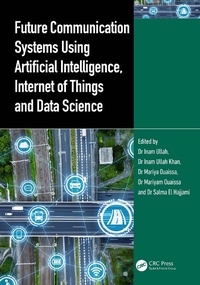
Future Communication Systems Using Artificial Intelligence, Internet of Things and Data Science
1st Edition
Published on 14. June 2024
252 pages
978-1-040-03952-6 (ISBN)
Description

Future Communication Systems Using Artificial Intelligence, Internet of Things and Data Science mainly focuses on the techniques of artificial intelligence (AI), Internet of Things (IoT) and data science for future communications systems.
The goal of AI, IoT and data science for future communications systems is to create a venue for industry and academics to collaborate on the development of network and system solutions based on data science, AI and IoT. Recent breakthroughs in IoT, mobile and fixed communications and computation have paved the way for a data-centric society of the future. New applications are increasingly reliant on machine-to-machine connections, resulting in unusual workloads and the need for more efficient and dependable infrastructures. Such a wide range of traffic workloads and applications will necessitate dynamic and highly adaptive network environments capable of self-optimization for the task at hand while ensuring high dependability and ultra-low latency.
Networking devices, sensors, agents, meters and smart vehicles/systems generate massive amounts of data, necessitating new levels of security, performance and dependability. Such complications necessitate the development of new tools and approaches for providing successful services, management and operation. Predictive network analytics will play a critical role in insight generation, process automation required for adapting and scaling to new demands, resolving issues before they impact operational performance (e.g., preventing network failures and anticipating capacity requirements) and overall network decision-making. To increase user experience and service quality, data mining and analytic techniques for inferring quality of experience (QoE) signals are required.
AI, IoT, machine learning, reinforcement learning and network data analytics innovations open new possibilities in areas such as channel modeling and estimation, cognitive communications, interference alignment, mobility management, resource allocation, network control and management, network tomography, multi-agent systems and network ultra-broadband deployment prioritization. These new analytic platforms will aid in the transformation of our networks and user experience. Future networks will enable unparalleled automation and optimization by intelligently gathering, analyzing, learning and controlling huge volumes of information.
The goal of AI, IoT and data science for future communications systems is to create a venue for industry and academics to collaborate on the development of network and system solutions based on data science, AI and IoT. Recent breakthroughs in IoT, mobile and fixed communications and computation have paved the way for a data-centric society of the future. New applications are increasingly reliant on machine-to-machine connections, resulting in unusual workloads and the need for more efficient and dependable infrastructures. Such a wide range of traffic workloads and applications will necessitate dynamic and highly adaptive network environments capable of self-optimization for the task at hand while ensuring high dependability and ultra-low latency.
Networking devices, sensors, agents, meters and smart vehicles/systems generate massive amounts of data, necessitating new levels of security, performance and dependability. Such complications necessitate the development of new tools and approaches for providing successful services, management and operation. Predictive network analytics will play a critical role in insight generation, process automation required for adapting and scaling to new demands, resolving issues before they impact operational performance (e.g., preventing network failures and anticipating capacity requirements) and overall network decision-making. To increase user experience and service quality, data mining and analytic techniques for inferring quality of experience (QoE) signals are required.
AI, IoT, machine learning, reinforcement learning and network data analytics innovations open new possibilities in areas such as channel modeling and estimation, cognitive communications, interference alignment, mobility management, resource allocation, network control and management, network tomography, multi-agent systems and network ultra-broadband deployment prioritization. These new analytic platforms will aid in the transformation of our networks and user experience. Future networks will enable unparalleled automation and optimization by intelligently gathering, analyzing, learning and controlling huge volumes of information.
More details
Edition
1. Auflage
Language
English
Place of publication
London
United Kingdom
Publishing group
Taylor & Francis Ltd
Target group
College/higher education
Professional and scholarly
Illustrations
10 Tables, black and white; 27 Line drawings, color; 3 Line drawings, black and white; 26 Halftones, color; 43 Illustrations, color; 13 Illustrations, black and white
ISBN-13
978-1-040-03952-6 (9781040039526)
Copyright in bibliographic data and cover images is held by Nielsen Book Services Limited or by the publishers or by their respective licensors: all rights reserved.
Schweitzer Classification
Other editions
Additional editions
Inam Ullah | Inam Ullah Khan | Mariya Ouaissa
Future Communication Systems Using Artificial Intelligence, Internet of Things and Data Science
Book
05/2026
1st Edition
CRC Press
€64.50
Shipment within 10-20 days
Inam Ullah | Inam Ullah Khan | Mariya Ouaissa
Future Communication Systems Using Artificial Intelligence, Internet of Things and Data Science
Book
06/2024
1st Edition
CRC Press
€165.50
Shipment within 10-20 days
Persons
Dr. Inam Ullah received a B.Sc. degree in Electrical Engineering (Telecommunication) from the Department of Electrical Engineering, University of Science and Technology Bannu (USTB), KPK, Pakistan, in 2016 and a Master's and Ph.D. degree in Information and Communication Engineering from the College of Internet of Things (IoT) Engineering, Hohai University (HHU), Changzhou Campus, 213022, China, in 2018 and 2022, respectively. He completed his postdoc with Brain Korea 2021 (BK21) at the Chungbuk Information Technology Education and Research Center, Chungbuk National University, Cheongju 28644, S Korea, from Oct. 2022 to March 31, 2023. He is currently an Assistant Professor at the Department of Computer Engineering, Gachon University, S Korea. His research interests include Robotics, Internet of Things (IoT), Wireless Sensor Networks (WSNs), Underwater Communication and Localization, Underwater Sensor Networks (USNs), Artificial Intelligence (AI), Big data, Deep learning, etc. He has authored more than 70 peer-reviewed articles on various research topics. He is the reviewer of many prominent journals, including IEEE Transactions on Industrial Informatics KSII Transactions on Internet & Information Systems, IEEE Transactions on Vehicular Technology, IEEE Transactions on Intelligent Transportation Systems, Transactions on Sustainable Computing, IEEE ACCESS, Sustainable Energy Technologies and Assessments, Future Generation Computer Systems (FGCS), Computers and Electrical Engineering (Elsevier), Internet of Things (IoT) Journal, Digital Communications & Networks (Elsevier), Wireless Communication & Mobile Computing (WCMC), Alexandria Engineering Journal Sensors, Electronics, Remote Sensing, Applied Sciences, Computational Intelligence and Neurosciences, etc. His awards and honors include the Best Student Award from the University of Science and Technology Bannu (USTB), KPK, Pakistan, in 2015 and the Prime Minister Laptop Scheme Award from the University of Science and Technology Bannu (USTB), KPK, Pakistan, in April 2015. Top-10 students award of the College of Internet of Things (IoT) Engineering, Hohai University, China in June 2019, Top-100 students award of Hohai University (HHU), China in June 2019, Jiangsu Province Distinguish International Students award (30,000 RMB) in 2019-2020, Certificate of Recognition from Hohai University (HHU), China in 2021 & 2022 both, Top-100 students award of Hohai University (HHU), China in May 2022, Top-10 Outstanding Students Award, Hohai University (HHU), China in June 2022, and Distinguished Alumni Award from University of Science and Technology Bannu (USTB), KPK, Pakistan in Oct. 2022.
Dr. Inam Ullah Khan is the Founder of Internet of Flying Vehicles-Lab at AI-EYS. Recently, he is working as Global Mentor/ Guest Lecturer at Impact Xcelerator, IE School of Science and Technology, Madrid, Spain. Previously, he was working as visiting researcher at King's College London, United Kingdom. Also, he was faculty member at different universities in Pakistan which include Center for Emerging Sciences Engineering & Technology (CESET), Islamabad, Abdul Wali Khan University, Garden Campus, Timergara Campus, University of Swat & Shaheed Zulfikar Ali Bhutto Institute of Science and Technology (SZABIST), Islamabad Campus. He completed his Ph.D. in Electronics Engineering from Department of Electronic Engineering, Isra University, Islamabad Campus, School of Engineering & Applied Sciences (SEAS). Also, he did his M.S. degree in Electronic Engineering at Department of Electronic Engineering, Isra University, Islamabad Campus, School of Engineering & Applied Sciences (SEAS). He had done undergraduate degree in Bachelor of Computer Science from Abdul Wali Khan University Mardan, Pakistan. He authored/coauthored more than 50 research articles in reputable journals, conferences and book chapters. His research interest includes Network System Security, Intrusion Detection, Intrusion Prevention, cryptography, Optimization techniques, WSN, IoT, Mobile Ad Hoc Networks (MANETS), Flying Ad Hoc Networks, and Machine Learning. He served in many international conferences as Session Chair/ Technical program committee member. Also, he served as Guest Editor with many prestigious international journals. Apart from that he is General Chair at International Conference on Trends and Innovations in Smart Technologies (ICTIST'22), virtually from London, United Kingdom. In addition, he also served as editor of several books. More interestingly, he was invited as technology expert many times on Pakistan National Television and other media outlets.
Dr. Mariya Ouaissa
Dr. Mariyam Ouaissa is currently an Assistant Professor in Networks and Systems at ENSA, Chouaib Doukkali University, El Jadida, Morocco. She received her Ph.D. degree in 2019 from National Graduate School of Arts and Crafts, Meknes, Morocco and her Engineering Degree in 2013 from the National School of Applied Sciences, Khouribga, Morocco. She is a communication and networking researcher and practitioner with industry and academic experience. Dr Ouaissa's research is multidisciplinary that focuses on Internet of Things, M2M, WSN, vehicular communications and cellular networks, security networks, congestion overload problem and the resource allocation management and access control. She is serving as a reviewer for international journals and conferences including as IEEE Access, Wireless Communications and Mobile Computing. Since 2020, she is a member of "International Association of Engineers IAENG" and "International Association of Online Engineering", and since 2021, she is an "ACM Professional Member". She has published more than 30 research papers (this includes book chapters, peer-reviewed journal articles, and peer-reviewed conference manuscripts), 10 edited books, and 6 special issue as guest editor. She has served on Program Committees and Organizing Committees of several conferences and events and has organized many Symposiums / Workshops / Conferences as a General Chair.
Dr. Salma El Hajjami is an Assistant Professor and Researcher at Faculty of science, Ibn Zohr University, Agadir, Morocco since 2021. She is a Ph.D, graduated in 2021 in Computer Science, at the Laboratory of Artificial Intelligence, Data Science and Emerging Systems from ENSA, Sidi Mohammed Ben Abdellah University, Fez, Morocco. She is a Computer Science Engineer, graduated in 2015 from National School of Applied Sciences Fez, Morocco. She has previous expertise acting in Ministry of interior Morocco as Research and Development Engineer from 2017 to 2021. She is member of International Association of Engineers (IAENG) and International Association of Online Engineering. Dr. Salma has made contributions in the fields of Social Big Data, Semantics Analytics, Anomaly Detection, and Imbalanced Big Data published at international conferences and journals. Her main research topics are Machine Learning, Deep Learning, Imbalanced Big Data, Data Science and Blockchain. She has served and continues to serve on technical program and organizer committees of several conferences also as a reviewer of numerous international journals.
Dr. Inam Ullah Khan is the Founder of Internet of Flying Vehicles-Lab at AI-EYS. Recently, he is working as Global Mentor/ Guest Lecturer at Impact Xcelerator, IE School of Science and Technology, Madrid, Spain. Previously, he was working as visiting researcher at King's College London, United Kingdom. Also, he was faculty member at different universities in Pakistan which include Center for Emerging Sciences Engineering & Technology (CESET), Islamabad, Abdul Wali Khan University, Garden Campus, Timergara Campus, University of Swat & Shaheed Zulfikar Ali Bhutto Institute of Science and Technology (SZABIST), Islamabad Campus. He completed his Ph.D. in Electronics Engineering from Department of Electronic Engineering, Isra University, Islamabad Campus, School of Engineering & Applied Sciences (SEAS). Also, he did his M.S. degree in Electronic Engineering at Department of Electronic Engineering, Isra University, Islamabad Campus, School of Engineering & Applied Sciences (SEAS). He had done undergraduate degree in Bachelor of Computer Science from Abdul Wali Khan University Mardan, Pakistan. He authored/coauthored more than 50 research articles in reputable journals, conferences and book chapters. His research interest includes Network System Security, Intrusion Detection, Intrusion Prevention, cryptography, Optimization techniques, WSN, IoT, Mobile Ad Hoc Networks (MANETS), Flying Ad Hoc Networks, and Machine Learning. He served in many international conferences as Session Chair/ Technical program committee member. Also, he served as Guest Editor with many prestigious international journals. Apart from that he is General Chair at International Conference on Trends and Innovations in Smart Technologies (ICTIST'22), virtually from London, United Kingdom. In addition, he also served as editor of several books. More interestingly, he was invited as technology expert many times on Pakistan National Television and other media outlets.
Dr. Mariya Ouaissa
Dr. Mariyam Ouaissa is currently an Assistant Professor in Networks and Systems at ENSA, Chouaib Doukkali University, El Jadida, Morocco. She received her Ph.D. degree in 2019 from National Graduate School of Arts and Crafts, Meknes, Morocco and her Engineering Degree in 2013 from the National School of Applied Sciences, Khouribga, Morocco. She is a communication and networking researcher and practitioner with industry and academic experience. Dr Ouaissa's research is multidisciplinary that focuses on Internet of Things, M2M, WSN, vehicular communications and cellular networks, security networks, congestion overload problem and the resource allocation management and access control. She is serving as a reviewer for international journals and conferences including as IEEE Access, Wireless Communications and Mobile Computing. Since 2020, she is a member of "International Association of Engineers IAENG" and "International Association of Online Engineering", and since 2021, she is an "ACM Professional Member". She has published more than 30 research papers (this includes book chapters, peer-reviewed journal articles, and peer-reviewed conference manuscripts), 10 edited books, and 6 special issue as guest editor. She has served on Program Committees and Organizing Committees of several conferences and events and has organized many Symposiums / Workshops / Conferences as a General Chair.
Dr. Salma El Hajjami is an Assistant Professor and Researcher at Faculty of science, Ibn Zohr University, Agadir, Morocco since 2021. She is a Ph.D, graduated in 2021 in Computer Science, at the Laboratory of Artificial Intelligence, Data Science and Emerging Systems from ENSA, Sidi Mohammed Ben Abdellah University, Fez, Morocco. She is a Computer Science Engineer, graduated in 2015 from National School of Applied Sciences Fez, Morocco. She has previous expertise acting in Ministry of interior Morocco as Research and Development Engineer from 2017 to 2021. She is member of International Association of Engineers (IAENG) and International Association of Online Engineering. Dr. Salma has made contributions in the fields of Social Big Data, Semantics Analytics, Anomaly Detection, and Imbalanced Big Data published at international conferences and journals. Her main research topics are Machine Learning, Deep Learning, Imbalanced Big Data, Data Science and Blockchain. She has served and continues to serve on technical program and organizer committees of several conferences also as a reviewer of numerous international journals.
Content
Section I AIoT and Challenges for Future Communication Systems
Chapter 1 ? Artificial Intelligence in the Internet of Things, Recent
Challenges and Future Prospects
Fazal Wahab, Mosa Khan, Inam Ullah and Yuning Tao
Chapter 2 ? Artificial Intelligence (AI)-Powered Internet of Things (IoT): Smartening Up IoT
Amal Saif and Qasem Abu Al-Haija
Chapter 3 ? Bridging the Future: The Confluence of Internet of Things and Artificial Intelligence in Communication System
Rahim Khan, Xuefei Ma, Sher Taj, Hina Hass an, Inam Ullah, Abdullah Alwabli, Yuning Tao and Habib Ullah
Section II The Future of Data Analytics in Communication
Chapter 4 ? The Future of Artificial Intelligence in Communication
Sadaf Huss ain, Tanweer Sohail, Rabia Afzaal and Muhamm ad Adnan Khan
Chapter 5 ? Data Science Meets Intelligent Internet of Things
Inam Ullah, Ijaz Ahamd, Muhamm ad Shahid Anwar, Yuning Tao and Muhamm ad Shafiq
Chapter 6 ? Data Science and Big Data Analytics
Faisal Rehman, Muhamm ad Muneer, Muhamm ad Hamza Sajjad and Naveed Riaz
Chapter 7 ? Artificial Intelligence and Machine Learning with Cyber Ethics for the Future World
Wassw a Shafik
Section III IoT-Based Techniques for Smart Future Architectures
Chapter 8 ? Internet of Metaverse Things (IoMT): Applications, Technology Challenges and Security Consideration
Muhamm ad Shahid Anwar, Wadee Alhalabi, Ahyoung Choi, Inam Ullah and Ahad Alhudali
Chapter 9 ? Social Internet of Things (SIoT): Recent Trends and Its Applications
Irshad Khalil, Adnan Khalil, Inam Ullah, Yuning Tao, Ijaz Khan, Shahzad Ashraf and Waleed M. Ism ael
Chapter 10 ? The Role of Software Defined Internet of Things (SDIoT) in Cloud Computing
Hania Batool, Adila Mehdi and Ahthasham Sajid
Chapter 11 ? Internet of Vehicles (IoV): Challenges, Threats and Routing Protocols
Mariya Ouaiss a, Mariyam Ouaiss a, Souk ayna Riff i Boualam, Zakaria Boulouard, Inam Ullah Khan and Sarah El Himer
Chapter 12 ? Edge Computing in the Digital Era: The Nexus of 5G, IoT and a Seamless Digital Future
Zahid Rasheed, Yong-Kui Ma, Inam Ullah, Yuning Tao, Ijaz Khan, Habib Khan and Muhamm ad Shafiq
Chapter 1 ? Artificial Intelligence in the Internet of Things, Recent
Challenges and Future Prospects
Fazal Wahab, Mosa Khan, Inam Ullah and Yuning Tao
Chapter 2 ? Artificial Intelligence (AI)-Powered Internet of Things (IoT): Smartening Up IoT
Amal Saif and Qasem Abu Al-Haija
Chapter 3 ? Bridging the Future: The Confluence of Internet of Things and Artificial Intelligence in Communication System
Rahim Khan, Xuefei Ma, Sher Taj, Hina Hass an, Inam Ullah, Abdullah Alwabli, Yuning Tao and Habib Ullah
Section II The Future of Data Analytics in Communication
Chapter 4 ? The Future of Artificial Intelligence in Communication
Sadaf Huss ain, Tanweer Sohail, Rabia Afzaal and Muhamm ad Adnan Khan
Chapter 5 ? Data Science Meets Intelligent Internet of Things
Inam Ullah, Ijaz Ahamd, Muhamm ad Shahid Anwar, Yuning Tao and Muhamm ad Shafiq
Chapter 6 ? Data Science and Big Data Analytics
Faisal Rehman, Muhamm ad Muneer, Muhamm ad Hamza Sajjad and Naveed Riaz
Chapter 7 ? Artificial Intelligence and Machine Learning with Cyber Ethics for the Future World
Wassw a Shafik
Section III IoT-Based Techniques for Smart Future Architectures
Chapter 8 ? Internet of Metaverse Things (IoMT): Applications, Technology Challenges and Security Consideration
Muhamm ad Shahid Anwar, Wadee Alhalabi, Ahyoung Choi, Inam Ullah and Ahad Alhudali
Chapter 9 ? Social Internet of Things (SIoT): Recent Trends and Its Applications
Irshad Khalil, Adnan Khalil, Inam Ullah, Yuning Tao, Ijaz Khan, Shahzad Ashraf and Waleed M. Ism ael
Chapter 10 ? The Role of Software Defined Internet of Things (SDIoT) in Cloud Computing
Hania Batool, Adila Mehdi and Ahthasham Sajid
Chapter 11 ? Internet of Vehicles (IoV): Challenges, Threats and Routing Protocols
Mariya Ouaiss a, Mariyam Ouaiss a, Souk ayna Riff i Boualam, Zakaria Boulouard, Inam Ullah Khan and Sarah El Himer
Chapter 12 ? Edge Computing in the Digital Era: The Nexus of 5G, IoT and a Seamless Digital Future
Zahid Rasheed, Yong-Kui Ma, Inam Ullah, Yuning Tao, Ijaz Khan, Habib Khan and Muhamm ad Shafiq
