

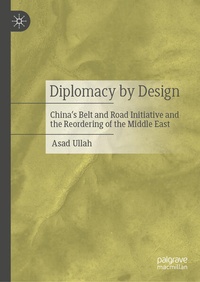
Diplomacy by Design
Description

This book offers a critical and original analysis of how China's Belt and Road Initiative (BRI) is actively reshaping the geopolitical architecture of the Middle East. Far from being a neutral economic enterprise, the BRI is conceptualized here as a deliberate and strategic modality of power-what the book terms "diplomacy by design"-through which China is redrawing regional alignments, recalibrating state relations, and subtly displacing long-standing Western influence.
Drawing on case studies from key Middle Eastern states-including the Gulf monarchies, Iran, Saudi Arabia, and some part of the Levant-the book situates China's infrastructural diplomacy within the broader context of regional fragmentation, post-American recalibration, and the emergence of multipolar diplomacy. It engages critically with concepts such as sovereignty, strategic autonomy, and the infrastructure-security nexus, arguing that the BRI constitutes a new grammar of international engagement that departs from traditional Western models.
More details
Other editions
Additional editions
Person
Asad Ullah is a Postdoctoral Fellow at the Institute of Political Science and Public Administration, Shandong University, China. His research delves into the complexities of Middle Eastern geopolitics, with a particular focus on regional security frameworks, energy politics, and the strategic interests of global powers in the region. Dr. Ullah's work critically examines the shifting balance of power in the Middle East, exploring the geopolitical implications of China's Belt and Road Initiative and the dynamics of conflict and cooperation among key state and non-state actors.
Content
Chapter 1: From Periphery to Pivot: China's Diplomacy by Design in the Middle East.-Chapter 2: Diplomacy by Design: Analytical Framework.- Chapter 3: Historical Evolution: From Periphery to Pivot.-Chapter 4: Twin Pillars: Previewing Saudi Arabia and Iran.- Chapter5: Constraints & Limits: The Boundaries of Chinese Influence.-Chapter 6: Conclusion: From Periphery to Pivot Reconsidered.
