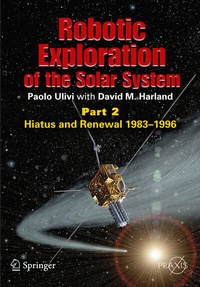
Robotic Exploration of the Solar System
Description

Paolo Ulivi and David Harland provide in "Robotic Exploration of the Solar System" a detailed history of unmanned missions of exploration of our Solar System As in their previous book Lunar Exploration, the subject will be treated wherever possible from an engineering and scientific standpoint. Technical descriptions of the spacecraft, of their mission designs and of instrumentations will be provided. Scientific results will be discussed in considerable depth, together with details of mission management.
The books will cover missions from the 1950s until the present day, and some of the latest missions and their results will appear in a popular science book for the first time. The authors will also cover many unflown projects, providing an indication of the ideas that proved to be unfulfilled at the time but which may still be proven and useful in the future.
Just like Lunar Exploration, these books will use sources only recently made available on the Soviet space program, in addition to some obscure and rarely used references on the European space program.
The project will deliver three volumes totaling over 1000 pages that will provide comprehensive coverage of the topic with thousands of references to the professional literature that should make it the 'first port of call' for people seeking information on the topic.
Reviews / Votes
From the reviews:
"Robotic Exploration of the Solar System Part 2 Hiatus and Renewal 1983-1989 is the second book in this comprehensive series describing planetary (and interplanetary) space missions. It's a hefty 535 pages packed with information. . The book describes all the missions in great detail from earliest proposals to last signal. . The illustrations complement the text very well. . All in all an outstanding book . ." (Jim Davis, Amazon, March, 2011)
"In this thick, heavy tome, Mr. Harland and co-author Paolo Ulivi turn their exceptional narrative skills, technical knowledge and attention to detail to the story of American, Soviet and European unmanned planetary missions . . the presentation of the material is outstanding. . I never found this volume to be at all boring. About 250 illustrations perfectly complement the text . and all of them clearly and usefully captioned. If you want to know something about unmanned planetary exploration, this is the book for you." (Terry Sunday, Amazon, August, 2011)
"This is the second volume of a three-book series chronicling solar system exploration from the dawn of the space age to the present. The authors describe not only the missions themselves but also their design, management, and instrumentation and the political backdrop to the selection and execution of these missions . . the book covers two of the big successes of the period in question, the Magellan and Galileo missions. . an excellent book and an excellent series." (Liftoff, Issue 260, November-December, 2010)
More details
Other editions
Additional editions