

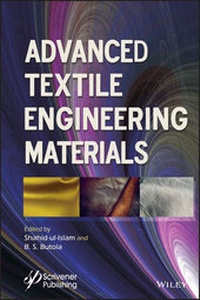
Advanced Textile Engineering Materials
Description

Advanced materials are undoubtedly becoming very popular as substitutes for traditional materials in the textile engineering field. Advanced textile engineering materials are giving way to innovative textile materials with novel functions and are widely perceived as offering huge potential in a wide range of applications such as healthcare, defense, personal protective equipment, textile antennas, garments for motion capture, and sensors, etc.
Advanced Engineering Textile Materials contains 13 chapters written by high profile contributors with many years of experience in textile technology, and cover fundamental and advanced approaches associated with the design and development of textile implants, conductive textiles, 3D textiles, smart-stimuli textiles, antiballistic textiles and fabric structures designed for a medical application intrabody/extra-body, implantable/non-implantable) and various modification and processing techniques.
More details
Other editions
Additional editions
Persons
Shahid-ul-Islam received his PhD in Chemistry from Jamia Millia Islamia (A Central University), India, in 2016. He then joined the Department of Textile Technology at the Indian Institute of Technology Delhi (IITD) where he is currently DST-SERB National Postdoctoral Fellow. His research interests include green chemistry, dyes and pigments, thermodynamics and kinetics of colorants, and textile finishing using polymeric nanocomposites. He is a recipient of several academic awards and competitive fellowships. He has published numerous peer-reviewed research articles in journals of high repute as well as edited 3 books with Wiley-Scrivener.
B. S. Butola obtained his B. Tech. (1990) and Ph.D. degrees (2005) and is an Associate Professor at the Department of Textile Technology, IIT, Delhi. His research interests include functionalization of textiles with metal oxides, use of shear thickening fluids for improving the impact performance of ballistic textiles, polymeric nanocomposites and smart colorants.
Content
Part 1: Chemical Aspects 1
1. Application of Stimuli-Sensitive Materials in Smart Textiles 3 Ali Akbar Merati
1.1. Introduction 3
1.2. Phase Change Materials 4
1.3. Shape Memory Materials 11
1.4. Chromic Materials 13
1.5. Conjugated Polymers 14
1.6. Conductive Polymers 16
1.7. Piezoelectricity 17
1.8. Optical Fibers 18
1.9. Hydrogels 20
1.10. Smart Textiles and Nanotechnology 22
1.11. Future Trends 23
References 23
2. Functional Finishing of Textile Materials and Its Psychological Aspects 31 Muhammad Mohsin and Qurat Ul Ain Malik
2.1. Introduction 31
2.2. Softeners 34
2.3. Oil- and Water-Repellent Finishes 36
2.4. Fire Retardants 39
2.5. Easy Care Finishing 43
2.6. Psychological Aspect of Functional Textiles 47
2.7. Challenges and Future Directions 50
2.8. Conclusion 50
References 51
3. Recent Advances in Protective Textile Materials 55 Santanu Basak, Animesh Laha, Mahadev Bar, and Rupayan Roy
3.1. Introduction 56
3.2. Application of the Protective Textile in the Defense Arena 65
3.3. Recent Advancements in Engineering to Create UV-Protective Textiles 70
3.4. Insect-Repellent Textiles 72
3.5. Microorganism Protective Textile Materials 75
3.6. Camouflage Application as Protective Textile 78
3.7. Challenges and Future Directions 79
References 80
4. Antibacterial Aspects of Nanomaterials in Textiles: From Origin to Release 87 Zahra Khodaparast, Akram Jahanshahi, and Mohammadreza Khalaj
4.1. Introduction 87
4.2. Nanomaterial Properties 89
4.3. Release 103
4.4. Conclusion 116
Acknowledgement 117
References 117
5. Modification of Wool and Cotton by UV Irradiation for Dyeing and Finishing Processes 125 Franco Ferrero, Gianluca Migliavacca, and Monica Periolatto
5.1. Introduction 126
5.2. Interaction of UV Radiation with Textile Fibers 128
5.3. Interaction of UV Radiation with Naturally Present Chromophores of Different Fibers 135
5.4. UV Irradiation on Wool 144
5.5. UV Irradiation on Cotton 162
5.6. Conclusions 168
5.7. Future Perspectives 169
References 170
6. Electroconductive Textiles 177 Arobindo Chatterjee and Subhankar Maity
6.1. Introduction 177
6.2. Electrical Conductivity 179
6.3. The Source of Conductivity in Conducting Polymers 182
6.4. Electroconductive Textiles Based on Metals 183
6.5. Electroconductive Textiles Based on Graphene 183
6.6. Electroconductive Textile Based on PPy 184
6.7. Conductive Polymer-Based Textiles 190
6.8. Effect of Various Yarns and Fabrics as Substrate 200
6.9. Applications of Electroconductive Textiles 202
6.10. Durability Properties of Conductive Polymer-Based Textiles 231
6.11. Future Scope and Challenges 239
6.12. Conclusions 239
References 240
7. Coated or Laminated Textiles for Aerostat and Stratospheric Airship 257 Bapan Adak and Mangala Joshi
7.1. Introduction 258
7.2. Global Competitors for Making Aerostat/Airship at Present 260
7.3. Working Atmosphere of Aerostats and High Altitude Airship (HAA) 260
7.4. Materials Used in LTA Envelopes 261
7.5. Case Studies on Different Coated or Laminated LTA Envelopes 272
7.6. Advanced Polymer Nanocomposites as Potential Material for LTA Envelopes 274
7.7. Models for Predicting the Performance and Service Life of Aerostats/Airships 280
7.8. Challenges and Future Scopes 281
7.9. Conclusion 282
References 283
8. Woolen Carpet Industry: Environmental Impact and Recent Remediation Approaches 289 Anu Mishra
8.1. Introduction 289
8.2. Flowchart of the Manufacture of a Woolen Carpet, Its Use and After-Use Disposal 290
8.3. Wool Fiber Production and Related Environmental Issues 290
8.4. Wool Fiber Cleaning and Related Environmental Issues 295
8.5. Woolen Carpet Yarn Manufacturing and Related Environmental Issues 299
8.6. Bleaching of Woolen Yarn and Related Environmental Issues 302
8.7. Dyeing of Woolen Carpet Yarn and Related Environmental Issues 303
8.8. Manufacture of Woolen Carpets and Related Environmental Issues 308
8.9. Washing of Carpets and Related Environmental Issues 311
8.10. Environmental Issues Related to the Usage of Woolen Carpets 314
8.11. Environmental Issues Related to the Disposal of Used Woolen Carpets 315
8.12. Some Remediation Approaches to Combat Environmental Issues of Wool Carpet Industry 315
8.13. Conclusion 324
References 324
9. Intensification of Textile Wastewater Treatment Processes 329 Mahmood Reza Rahimi and Soleiman Mosleh
9.1. Introduction 330
9.2. AOP Techniques 333
9.3. Process Intensification 343
9.4. Equipment and Processes 347
9.5. Catalyst Design and Modification 354
9.6. Economic Evaluation/Justification of AOPs 357
9.7. Industrial and Large-Scale Applications 366
9.8. Application of Nanostructures in Wastewater Treatment 367
9.9. Challenges and Future Directions 370
9.10. Conclusion 371
References 371
10. Visible-Light-Induced Photocatalytic Degradation of Textile Dyes over Plasmonic Silver-Modified TiO2 389 Rashmi Acharya, Brundabana Naik, and K. M. Parida
10.1. Introduction 390
10.2. Basic Principle of Photocatalysis 391
10.3. TiO2 as a Versatile Photocatalyst 392
10.4. Silver (Ag)-Modified TiO2 (Ag-TiO2) as Visible-Light-Induced Photocatalyst 393
10.5. Ag-Modified TiO2 with Non-Metal Doping 404
10.6. Ag-TiO2 with Other Plasmonic Metals 408
10.7. Conclusion 410
References
Part 2: Mechanical Aspects 419
11. Application of Textile Materials in Composites 421 Swati Sharma, Indu Chauhan, and Bhupendra Singh Butola
11.1. Introduction 421
11.2. Essential Properties of Fibers for Composite Applications 427
11.3. Textile Fibers Used for Composite Applications 432
11.4. Surface Modification of Fibers 443
11.5. Manufacturing of Textile Composite Materials 444
11.6. Application of Textile Composites in Various Industries 451
11.7. Conclusions 454
References 455
12. Emerging Trends in Three-Dimensional Woven Preforms for Composite Reinforcements 463 R. N. Manjunath and B. K. Behera
12.1. Introduction 463
12.2. Three-Dimensional Fabrics 466
13. Evolution of Soft Body Armor 499 Sanchi Arora and Aranya Ghosh
13.1. Introduction 499
13.2. Constituents of Soft Body Armor 501
13.3Performance Evaluation of Materials 526
13.4. Advancements in Soft Body Armor Technology 532
13.5. Conclusion 540
References 541
Index 553
Chapter 1
Application of Stimuli-Sensitive Materials in Smart Textiles
Ali Akbar Merati
Advanced Textile Materials and Technology Research Institute and Textile Engineering Department, Amirkabir University of Technology, Tehran, Iran
Email: merati@aut.ac.ir
Abstract
Stimuli-sensitive materials have the ability to sense and respond to various kinds of physical and chemical or biochemical stimuli in their environment. These materials are a convergence of different sciences such as material sciences, physics, chemistry, electrical engineering, wireless and mobile telecommunications, and nanotechnologies. They have many potential applications in smart textiles in the fields of medicine, protection, security communication, and textile electronics. Smart textiles are an interesting class of materials that can be prepared by a variety of methods. The functionality of smart textiles consists of many fields such as informing, protecting, and relaxing the wearer. The objective of this chapter is to present the latest research results together with basic concepts related to the preparation methods, characterizations, and applications of stimuli-sensitive materials in smart textiles and their importance in clothing. Future trends in this area of research are presented and issues regarding technology development and its uptake are highlighted.
Keywords: Smart textile, chromic materials, conductive materials, electronic textiles, phase change materials, shape memory materials
1.1 Introduction
Processability and flexibility are usually the two most important parameters of fine and elastic fibers used in order to make comfortable fabric and clothing. The wearable and comfortable fibrous materials such as yarn, fabric, and garments should be able to withstand handling in processing and end use without damaging functionality. The smart wearable textiles are fibrous materials made of smart materials such as shape memory materials (SMMs), phase change materials (PCMs), chromic materials, optic fibers, conductive materials, mechanical responsive materials, hydrogels, intelligent coating/membranes, micro and nanomaterials, and piezoelectric materials able to sense both the human body and external environment thanks to the presence of various kinds of sensors in their structure [1-4]. In other words, a smart textile allows the user to wear functionalized common clothes in which the user can access information about his personal biophysical data and/or environmental data. The potential of smart textile is enormous. One could think of smart clothing that makes us feel comfortable at all times, during any activity and in any environmental condition. A suit that protects and monitors, that warns in case of danger and even helps to treat diseases and injuries, is an example of smart clothing. Such clothing could be used from the moment we are born till the end of our life. These clothes should be like ordinary clothes providing special functions in various situations according to their design and application [5].
All smart materials involve an energy transfer from the stimuli to response given out by the material. They have the ability to do some sort of processing, analyzing, and responding. The amount of energy transferred to the response is determined by the properties of the material. For example, a material's specific heat (property) will determine how much heat (energy) is needed in order to change its temperature by a specified amount. The smart materials can be incorporated into the textile substrates at any of the levels, namely, fiber spinning level, yarn/fabric formation level, and finishing level [6]. Numerous scientists are researching to develop products with the emerging demand of smart textiles in various phases of life.
This chapter highlights all the main fields of applications of stimuli-responsive smart materials in textiles in various fields of applications such as healthcare, health monitoring, medicine, personal protective equipment, personal communication, textile antennas, garments for motion capture, and sensors (Table 1.1).
Table 1.1 Examples of application of stimuli-responsive materials in textile.
Stimuli-sensitive materials Benefits of treating textile Examples of potential applications Phase change materials (PCMs) Cooling, insulation, thermoregulating Blankets, bed sheets, dress shirts, T-shirts, jackets, vests, undergarments, socks, gloves, helmets, shoes and boots, earmuffs, hats and rainwear, seat covers in cars and chairs in offices, firefighters protective clothing, bulletproof fabrics, space suits, sailor suits, and other textile products Shape memory materials (SMMs) Insulation, shape forming, protection, compression, moisture management Shoes, breathable fabrics, thermal insulating clothes, crease- and shrink-resistant fabrics, fishing yarn, shirt neck bands, cap edges, casual clothing and sportswear, shape-formed dresses, protective clothing, flame-retardant fabrics, compression stocking, aesthetic effects, etc. Chromic materials Color change Fancy clothes, sports garments, workwear, soldier and weapons camouflage fabrics, technical and medical textiles Conjugated polymers Sensing Sensors for various biologically and chemically important target molecules, scaffolds for nerve tissue engineering Conductive materials Electrically conducting Electrically conductive textiles (fibers, yarns, fabrics), wearable electronics and fashion for healthcare, safety, homeland security, computation, thermal purposes, protective clothing, child monitoring, health monitoring, space programs, interior design Piezoelectric materials Energy harvesting, energy conversion, sensing, electricity generating E-textiles and wearable computing, electricity generation for various device applications, motion sensor Optic fibers Sensing, illumination, radiation, signal transmission Flexible flat panel displays, optic fiber fabric display Hydrogels Swelling/shrinkage change Water vapor-permeable fabrics, thermal-responsive hygroscopic fabrics1.2 Phase Change Materials
Phase change materials (PCMs) are theoretically able to change state at nearly a constant temperature and therefore to store a large quantity of energy to regulate temperature fluctuations [4, 7]. PCMs can exist in at least two different phases (an amorphous and one or more crystalline phases), and they can be switched repeatedly between these phases. The thermal energy storage in PCMs occurs when they change from solid to liquid and the energy dissipates when they change back from liquid to solid. The different phases of PCMs have distinctly different physical properties such as electrical conductivity, optical reflectivity, mass density, or thermal conductivity. PCMs keep people comfortable through the absorbing, storage, and releasing of the heat. Without PCMs, the thermal insulation capacity of clothing depends on the thickness and density of the fabric. Incorporating microcapsules of PCMs into textile structures improves the thermal performance of the textiles [4]. There are many thermal benefits of treating textile structures with PCM microcapsules such as cooling, insulation, and the thermoregulating effect. PCMs are applicable in blankets and comforters, bed sheets, dress shirts, T-shirts, undergarments, swaddling blankets, and other textile products. There are several factors that need to be considered when selecting a PCM. An ideal PCM will have high heat of fusion, high thermal conductivity, high specific heat and density, long-term reliability during repeated cycling, and dependable freezing behavior.
Paraffin waxes are the most common PCMs, which can be microencapsulated and then either integrated into fiber or used as a coating in textiles that have a high heat of fusion per unit weight, large melting point selection, and a low thermal conductivity; provide dependable cycling; are noncorrosive; and are chemically inert. When designing with paraffin PCM, void management is important due to the volume change from solid to liquid. Hydrated salts are another category of PCMs. These PCMs have a high heat of fusion per unit weight and volume, have a relatively high thermal conductivity for non-metals, and show small volume changes between solid and liquid phases. There are many other classes of PCMs. PCMs that have a melting point from 15 to 35°C are the most effective useful PCMs in textile fields. Other required properties for a PCM for a high-efficiency cooling system in textile fields are the slight temperature difference between the melting point and the solidification point, having low toxicity and being harmless to the environment, being non-flammable, ease of availability, and low price. The specified roles of PCMs in outdoor and protective smart textiles are the absorption of body heat surplus, insulation effect caused by heat emission of the PCM into the fibrous structure, and thermoregulating effect, which maintains the microclimate temperature to nearly constant [8].
The incorporation of PCMs within a fiber in the spinning process, coating, and laminating on the fabric are various methods of using PCMs in...
