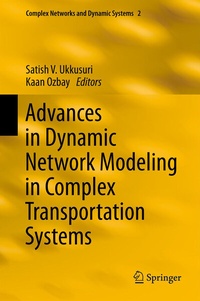
Advances in Dynamic Network Modeling in Complex Transportation Systems
Description

This edited book focuses on recent developments in Dynamic Network Modeling, including aspects of route guidance and traffic control as they relate to transportation systems and other complex infrastructure networks. Dynamic Network Modeling is generally understood to be the mathematical modeling of time-varying vehicular flows on networks in a fashion that is consistent with established traffic flow theory and travel demand theory.
Dynamic Network Modeling as a field has grown over the last thirty years, with contributions from various scholars all over the field. The basic problem which many scholars in this area have focused on is related to the analysis and prediction of traffic flows satisfying notions of equilibrium when flows are changing over time. In addition, recent research has also focused on integrating dynamic equilibrium with traffic control and other mechanism designs such as congestion pricing and network design. Recently, advances in sensor deployment, availability of GPS-enabled vehicular data and social media data have rapidly contributed to better understanding and estimating the traffic network states and have contributed to new research problems which advance previous models in dynamic modeling.
A recent National Science Foundation workshop on "Dynamic Route Guidance and Traffic Control" was organized in June 2010 at Rutgers University by Prof. Kaan Ozbay, Prof. Satish Ukkusuri , Prof. Hani Nassif, and Professor Pushkin Kachroo. This workshop brought together experts in this area from universities, industry and federal/state agencies to present recent findings in this area. Various topics were presented at the workshop including dynamic traffic assignment, traffic flow modeling, network control, complex systems, mobile sensor deployment, intelligent traffic systems and data collection issues. This book is motivated by the research presented at this workshop and the discussions that followed.
More details
Other editions
Additional editions