

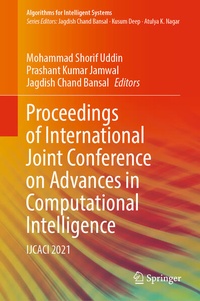
Proceedings of International Joint Conference on Advances in Computational Intelligence
IJCACI 2021
1st Edition
Published on 18. May 2022
XIV, 648 pages
978-981-19-0332-8 (ISBN)
Description

This book gathers outstanding research papers presented at the 5th International Joint Conference on Advances in Computational Intelligence (IJCACI 2021), held online during October 23-24, 2021. IJCACI 2021 is jointly organized by Jahangirnagar University (JU), Bangladesh, and South Asian University (SAU), India. The book presents the novel contributions in areas of computational intelligence and it serves as a reference material for advance research. The topics covered are collective intelligence, soft computing, optimization, cloud computing, machine learning, intelligent software, robotics, data science, data security, big data analytics, and signal and natural language processing.
More details
Series
Language
English
Place of publication
Singapore
Singapore
Publishing group
Springer Singapore
Target group
Professional and scholarly
Product notice
Reflowable
Illustrations
XIV, 648 p. 289 illus., 222 illus. in color.
File size
15,97 MB
ISBN-13
978-981-19-0332-8 (9789811903328)
DOI
10.1007/978-981-19-0332-8
Schweitzer Classification
Other editions
Additional editions
Mohammad Shorif Uddin | Prashant Kumar Jamwal | Jagdish Chand Bansal
Proceedings of International Joint Conference on Advances in Computational Intelligence
IJCACI 2021
Book
05/2022
Springer
€299.59
Shipment within 3-4 weeks
Persons
Prof. Mohammad Shorif Uddin completed his Doctor of Engineering (Ph.D.) at Kyoto Institute of Technology in 2002, Japan, Master of Technology Education at Shiga University, Japan, in 1999, Bachelor of Electrical and Electronic Engineering at Bangladesh University of Engineering and Technology (BUET) in 1991 and Master of Business Administration (MBA) from Jahangirnagar University in 2013. He began his teaching career as Lecturer in 1991 at Chittagong University of Engineering and Technology (CUET). In 1992, he joined the Computer Science and Engineering Department of Jahangirnagar University, and at present, he is a professor of this department. Besides, he is Teacher-in-Charge of the ICT Cell of Jahangirnagar University. He served as Chairman of the Computer Science and Engineering Department of Jahangirnagar University from June 2014 to June 2017 and as Adviser of ULAB from September 2009 to October 2020. He undertook postdoctoral research at Bioinformatics Institute, Singapore, Toyota Technological Institute, Japan, and Kyoto Institute of Technology, Japan, Chiba University, Japan, Bonn University, Germany, Institute of Automation, Chinese Academy of Sciences, China. His research is motivated by applications in the fields of artificial intelligence, imaging informatics, and computer vision. He holds two patents for his scientific inventions and has published more than 170 research papers in international journals and conference proceedings. He had delivered a remarkable number of keynotes and invited talks and acted as General Chair or TPC Chair or Co-Chair of many international conferences. He received the Best Paper Award in the International Conference on Informatics, Electronics & Vision (ICIEV2013), Dhaka, Bangladesh, and the Best Presenter Award from the International Conference on Computer Vision and Graphics (ICCVG 2004), Warsaw, Poland. He was Coach of Janhangirnagar University ACM ICPC World Finals Teams in 2015 and 2017 and supervised agood number of doctoral and master theses. He is currently President of Bangladesh Computer Society (BCS), Fellow of IEB and BCS, a Senior Member of IEEE, and Associate Editor of IEEE Access.
Prof. Prashant K. Jamwal earned Ph.D. degree and a post-doctoral fellowship from the University of Auckland, New Zealand. Earlier, he had obtained M. Tech. from I.I.T., India, securing the first position in all the disciplines and B. Tech. from MNREC, Allahabad, India. Presently, he is working as Associate Professor at the School of Engineering and design sciences, Nazarbayev University (NU), Astana, Kazakhstan. He is actively pursuing research in artificial intelligence, multi-objective evolutionary optimization, mechatronics systems, biomedical robotics, and fuzzy mathematics. He is applying his research in the development of medical robots for rehabilitation and surgical applications besides the development of improved algorithms for cancer data analytics. He hasmore than 25 years of teaching and research experience and has published many research articles in reputed international journals/conferences. He has won many awards such as best paper awards in conferences, best digital solution award for his medical robots, Asian Universities Alliance (AUA) Scholars Award, etc., and recently United Nations acknowledged one of his robotics projects as one of the top twenty innovative projects in the world. He is working as Editor for the International Journal of bio-mechatronics and bio-robotics and as a reviewer to quite a few international journals and conferences of repute. He led many government-funded research projects and has so far received research grants worth more than $5M including a prestigious World Bank grant.
Dr. Jagdish Chand Bansal is an Associate Professor at South Asian University New Delhi and Visiting Faculty at Maths and Computer Science, Liverpool Hope University UK. Dr. Bansal has obtained his Ph.D. in Mathematics from IIT Roorkee. Before joining SAU, New Delhi he has worked as an Assistant Professor at ABV- Indian Institute of Information Technology and Management Gwalior and BITS Pilani. His Primary area of interest is Swarm Intelligence and Nature Inspired Optimization Techniques. Recently, he proposed a fission-fusion social structure-based optimization algorithm, Spider Monkey Optimization (SMO), which is being applied to various problems from the engineering domain. He has published more than 70 research papers in various international journals/conferences. He is the editor in chief of the journal MethodsX published by Elsevier. He is the series editor of the book series Algorithms for Intelligent Systems (AIS) and Studies in Autonomic, Data-driven and Industrial Computing (SADIC) published by Springer. He is the editor in chief of International Journal of Swarm Intelligence (IJSI) published by Inderscience. He is also the Associate Editor of IEEE ACESSS publishedby IEEE and ARRAY published by Elsevier. He is the general secretary of Soft Computing Research Society (SCRS). He has also received Gold Medal at UG and PG levels.
Prof. Prashant K. Jamwal earned Ph.D. degree and a post-doctoral fellowship from the University of Auckland, New Zealand. Earlier, he had obtained M. Tech. from I.I.T., India, securing the first position in all the disciplines and B. Tech. from MNREC, Allahabad, India. Presently, he is working as Associate Professor at the School of Engineering and design sciences, Nazarbayev University (NU), Astana, Kazakhstan. He is actively pursuing research in artificial intelligence, multi-objective evolutionary optimization, mechatronics systems, biomedical robotics, and fuzzy mathematics. He is applying his research in the development of medical robots for rehabilitation and surgical applications besides the development of improved algorithms for cancer data analytics. He hasmore than 25 years of teaching and research experience and has published many research articles in reputed international journals/conferences. He has won many awards such as best paper awards in conferences, best digital solution award for his medical robots, Asian Universities Alliance (AUA) Scholars Award, etc., and recently United Nations acknowledged one of his robotics projects as one of the top twenty innovative projects in the world. He is working as Editor for the International Journal of bio-mechatronics and bio-robotics and as a reviewer to quite a few international journals and conferences of repute. He led many government-funded research projects and has so far received research grants worth more than $5M including a prestigious World Bank grant.
Dr. Jagdish Chand Bansal is an Associate Professor at South Asian University New Delhi and Visiting Faculty at Maths and Computer Science, Liverpool Hope University UK. Dr. Bansal has obtained his Ph.D. in Mathematics from IIT Roorkee. Before joining SAU, New Delhi he has worked as an Assistant Professor at ABV- Indian Institute of Information Technology and Management Gwalior and BITS Pilani. His Primary area of interest is Swarm Intelligence and Nature Inspired Optimization Techniques. Recently, he proposed a fission-fusion social structure-based optimization algorithm, Spider Monkey Optimization (SMO), which is being applied to various problems from the engineering domain. He has published more than 70 research papers in various international journals/conferences. He is the editor in chief of the journal MethodsX published by Elsevier. He is the series editor of the book series Algorithms for Intelligent Systems (AIS) and Studies in Autonomic, Data-driven and Industrial Computing (SADIC) published by Springer. He is the editor in chief of International Journal of Swarm Intelligence (IJSI) published by Inderscience. He is also the Associate Editor of IEEE ACESSS publishedby IEEE and ARRAY published by Elsevier. He is the general secretary of Soft Computing Research Society (SCRS). He has also received Gold Medal at UG and PG levels.
Content
Performance Analysis of Secure Hybrid Approach for Sharing Data Securely in Vehicular Adhoc Network.- Particle swarm optimization and computational algorithm based weighted fuzzy time series forecasting method.- Assessing Usability of Mobile Applications Developed for Autistic Users through Heuristic and Semiotic Evaluation.- Blockchain Implementations and Use Cases for Inhibiting COVID-19 Pandemic.- Ant Colony Optimization to Solve the Rescue Problem as a Vehicle Routing Problem with Hard Time Windows.- Applying Opinion Leaders to Investigate the Best-of-n Decision Problem in Decentralized Systems.- Pathfinding in the Paparazzi Problem Comparing Different Distance Measures.- Empirical Evaluation of Motion Cue for Passive-Blind Video Tamper Detection Using Optical Flow Technique.- Quantifying Changes in Sundarbans Mangrove Forest Through GEE Cloud Computing Approach.- Metaheuristics and Hyper-Heuristics based on Evolutionary Algorithms for Software Integration Testing.
