

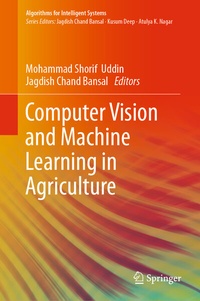
Computer Vision and Machine Learning in Agriculture
Description

This book discusses computer vision, a noncontact as well as a nondestructive technique involving the development of theoretical and algorithmic tools for automatic visual understanding and recognition which finds huge applications in agricultural productions. It also entails how rendering of machine learning techniques to computer vision algorithms is boosting this sector with better productivity by developing more precise systems. Computer vision and machine learning (CV-ML) helps in plant disease assessment along with crop condition monitoring to control the degradation of yield, quality, and severe financial loss for farmers. Significant scientific and technological advances have been made in defect assessment, quality grading, disease recognition, pests, insects, fruits, and vegetable types recognition and evaluation of a wide range of agricultural plants, crops, leaves, and fruits. The book discusses intelligent robots developed with the touch of CV-ML which can help farmers to perform various tasks like planting, weeding, harvesting, plant health monitoring, and so on. The topics covered in the book include plant, leaf, and fruit disease detection, crop health monitoring, applications of robots in agriculture, precision farming, assessment of product quality and defects, pest, insect, fruits, and vegetable types recognition.
More details
Other editions
Additional editions
Persons
Prof. Mohammad Shorif Uddin received his Ph.D. degree in Information Science from Kyoto Institute of Technology in 2002, Japan, Master of Technology Education degree from Shiga University, Japan, in 1999, Bachelor of Electrical and Electronic Engineering degree from Bangladesh University of Engineering and Technology in 1991, and also MBA from Jahangirnagar University in 2013. He began his teaching career as Lecturer in 1991 at Bangladesh Institute of Technology, Chittagong (Renamed as CUET). He joined the Department of Computer Science and Engineering of Jahangirnagar University in 1992, and currently, he is Professor of this department. In addition, he is Teacher-in-Charge of ICT Cell of Jahangirnagar University. He served as Chairman of Computer Science and Engineering of Jahangirnagar University from June 2014 to June 2017. He undertook postdoctoral researches at Bioinformatics Institute, Singapore, Toyota Technological Institute, Japan, Kyoto Institute of Technology,Japan, Chiba University, Japan, Bonn University, Germany, and Institute of Automation, Chinese Academy of Sciences, China. His research is motivated by applications in the fields of artificial intelligence, imaging informatics, and computer vision. Mohammad Uddin is IEEE Senior Member and Fellow of Bangladesh Computer Society (BCS) and The Institution of Engineers Bangladesh (IEB). He has lectured a good number of undergraduate and graduate courses, wrote more than 125 journal and conference papers, and organized some national and international conferences and seminars. He had delivered a remarkable number of keynotes and invited talks and acted as General Chair as well as TPC Chair of many international conferences. He holds two patents for his scientific inventions and received the Best Paper Award in the International Conference on Informatics, Electronics & Vision (ICIEV2013), Dhaka, Bangladesh, and Best Presenter Award from the International Conference on Computer Vision and Graphics (ICCVG 2004), Warsaw, Poland. He is an Associate Editor of IEEE Access.
Dr. Jagdish Chand Bansal is Associate Professor at South Asian University New Delhi and Visiting Faculty at Maths and Computer Science, Liverpool Hope University UK. Dr. Bansal has obtained his Ph.D. in Mathematics from IIT Roorkee. Before joining SAU New Delhi, he has worked as Assistant Professor at ABV-Indian Institute of Information Technology and Management Gwalior and BITS Pilani. His primary area of interest is swarm intelligence and nature-inspired optimization techniques. Recently, he proposed a fission-fusion social structure-based optimization algorithm, Spider Monkey Optimization (SMO), which are being applied to various problems from engineering domain. He has published more than 70 research papers in various international journals/conferences. He is Series Editor of the book series Algorithms for Intelligent Systems (AIS) and Studies in Autonomic, Data-driven and Industrial Computing (SADIC) published by Springer. He is Editor-in-Chief of the International Journal of Swarm Intelligence (IJSI) published by Inderscience. He is also Associate Editor of IEEE ACESSS published by IEEE and ARRAY published by Elsevier. He is Steering Committee Member and General Chair of the annual conference series SocProS. He is General Secretary of Soft Computing Research Society (SCRS). He has also received Gold Medal at UG and PG levels.
