

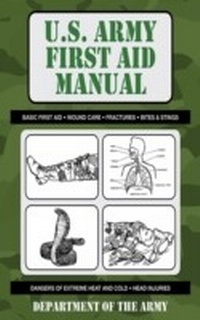
U.S. Army First Aid Manual
1st Edition
Published on 1. November 2009
304 pages
978-1-62873-236-8 (ISBN)
Description

U.S. Army First Aid Manual offers skills and knowledge necessary for many life-threatening situations, with an emphasis on treating oneself and aiding others-of use to soldiers in the field, to outdoorsmen, or to anyone who may find themselves in a dangerous situation without a medical professional on-hand. This is the official manual for treating every type of injury and affliction in the field. Covering a broad range of topics in precise, easy-to-understand language, it emphasizes prompt and effective action in sustaining life and preventing or minimizing further suffering and damage. U.S. Army First Aid Manual is fascinating reading for anyone with an interest in military practice and an essential handbook for anyone who is regularly away from immediate medical care.
More details
Other editions
Additional editions
U.S. Department of the Army
U.S. Army First Aid Manual
Book
11/2009
Skyhorse Publishing
€14.50
Shipment within 3-4 weeks
Person
The Department of the Army (DA) is one of the three military departments within the Department of Defense of the United States of America. Its mission is to fight and win our Nation' s wars by providing prompt, sustained land dominance across the full range of military operations and spectrum of conflict in support of combatant commanders.
Content
- Cover
- Title
- Copyright
- TABLE OF CONTENTS
- PREFACE
- CHAPTER 1 FUNDAMENTAL CRITERIA FOR FIRST AID
- Section I. Evaluate Casualty
- 1-1. Casualty Evaluation (081-831-1000)
- 1-2. Medical Assistance (081-831-1000)
- Section II. Understand Vital Body Functions
- 1-3. Respiration and Blood Circulation
- 1-4. Adverse Conditions
- CHAPTER 2 BASIC MEASURES FOR FIRST AID
- Section I. Open the Airway and Restore Breathing
- 2-1. Breathing Process
- 2-2. Assessment (Evaluation) Phase (081-831-1000 and 081-831-1042)
- 2-3. Opening the Airway-Unconscious and not Breathing Casualty (081-831-1042)
- 2-4. Rescue Breathing (Artificial Respiration)
- 2-5. Preliminary Steps - All Rescue Breathing Methods (081-831-1042)
- 2-6. Mouth-to-Mouth Method (081-831-1042)
- 2-7. Mouth-to-Nose Method
- 2-8. Heartbeat
- 2-12. Airway Obstructions
- 2-13. Opening the Obstructed Airway-Conscious Casualty (081-831-1003)
- 2-14. Open an Obstructed Airway (081-831-1042)-Casualty Lying or Unconscious
- Section II. Stop the Bleeding and Protect the Wound
- 2-15. Clothing (081-831-1016)
- 2-16. Entrance and Exit Wounds
- 2-17. Field Dressing (081-831-1016)
- 2-18. Manual Pressure (081-831-1016)
- 2-19. Pressure Dressing (081-831-1016)
- 2-20. Tourniquet (081-831-1017)
- Section III. Check and Treat for Shock
- 2-21. Causes and Effects
- 2-22. Signs/Symptoms (081-831-1000)
- 2-23. Treatment/Prevention (081-831-1005)
- CHAPTER 3 FIRST AID FOR SPECIAL WOUNDS
- Section I. Give Proper First Aid for Head Injuries
- 3-1. Head Injuries
- 3-2. Signs/Symptoms (081-831-1000)
- 3-3. General First Aid Measures (081-831-1000).
- 3-4. Dressings and Bandages
- Section II. Give Proper First Aid for Face and Neck Injuries
- 3-5. Face Injuries
- 3-6. Neck Injuries
- 3-7. Procedure
- 3-8. Dressings and Bandages (081-831-1033)
- Section III. Give Proper First Aid for Chest and Abdominal Wounds and Burn Injuries
- 3-9. Chest Wounds (081-831-1026)
- 3-10. Chest Wound(s) Procedure (081-831-1026)....
- 3-11. Abdominal Wounds
- 3-12. Abdominal Wound(s) Procedure (081-831-1025)
- 3-13. Burn Injuries
- 3-14. First Aid for Burns (081-831-1007)
- Section IV. Apply Proper Bandages to Upper and Lower Extremities
- 3-15. Shoulder Bandage
- 3-16. Elbow Bandage
- 3-17. Hand Bandage
- 3-18. Leg (Upper and Lower) Bandage
- 3-19. Knee Bandage
- 3-20. Foot Bandage
- CHAPTER 4 FIRST AID FOR FRACTURES
- 4-1. Kinds of Fractures
- 4-2. Signs/Symptoms of Fractures (081-831-1000)
- 4-3. Purposes of Immobilizing Fractures
- 4-4. Splints, Padding, Bandages, Slings, and Swathes (081-831-1034)
- 4-5. Procedures for Splinting Suspected Fractures (081-831-1034)
- 4-6. Upper Extremity Fractures (081-831-1034)
- 4-7. Lower Extremity Fractures (081-831-1034)
- 4-8. Jaw, Collarbone, and Shoulder Fractures
- 4-9. Spinal Column Fractures (081-831-1000)
- 4-10. Neck Fractures (081-831-1000)
- CHAPTER 5 FIRST AID FOR CLIMATIC INJURIES
- 5-1. Heat Injuries
- 5-2. Cold Injuries
- CHAPTER 6 FIRST AID FOR BITES AND STINGS
- 6-1. Types of Snakes
- 6-2. Snakebites
- 6-3. Human and Other Animal Bites
- 6-4. Marine (Sea) Animals
- 6-5. Insect Bites/Stings
- 6-6. Table
- CHAPTER 7 FIRST AID IN TOXIC ENVIRONMENTS
- Section I. Individual Protection and First Aid Equipment For Toxic Substances
- 7-1. Toxic Substances
- 7-2. Protective and First Aid Equipment
- Section II. Chemical-Biological Agents
- 7-3. Classification
- 7-4. Conditions for Masking Without Order or Alarm
- 7-5. First Aid for a Chemical Attack (081-831-1030 and 081-831-1031)
- Section III. Nerve Agents
- 7-6. Background Information
- 7-7. Signs/Symptoms of Nerve Agent Poisoning (081-831-1030 and 081-831-1031)
- 7-8. First Aid for Nerve Agent Poisoning (081-831-1030)
- Section IV. Other Agent
- 7-9. Blister Agents
- 7-10. Choking Agents (Lung-Damaging Agents)
- 7-11. Blood Agents
- 7-12. Incapacitating Agents
- 7-13. Incendiaries
- 7-14. First Aid for Biological Agents
- 7-15. Toxins
- 7-16. Radiological
- CHAPTER 8 FIRST AID FOR PSYCHOLOGICAL REACTIONS
- 8-1. Explanation of Term "Psychological First Aid"
- 8-2. Importance of Psychological First Aid
- 8-3. Situations Requiring Psychological First Aid
- 8-4. Interrelation of Psychological and Physical First Aid
- 8-5. Goals of Psychological First Aid
- 8-6. Respect for Others' Feelings
- 8-7. Emotional and Physical Disability
- 8-8. Emotional Reaction to Injury
- 8-9. Emotional Reserve Strength of Distressed Soldiers
- 8-10. Battle Fatigue (and Other Combat Stress Reactions [CSR])
- 8-11. Reactions to Stress
- 8-12. Severe Stress or Battle Fatigue Reactions
- 8-13. Application of Psychological First Aid
- 8-14. Reactions and Limitations
- 8-15. Tables
- Appendix A FIRST AID CASE AND KITS, DRESSINGS, AND BANDAGES
- A-1. First Aid Case with Field Dressings and Bandages
- A-2. General Purpose First Aid Kits
- A-3. Contents of First Aid Case and Kits
- A-4. Dressings
- A-5. Standard Bandages
- A-6. Triangular and Cravat (Swathe) Bandages
- Appendix B RESCUE AND TRANSPORTATION PROCEDURES
- B-1. General
- B-2. Principles of Rescue Operations
- B-3. Task (Rescue) Identification
- B-4. Circumstances of the Rescue
- B-5. Plan of Action
- B-6. Mass Casualties
- B-7. Proper Handling of Casualties
- B-8. Transportation of Casualties Page
- B-9. Manual Carries (081-831-1040 and 081-831-1041)
- B-10. Improvised Litters (Figures B-15 through B-17) (081-831-1041)
- Appendix C COMMON PROBLEMS/CONDITIONS
- Section I. HEALTH MAINTENANCE
- C-1. General
- C-2. Personal Hygiene
- C-3. Diarrhea and Dysentery
- C-4. Dental Hygiene
- C-5. Drug (Substance) Abuse
- C-6. Sexually Transmitted Diseases
- Section II. First Aid For Common Problems
- C-7. Heat Rash (or Prickly Heat)
- C-8. Contact Poisoning (Skin Rashes)
- C-9. Care of the Feet
- C-10. Blisters
- Appendix E DIGITAL PRESSURE
- Appendix F DECONTAMINATION PROCEDURES
- F-1. Protective Measures and Handling of Casualties
- F-2. Personal Decontamination
- F-3. Casualty Decontamination
- Appendix G SKILL LEVEL 1 TASKS
- Glossary
- References
- Index
