

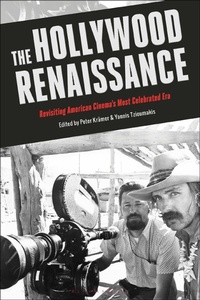
The Hollywood Renaissance
Revisiting American Cinema's Most Celebrated Era
1st Edition
Published on 28. June 2018
288 pages
978-1-5013-3790-1 (ISBN)
Description

In December 1967, Time magazine put Bonnie and Clyde on its cover and proudly declared that Hollywood cinema was undergoing a 'renaissance'. For the next few years, a wide range of formally and thematically challenging films were produced at the very centre of the American film industry, often (but by no means always) combining success at the box office with huge critical acclaim, both then and later. This collection brings together acknowledged experts on American cinema to examine thirteen key films from the years 1966 to 1974, starting with Who's Afraid of Virginia Woolf?, a major studio release which was in effect exempted from Hollywood's Production Code and thus helped to liberate American filmmaking from (self-)censorship. Long-standing taboos to do with sex, violence, race relations, drugs, politics, religion and much else could now be broken, often in conjunction with extensive stylistic experimentation. Whereas most previous scholarship has examined these developments through the prism of auteurism, with its tight focus on film directors and their oeuvres, the contributors to this collection also carefully examine production histories and processes. In doing so they pay particular attention to the economic underpinnings and collaborative nature of filmmaking, the influence of European art cinema as well as of exploitation, experimental and underground films, and the connections between cinema and other media (notably publishing, music and theatre). Several chapters show how the innovations of the Hollywood Renaissance relate to further changes in American cinema from the mid-1970s onwards.
Reviews / Votes
Kraemer and Tzioumakis present 13 thoughtful, concise essays ... The Hollywood Renaissance adds to previous studies by cogently placing each film within the larger industrial, cultural, and sociopolitical context of US cinema. * CHOICE * Launches compelling new perspectives on 'American cinema's most celebrated era' ... The Hollywood Renaissance's corps of contributors ensures a high overall quality. Each chapter, organized chronologically around a single ?lm, delivers perspicacious analysis. Methodologies vary, but always to pro?table effect. * The Year's Work in Critical and Cultural Theory * Foregrounding form, style, and content, not only do Tzioumakis and Kraemer privilege these themes as the central philosophy at the heart of American cinema's new generation of filmmakers in the 1960s and early '70s (writers, designers and producers as well as directors), they offer us a collection of essays that are formative and stylish in their own right. Assembling some of the best scholars for the task, The Hollywood Renaissance is less an exercise in nostalgic remembrance and much more a persuasive and brilliant updating of the reasons why this coterie of filmmakers, and this era, continues to matter today. Superbly conceived and wonderfully realised throughout every chapter, if you want to know what made the Hollywood Renaissance the creative force it was, and the overriding influence it continues to be, this book has all the answers. Quite simply, Indispensable. * Ian Scott, Senior Lecturer in American Studies, University of Manchester, UK * The Hollywood Renaissance digs deep and goes wide to change dramatically the way we think about this much-studied, legendary period of American filmmaking. Instead of emphasizing the auteurist approach of previous studies, this marvelous volume emphasizes the overlooked element of collaboration among filmmakers in a multi-faceted industrial context that produced landmark titles such as Bonnie and Clyde but also included significant if less-studied films such as Funny Girl and Lady Sings the Blues. The result is a volume full of lively, always enlightening new essays into a celebrated period fifty years on. * Matthew H. Bernstein, Goodrich C. White Professor and Chair of Film and Media Studies, Emory University, USA *More details
Edition
1. Auflage
Language
English
Place of publication
New York
United States
Publishing group
Bloomsbury Publishing PLC (Digital)
Illustrations
15 bw illus
ISBN-13
978-1-5013-3790-1 (9781501337901)
Copyright in bibliographic data and cover images is held by Nielsen Book Services Limited or by the publishers or by their respective licensors: all rights reserved.
Schweitzer Classification
Other editions
Additional editions
Yannis Tzioumakis | Peter Kraemer
The Hollywood Renaissance
Revisiting American Cinema's Most Celebrated Era
Book
06/2018
Bloomsbury Academic USA
€193.13
Shipment within 15-20 days
Yannis Tzioumakis | Peter Kraemer
The Hollywood Renaissance
Revisiting American Cinema's Most Celebrated Era
Book
06/2018
Bloomsbury Academic USA
€32.50
Shipment within 15-20 days
Persons
Peter Kraemer is a Senior Fellow in the School of Art, Media and American Studies at the University of East Anglia, UK. He is the author and editor of eight academic books, among them The New Hollywood: From Bonnie and Clyde to Star Wars (2005) and the BFI Film Classic on 2001: A Space Odyssey (2010).
Yannis Tzioumakis is Reader in Film and Media Industries at the University of Liverpool, UK. He is the author of four books, most recently of American Independent Cinema: An Introduction, 2nd edition (2017) and co-editor of four collections of essays, most recently of The Routledge Companion to Cinema and Politics (2016).
Yannis Tzioumakis is Reader in Film and Media Industries at the University of Liverpool, UK. He is the author of four books, most recently of American Independent Cinema: An Introduction, 2nd edition (2017) and co-editor of four collections of essays, most recently of The Routledge Companion to Cinema and Politics (2016).
Content
List of Contributors
Introduction (Peter Kraemer, University of East Anglia, UK; and Yannis Tzioumakis, University of Liverpool, UK)
1. Who's Afraid of Virginia Woolf? (1966): The Commercial and Regulatory Impact of the First American Art Film, Justin Wyatt (University of Rhode Island, USA)
2. The Film Editors who Invented the Hollywood Renaissance: Ralph Rosenblum, Sam O'Steen, and Dede Allen's Bonnie and Clyde, Warren Buckland (Oxford Brookes University, UK)
3. 'I smell money!' Class Product, The Graduate, and the Corporatisation of Embassy, Anthony McKenna (Shanghai Jiatong University, China)
4. 'A Triumph of Aura over Appearance': Barbra Streisand, Funny Girl (1968) and the Hollywood Renaissance, Peter Kraemer (University of East Anglia, UK)
5. The Auteurist Special Effects Film: Kubrick's 2001: A Space Odyssey (1968) and the 'Single-Generation Look', Julie Turnock (University of Illinois, Urbana Champaign, USA)
6. 'About as Brutal, Relevant and Exploitable as They Come': Medium Cool and Political Filmmaking, Oliver Gruner (University of Portsmouth, UK)
7. From Exploitation to Legitimacy: Easy Rider (1969) and Independent Cinema's Journey into Hollywood, Yannis Tzioumakis (University of Liverpool)
8. Hollywood Trade: Midnight Cowboy (1969) and Underground Cinema, Gary Needham (University of Liverpool, UK)
9. Zabriskie Point (1970), Michelangelo Antonioni and European Directors in Hollywood, Melis Behlil (Kadir Has University, Turkey)
10. Becoming Hal Ashby: Intersectional Politics, the 'Hollywood Renaissance' and Harold and Maude (1971), Philip Drake (Edge Hill University, UK)
11. A Matter of Race and Gender: Lady Sings the Blues (1972) and the Hollywood Renaissance Canon, Charlene Regester (University of North Carolina, Chapel Hill, USA)
12. De Niro and Scorsese: Director-Actor Collaboration in Mean Streets (1973) and the Hollywood Renaissance, R. Colin Tait (Texas Christian University, USA)
13. Coppola's The Conversation (1974) and Walter Murch's Sound Worlds, Frederick Wasser (CUNY, Brooklyn College, USA)
Index
Introduction (Peter Kraemer, University of East Anglia, UK; and Yannis Tzioumakis, University of Liverpool, UK)
1. Who's Afraid of Virginia Woolf? (1966): The Commercial and Regulatory Impact of the First American Art Film, Justin Wyatt (University of Rhode Island, USA)
2. The Film Editors who Invented the Hollywood Renaissance: Ralph Rosenblum, Sam O'Steen, and Dede Allen's Bonnie and Clyde, Warren Buckland (Oxford Brookes University, UK)
3. 'I smell money!' Class Product, The Graduate, and the Corporatisation of Embassy, Anthony McKenna (Shanghai Jiatong University, China)
4. 'A Triumph of Aura over Appearance': Barbra Streisand, Funny Girl (1968) and the Hollywood Renaissance, Peter Kraemer (University of East Anglia, UK)
5. The Auteurist Special Effects Film: Kubrick's 2001: A Space Odyssey (1968) and the 'Single-Generation Look', Julie Turnock (University of Illinois, Urbana Champaign, USA)
6. 'About as Brutal, Relevant and Exploitable as They Come': Medium Cool and Political Filmmaking, Oliver Gruner (University of Portsmouth, UK)
7. From Exploitation to Legitimacy: Easy Rider (1969) and Independent Cinema's Journey into Hollywood, Yannis Tzioumakis (University of Liverpool)
8. Hollywood Trade: Midnight Cowboy (1969) and Underground Cinema, Gary Needham (University of Liverpool, UK)
9. Zabriskie Point (1970), Michelangelo Antonioni and European Directors in Hollywood, Melis Behlil (Kadir Has University, Turkey)
10. Becoming Hal Ashby: Intersectional Politics, the 'Hollywood Renaissance' and Harold and Maude (1971), Philip Drake (Edge Hill University, UK)
11. A Matter of Race and Gender: Lady Sings the Blues (1972) and the Hollywood Renaissance Canon, Charlene Regester (University of North Carolina, Chapel Hill, USA)
12. De Niro and Scorsese: Director-Actor Collaboration in Mean Streets (1973) and the Hollywood Renaissance, R. Colin Tait (Texas Christian University, USA)
13. Coppola's The Conversation (1974) and Walter Murch's Sound Worlds, Frederick Wasser (CUNY, Brooklyn College, USA)
Index
