

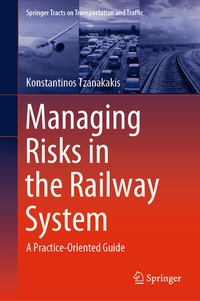
Managing Risks in the Railway System
Description

This book offers a comprehensive and practice-oriented guide to risk management, with a special emphasis on the physical and environmental risks related to the operations of railway systems. It is intended to provide a roadmap for managing the risk by controlling safety. Starting with a concise historical introduction and by presenting basic concepts of risk management, the book describes in turn the railway systems and their complexity. Then, it goes in depth into the process of risk management, describing the main elements, from risk identification, analysis and assessment to risk monitoring and communication. Different risk assessment techniques are reviewed in detail, and the main components of a risk management plan are presented. The book concludes with an introduction to health risk management, describing strategies for performing health risk assessments for staff in safety-critical positions. Based on the conviction that controlling safety is the main strategy in managing risk, and on the fact that the systems we would like to control are complex ones, this book provides transport and safety engineers with the necessary knowledge to effectively managing the risks of the railway system.
More details
Other editions
Additional editions
Person
Konstantinos Tzanakakis received a Civil Engineering Master's Degree from the University of Hannover, Germany, and a Master Executive MBA from the Athens University of Economics & Business, Greece. Out of his 35-year experience in the railway sector, he was serving as the Director of the Greek Railways Organization for eight years. He worked in Serbia, being involved in the restructuring of the Serbian Railways between 2011 and 2013. Between 2015 and 2019, he served as a Senior Railway Expert at the Ministry of Transport and Communications in Oman, taking care of various railway institutional issues, railway policies and the establishment of a Railway Authority in Oman. Between 2013 and 2014, he made a major contribution to the development of the Oman National Railway Network, while working for the Oman Rail Company. Currently, he is working as a Project Manager for two railway projects in both Albania and Egypt.
Konstantinos Tzanakakis is also the founder of RAILHOW (https://railhow.com/), an initiative with the purpose of developing and delivering well-researched and practical-oriented Engineering & Leadership digital resources and training. With a strong professional focus on the efficiency of the railway system, he is also the author of the book "The Railway Track and its Long-Term Behaviour", published by Springer in 2013. In recent years, he has been invited as a speaker to several railway congresses; he held various workshops about best practices in track maintenance, and strategies for keeping a high-performance railway track.
