

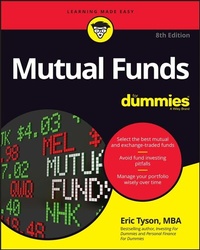
Mutual Funds For Dummies
Description

Mutual funds and exchange-traded funds (ETFs) are great for professional management, diversification and liquidity into your portfolio, but what are the costs and risks? And how have the best investment strategies changed with the rise of robo-investing, ETFs, and new tax rules? Mutual Funds For Dummies answers all your questions, giving you insight on how to find the best-managed funds that match your financial goals.
With straightforward advice and plenty of specific fund recommendations, Eric Tyson helps you avoid fund-investing pitfalls and maximize your returns. This new edition covers the latest investment trends and philosophies, including factor investing, ESG investing, and online investing. You'll also find completely updated coverage on the best mutual funds and ETFs in each category.
Earn more with funds!
- Learn how mutual funds and ETFs work and determine how much of your portfolio to devote
- Weigh the pros and cons of funds, and use funds to help you pick your own stocks
- Make the most of online investing and other new technologies and trends
- Maximize your gains by choosing the funds and strategies that work for you
Mutual Funds For Dummies is a trusted resource, and this update has arrived to help you plan and implement a successful investment strategy. The fund market is rebounding-get on the train and take advantage of the opportunity today!
More details
Other editions
Additional editions
Content
- Intro
- Title Page
- Copyright Page
- Table of Contents
- Introduction
- What's New in This Edition
- How This Book Is Different
- Foolish Assumptions
- Icons Used in This Book
- Beyond the Book
- Where to Go from Here
- Part 1 Getting Started with Funds
- Chapter 1 Making More Money, Taking Less Risk
- Introducing Mutual Funds and Exchange-Traded Funds
- Making Sense of Investments
- Lending investments: Interest on your money
- Ownership investments: More potential profit (and risk)
- Surveying the Major Investment Options
- Savings and money market accounts
- Bonds
- Stocks
- Overseas/international investments
- Real estate
- Gold, silver, currencies, and the like
- Annuities
- Life insurance
- Limited partnerships
- Reviewing Important Investing Concepts
- Getting a return: Why you invest
- Measuring risks: Investment volatility
- Diversifying: A smart way to reduce risk
- Chapter 2 Fund Pros and Cons
- Getting a Grip on Funds
- Financial intermediaries
- Open-end versus closed-end funds
- Opting for Mutual Funds
- Fund managers' expertise
- Funds save you money and time
- Fund diversification minimizes your risk
- Funds undergo regulatory scrutiny
- You choose your risk level
- Fund risk of bankruptcy is nil
- Funds save you from sales sharks
- You have convenient access to your money
- Addressing the Drawbacks
- Don't worry about these . . .
- Watch out for these . . .
- Chapter 3 Funding Your Goals and Dreams
- Acting Before Researching: The Story of Justine and Max
- Lining Up Your Ducks Before You Invest
- Pay off your consumer debts
- Review your insurance coverage
- Figure out your financial goals
- Determine how much you're saving
- Examine your spending and income
- Maximize tax-deferred retirement account savings
- Determine your tax bracket
- Assess the risk you're comfortable with
- Review current investment holdings
- Consider other "investment" possibilities
- Reaching Your Goals with Funds
- The financial pillow - an emergency reserve
- The golden egg - investing for retirement
- The white picket fence - saving for a home
- The ivory tower - saving for college and higher education
- Part 2 Evaluating Alternatives to Funds
- Chapter 4 Selecting Your Own Stocks and Bonds
- Deciding to Choose Your Own Stocks and Bonds
- Beware the claims of stock-picking gurus
- Know the drawbacks of investing in individual securities
- Understand the psychology of selecting stocks
- Picking Your Own Stocks and Bonds
- Chapter 5 Exchange-Traded Funds and Other Fund Lookalikes
- Understanding Exchange-Traded Funds
- Understanding ETF advantages
- Eyeing ETF drawbacks
- Seeing the pros and cons of trading ETFs
- Identifying the best ETFs
- Mimicking Closed-End Funds: Unit Investment Trusts
- Customizing Your Own Funds Online
- Chapter 6 Hedge Funds and Other Managed Options
- Hedge Funds: Extremes of Costs and Risks
- Getting the truth about hedge funds
- Investigating hedge funds
- Managed Accounts with Hefty Fees
- Private Money Managers: One-on-One
- Robo-Advisors: Automated Investment
- Part 3 Separating the Best from the Rest
- Chapter 7 Finding the Best Funds
- Evaluating Gain-Eating Costs
- Losing the load: Say no to commissions
- Considering a fund's operating expenses
- Weighing Performance and Risk
- Star today, also-ran tomorrow
- Apples to apples: Comparing performance numbers
- Recognizing Manager Expertise
- Chapter 8 Using Fund Publications
- Reading Prospectuses - the Important Stuff, Anyway
- Cover page
- Fund profile
- Fund management and other fund information
- Investment objectives and risks
- Investment advisor
- Financial highlights
- Reviewing Annual Reports
- Introduction and performance discussion
- Investment advisor's thoughts
- Performance and its components
- Investment holdings
- Investigating the Statement of Additional Information (SAI)
- Chapter 9 Buying Funds from the Best Firms
- Finding the Best Buys
- The Vanguard Group
- Fidelity Investments
- Dodge & Cox
- Oakmark
- T. Rowe Price
- TIAA
- USAA
- Other fund companies
- Discount Brokers: Mutual Fund Supermarkets
- Buying direct versus discount brokers
- Why to buy funds direct
- Why to buy through a discount broker
- Debunking "No Transaction Fee" funds
- Using the best discount brokers
- Places to Pass By
- Hiring an Advisor: The Good, Bad, and Ugly
- The wrong reason to hire an advisor
- The right reasons to hire an advisor
- Beware of conflicts of interest
- Your best options for help
- If you seek a salesperson
- Part 4 Crafting Your Fund Portfolio
- Chapter 10 Perfecting a Fund Portfolio
- Asset Allocation: An Investment Recipe
- Allocating to reduce your risks
- Looking toward your time horizon
- Taxes: It's What You Keep That Matters
- Fitting funds to your tax bracket
- Understanding ordinary (marginal) income tax rates
- Lower tax rates on stock dividends and long-term capital gains
- Minimizing your taxes on funds
- Use tax-free money market and bond funds
- Invest in tax-friendly stock funds
- Watch the calendar
- Fund-Investing Strategies
- Market timing versus buy-and-hold investing
- Active versus index fund managers
- Putting Your Plans into Action
- Determining how many funds and families to use
- Matching fund allocation to your asset allocation
- Allocating when you don't have much to allocate
- Investing large amounts: To lump or to average?
- Sorting through your existing investments
- Chapter 11 Money Market Funds: Beating the Bank
- Money Market Funds 101
- Comparing money funds with bank accounts
- Finding uses for money funds
- Refuting common concerns
- Grasping what money market funds invest in
- Choosing a Great Money Market Fund
- Understanding why yield and expenses go hand in hand
- Looking at your tax situation
- Deciding where you want your home base
- Keeping your investments close to home
- Considering other issues
- Finding the Recommended Funds
- Taxable money market funds
- U.S. Treasury money market funds
- Municipal tax-free money market funds
- Chapter 12 Bond Funds: When Boring Is Best
- Understanding Bonds
- Sizing Up a Bond Fund's Personality
- Maturity: Counting the years until you get your principal back
- Duration: Measuring interest rate risk
- Credit quality: Determining whether bonds will pay you back
- Issuer: Knowing who you're lending to
- Management: Considering the passive or active type
- Inflation-indexed Treasury bonds
- Investing in Bond Funds
- Why you may (and may not) want to invest in bond funds
- How to pick a bond fund with an outcome you can enjoy
- Don't overemphasize past performance
- Be careful with yield quotes
- Do focus on costs
- How to obtain tax-free income
- Eyeing Recommended Bond Funds
- Short-term bond funds
- Intermediate-term bond funds
- Long-term bond funds
- Exploring Alternatives to Bond Funds
- Certificates of deposit
- Individual bonds
- Guaranteed-investment contracts
- Mortgages
- Chapter 13 Stock Funds: Meeting Your Longer Term Needs
- Seeing Your Money Grow
- Be patient
- Add regularly to your stock investments
- Using Funds to Invest in Stocks
- Reducing risk and increasing returns
- Making money: How funds do it
- Seeing your stock fund choices
- The Best Stock Funds
- Mixing it up: Recommended hybrid funds
- Letting computers do the heavy lifting: Recommended index funds
- Keeping it local: Recommended U.S.-focused stock funds
- Being worldly: Recommended international funds
- Expanding your horizon: Recommended global stock funds
- Chapter 14 Specialty Funds
- Sector Funds: Should You or Shouldn't You Invest in Them?
- Landlording Made Easy: Real Estate Investment Trust (REIT) Funds
- Profiting from What Everyone Needs: Utility Funds
- Factor Investing and Factor Funds
- Arming for Armageddon: Precious Metals Funds
- Crypto Funds: Pathway to Digital Riches?
- From Energy to Metals: Clarifying Commodity Funds
- Hedging: Market Neutral (Long-Short) Funds
- Matching Values to Investments: ESG Funds
- Evil is in the eye of the beholder
- Ways to express your social concerns
- Chapter 15 Working It Out: Sample Portfolios
- Getting Started
- Starting from square one: Melinda
- Silencing student loans: Saanvi, the student
- Living month to month with debt: Mobile Marcos
- Competing goals: Gina and George
- Wanting lots and lotsa money: Pat and Chris
- Changing Goals and Starting Over
- Funding education: The Lees
- Rolling over (but not playing dead): Rafaella
- Wishing for higher interest rates: Nell, the near-retiree
- Lovin' retirement: Noel and Patricia
- Dealing with a Mountain of Moola
- He's in the money: Cash-rich Carlos
- Inheritances: Loaded Liz
- Getting Unstuck
- Chapter 16 Applications, Transfers, and Other Useful Forms
- Taking the Nonretirement Account Route
- Filling in the blanks: Application basics
- Buying into brokerage accounts
- Preparing for Leisure: Retirement Accounts
- Retirement account applications
- What to do before transferring accounts
- Filling out transfer forms
- Investing on Autopilot
- Finding Help for an Overwhelmed Brain
- Part 5 Keeping Current and Informed
- Chapter 17 Evaluating Your Funds and Adjusting Your Portfolio
- Deciphering Your Fund Statement
- Trade date or date of transaction
- Transaction description
- Dollar amount
- Share price or price per share
- Share amount or shares transacted
- Shares owned or share balance
- Account value
- Interpreting Brokerage Firm Statements
- Portfolio overview
- Account transaction details
- Assessing Your Funds' Returns
- Getting a panoramic view: Total return
- Focusing on the misleading share price
- Figuring total return
- Assessing your funds' performance
- Deciding Whether to Sell, Hold, or Buy More
- Handling bear markets
- Dealing with fund company consolidations
- Tweaking and Rebalancing Your Portfolio
- Chapter 18 The Taxing Side of Mutual Funds
- Mutual Fund Distributions Form: 1099-DIV
- Box 1a: Total ordinary dividends
- Box 1b: Qualified dividends
- Box 2a: Total capital gains distributions
- Box 3: Nondividend distributions
- Box 4: Federal income tax withheld
- Box 7: Foreign tax paid
- When You Sell Your Fund Shares
- Introducing the "basis" basics
- Accounting for your basis
- Deciding when to take your tax lumps or deductions
- Looking at fund sales reports: Form 1099-B
- Getting help: When you don't know how much you paid for a fund
- Retirement Fund Withdrawals and Form 1099-R
- Minimizing taxes and avoiding penalties
- Making sense of Form 1099-R for IRAs
- Withdrawing from non-IRA accounts
- Understanding form 1099-R for non-IRAs
- Chapter 19 Common Fund Problems and How to Fix Them
- Playing the Phone Game
- Troubleshooting Bungled Transactions
- Specifying Funds to Buy at Discount Brokers
- Making Deposits in a Flash
- Verifying Receipt of Deposits
- Transferring Money Quickly
- Losing Checks and Applications in the Mail
- Changing Options after Opening Your Account
- Making Sense of Your Statements and Profits
- Changing Addresses
- Finding Funds You Forgot to Move
- Untangling Account Transfer Snags
- Eliminating Marketing Solicitations
- Digging Out from under the Statements
- Getting Older Account Statements
- Chapter 20 Information Sources: Fund Ratings and Forecasters
- Entering Cyberspace: What the Internet Is Good For
- Understanding Online Perils
- Avoiding the Bad Stuff
- Looking into market timing and crystal balls
- Keeping them honest and providing new fodder: The Hulbert Financial Digest
- Using bogus rankings, token awards, and mystery testimonials
- Pitching a product: Filler and ads in newsletter form
- Investing newsletter Hall of Shame
- Getting In on the Good Stuff
- Investment Company Institute
- Morningstar
- T. Rowe Price
- Securities and Exchange Commission
- Vanguard.com
- EricTyson.com
- Part 6 The Part of Tens
- Chapter 21 Ten Common Fund-Investing Mistakes and How to Avoid Them
- Lacking an Overall Plan
- Failing to Examine Sales Charges and Expenses
- Chasing Past Performance
- Ignoring Tax Issues
- Getting Duped by "Advisors"
- Falling Prey to the Collection Syndrome
- Trying to Time the Market's Movements
- Following Prognosticators' Predictions
- Being Swayed by Major News Events
- Comparing Your Funds Unfairly
- Chapter 22 Ten Fund-Investing Fears to Conquer
- Investing with Little Money
- Investing in Uninsured Funds
- Rising Interest Rates
- Missing High Returns from Stocks
- Waiting to Get a Handle on the Economy
- Buying the Best-Performing Funds
- Waiting for an Ideal Buying Opportunity
- Obsessing Over Your Funds
- Thinking You've Made a Bad Decision
- Lacking in Performance
- Chapter 23 Ten Tips for Hiring a Financial Advisor
- Communicator or Obfuscator?
- Financial Planner or Money Manager?
- Is Your Focus on Market Timing and Active Management?
- Who's in Control?
- Fees: What's Your Advice Going to Cost?
- How Do You Make Investing Decisions?
- What's Your Track Record?
- What Are Your Qualifications and Training?
- What Are Your References?
- Do You Carry Liability Insurance?
- Appendix Recommended Fund Companies and Brokers
- Index
- EULA
