

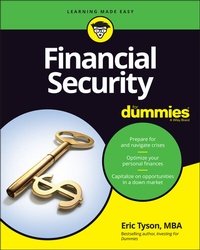
Financial Security For Dummies
Description

Crisis is inevitable--but it doesn't have to torpedo your finances! Financial Security For Dummies offers proven advice to help you prep your finances for the next economic downturn, personal setback, pandemic, plague of locusts--or anything else life throws your way. This book contains the historical perspective and up-to-date info you'll need to anticipate, understand, and navigate a wide range of personal financial challenges.
If your monthly income and expenses are on steady ground and you're ready to secure your financial future, this is the For Dummies guide for you. Not only will you create a plan to keep your family's finances afloat during turbulent times, but you'll also be liberated from the pressure to "keep up with the Joneses" so you can make smarter financial decisions, starting today. This book will help you:
* Gain an understanding of how unforeseen personal or global events could affect your financial life
* Learn strategies for protecting your assets when economic downturns and other emergencies occur
* Feel confident in your unique path to financial freedom so you can remain calm when life takes an unexpected turn
* Build a survival plan for protecting yourself with broader safety nets, better money decisions, and improved financial literacy
Whether you want to reduce your stress surrounding your financial goals or take advantage of financial opportunities crises create, Financial Security For Dummies will equip you to navigate financial challenges and ultimately achieve peace of mind.
More details
Other editions
Additional editions
Person
Content
Chapter 1
Navigating the (Bumpy) Road to Financial Independence
IN THIS CHAPTER
Defining and reaching for financial security
Dealing with crises
Tapping opportunities during tough times
Achieving financial independence and feeling financially secure are admittedly subjective assessments. A nest egg of $200,000 may seem like a lot to some people but not to a high-income earner who is accustomed to spending $100,000+ annually.
Now, for many people the feeling of financial security isn't simply a matter of how much money you have to your name. Numerous other factors may contribute to feeling secure financially, which I help you to understand.
In my work as a financial counselor and educator, I've also seen people for whom having a certain level of wealth to feel secure is a moving target. And those targets tend to keep getting bigger and bigger over time once a given lower targeted amount has been achieved.
In this overview chapter, I walk you through determining what financial security means to you, assessing where you are now, and helping you think through what you need to do to accomplish your goals. I also survey the landscape of crises, both personal and in the broader economy, which you should be prepared to handle. Finally, I discuss how to best position yourself to benefit from the inevitable opportunities that present themselves during tough economic times.
Reaching for Financial Security
A good place to begin is by defining what financial security means to you and what is and isn't important to you. Then I help you think through and understand where you are now and what you may need to do to accomplish your goals.
Defining what you value
If saving money is a good habit, the more you save, the better, right? Well, no, not really, unless your sole goal is to amass as much money in various accounts as possible. But what if you're not spending enough to eat a healthy diet? How about some time and money so that you can regularly rest and enjoy some recreation? What about some spending for the special people in your life?
Think about all the big decisions in your life: choosing and finding a job, a place to live, a spouse, and so on. For most people, there's a financial component to all of these. When thinking about personal goals, nearly all of them take money to accomplish. Money is inextricably linked to the rest of your life. Making the best financial decisions starts with the big picture and the rest of your life in mind - in other words, holistically.
Suppose like many people, you are working and earning money. You'd like to save and invest some of that and not have to continue working full-time for the rest of your life. But you probably have some other competing uses for your money. These may include things like saving to buy a home or start a business, expenses for your family, a future vacation, and so forth.
Money shares some similarities with food. If you don't have enough, you likely notice the insufficiency of your resources. Having more than enough with some reserves and extras usually provides most people with some peace of mind. Different people, though, have different views of how much extra they may want to have.
The virtue of a capitalistic economy is that within reason, if you're willing to work hard and seek to improve yourself and your work, over time you should be able to see your money grow. The progress and advancement of technology and society generally increase the purchasing power of your money over time.
Some folks lose sight of the differences between necessities and luxuries, especially in affluent and upper-middle class communities and circles. We can always find people with bigger homes and more expensive cars who have taken more exotic vacations. The bar can continually be set higher and higher in terms of how much money we "need."
The continual improvement of products and services, particularly those that incorporate a lot of technology, leads to more folks taking for granted how "luxurious" some of today's choices are compared with those of the past. Consider what's happened with personal computers and smartphones. Today, consumers buy smartphones that have many of the same functionalities and can access far more information than personal computers could a generation or two ago. And you can buy today's smartphones for less than the cost of personal computers from a generation or two ago. Today's smartphones are like a handheld personal computer, a phone (that can easily travel with you), and a quality camera all rolled into one!
Automobiles have far more features, especially safety features like air bags and anti-lock brakes, compared to those from a generation or two ago. Today's cars are dramatically more fuel efficient too.
Just walk through most homes and apartments today and you'll find all sorts of devices like microwave ovens, printers, HDTVs, washers and dryers, dishwashers, and so on, which are far better and relatively less costly than in prior generations. And in some cases, these devices didn't exist or weren't widespread not that many generations ago.
So, I urge you to step back and think about what it is that you value and to recognize how "luxurious" are so many of the choices and options that we have in modern American society. With many products and services, we get far more for our money than did folks a generation or two ago.
That said, we can all think of some expense categories like higher education, housing in some higher-demand cities (such as New York City and San Francisco) and portions of the healthcare industry where the rate of price increases (inflation) may exceed increases in typical wages and the general cost of living. These categories are the exception, not the rule, and you can take steps and actions to mitigate and blunt some or even much of the excessive price increases through the strategies I discuss in this book.
Especially in our consumption-oriented society, some folks may get carried away with working and earning more and amassing more money. Life is short, and you can't take your money with you in the end. So, there's something to be said for balancing work, earning and saving money, and having sufficient time for family, friends, and your activities and hobbies.
Assessing where you are
What's your current personal financial health? There are numerous ways to measure that. When I've worked with clients as a financial counselor and as an educator, I've found the following exercises to be valuable:
- Net worth analysis: Your ability to accomplish important financial goals, such as buying a home and someday retiring from full-time work, depends upon your net worth. To derive your net worth, you total up your financial assets and subtract your financial liabilities. I typically exclude a person's home in this analysis unless they plan to tap some portion of their home's equity, by trading down to a lower-priced property.
- Spending analysis: You should know where your money goes in a typical month or year, especially if you'd like to save a greater portion of your employment income. Analyzing your historic spending can tell you just that.
- Saving analysis: Over the past year, what portion of your work income were you able to save? Many people don't know the answer to that important question, and if you don't, you can't really know whether you're on track to accomplish your financial and personal goals.
- Your investment portfolio: Can your investment portfolio be improved? Do you understand your current investments? How do your current holdings stack up in terms of costs/fees and performance within their respective peer groups? Do your current investment holdings match your risk and return preferences?
- Your home: If you currently rent or own a home but are looking to sell and buy another, that takes some advance planning and analysis. Since housing costs can consume a significant portion of your income and budget, you should ensure that a change in your housing situation fits with your financial and personal goals and planning.
- Insurance review: You should have insurance to protect you against losses that could be financially catastrophic to you and your loved ones. I know from my counseling work that many folks have gaps in their insurance coverage and are wasting money on overpriced or unnecessary policy features.
- Employee benefits review: Plenty of employees don't bother to read and review their employee benefits, which typically include various insurance coverages and possibly a retirement savings plan. Employee benefits can actually be quite valuable and should be coordinated with your overall financial plan.
These elements form a personal financial plan. You can hire a competent and ethical financial planner to assemble such a plan for you, but you should beware that many folks sell products on commission or charge hefty ongoing money management fees. Others aren't interested or experienced enough to help you with nuts-and-bolts issues like analyzing your spending. See Part 4 for more details on getting your personal finance house in order.
Grasping financial lingo and trends
Personal financial knowledge and literacy is an enormous obstacle for too many people, including those who...
