

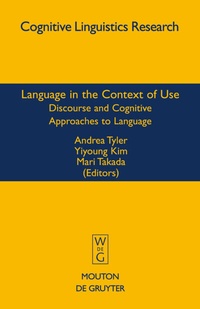
Language in the Context of Use
Description

The volume explores key convergences between cognitive and discourse approaches to language and language learning, both first and second. The emphasis is on the role of language as it is used in everyday interaction and as it reflects everyday cognition. The contributors share a usage-based perspective on language - whether they are examining grammar or metaphor or interactional dynamics - which situates language as part of a broader range of systems which underlie the organization of social life and human thought.
While sharing fundamental assumptions about language, the particulars of the areas of inquiry and emphases of those engaged in discourse analysis versus cognitive linguistics are diverse enough that, historically, many have tended to remain unaware of the interrelations among these approaches. Thus, researchers have also largely overlooked the possibilities of how work from each perspective can challenge, inform, and enrich the other.
The papers in the volume make a unique contribution by more consciously searching for connections between the two broad approaches. The results are a set of dynamic, thought-provoking analyses that add considerably to our understanding of language and language learning. The papers represent a rich range of frameworks within a usage-based approach to language. Cognitive Grammar, Mental Space and Blending Theory, Construction Grammar, ethnomethodology, and interactional sociolinguistics are just some of the frameworks used by the researchers in this volume. The particular subjects of inquiry are also quite varied and include first and second language learning, signed language, syntactic phenomena, interactional regulation and dynamics, discourse markers, metaphor theory, polysemy, language processing and humor.
The volume is of interests to researchers in cognitive linguistics, discourse and conversational analysis, and first and second language learning, as well as signed languages.
More details
Other editions
Additional editions
Persons
Content
2 - Contents [Seite 5]
3 - Introduction [Seite 7]
4 - Personal and interpersonal gesture spaces: Functional contrasts in language and gesture [Seite 31]
5 - The role of compound pragmatic markers in the construction of Catalan oral narrative [Seite 59]
6 - Analyzing narrative informativeness in speech and writing [Seite 77]
7 - Usage-based and form-focused SLA: The implicit and explicit learning of constructions [Seite 99]
8 - Perspective shifts in ASL narratives: The problem of clause structure [Seite 127]
9 - Making dative a case for semantic analysis: Differences in use between native and non-native speakers of German [Seite 151]
10 - Personal pronouns, blending, and narrative viewpoint [Seite 173]
11 - Meaning construction in humorous discourse: Context and incongruities in conceptual blending [Seite 189]
12 - Mental spaces and mental verbs in early child English [Seite 205]
13 - Spanish gustar vs. English like: A cognitive analysis of the constructions and its implication for SLA [Seite 239]
14 - The development of verb-argument structure in child discourse: On the use of construction variation in peer play [Seite 261]
15 - Another look at French split intransitivity [Seite 275]
16 - BORING: It's anything but [Seite 291]
17 - It's like making a soup: Metaphors and similes in spoken news discourse [Seite 307]
18 - A discourse approach to metaphor: Explaining systematic metaphors for literacy processes in a school discourse community [Seite 327]
19 - 'Superschemas' and the grammar of metaphorical mappings [Seite 345]
20 - Backmatter [Seite 367]
