

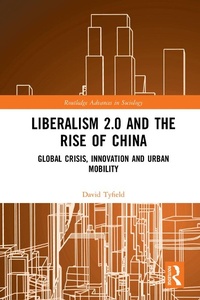
Liberalism 2.0 and the Rise of China
Global Crisis, Innovation and Urban Mobility
Published on 5. September 2017
280 pages
978-1-317-56540-6 (ISBN)
Description

What can we do in this period of historic, global turbulence? Mainstream narratives have no plausible account of how to stop exacerbating the multiple, overlapping challenges; much less begin to address them meaningfully. The only thing everyone agrees is innovation will be needed.
But what is innovation? Usually, it is understood as new technologies that will 'solve' specific 'problems' - and, it is hoped, return life to a 'business as usual' of progress in individual freedom and wealth. But innovation is a thoroughly social process with profound implications for the arrangement of power in a society, hence shaping the emergence of new social systems. Exploring evidence from the key arenas of low-carbon innovation, including in the pivotal location of a rising China, this book describes the global systemic crisis of a neoliberal world order and the embryonic emergence of an alternative global power regime of a 'liberalism 2.0'. This augurs both a web 2.0-based revitalization of the classical liberalism of the nineteenth century and new Dickensian inequalities and injustices. Against hopes that the present is a 'revolutionary' moment, therefore, political engagement with this emerging power regime is thus presented as the most productive strategy for a progressive twenty-first century politics.
But what is innovation? Usually, it is understood as new technologies that will 'solve' specific 'problems' - and, it is hoped, return life to a 'business as usual' of progress in individual freedom and wealth. But innovation is a thoroughly social process with profound implications for the arrangement of power in a society, hence shaping the emergence of new social systems. Exploring evidence from the key arenas of low-carbon innovation, including in the pivotal location of a rising China, this book describes the global systemic crisis of a neoliberal world order and the embryonic emergence of an alternative global power regime of a 'liberalism 2.0'. This augurs both a web 2.0-based revitalization of the classical liberalism of the nineteenth century and new Dickensian inequalities and injustices. Against hopes that the present is a 'revolutionary' moment, therefore, political engagement with this emerging power regime is thus presented as the most productive strategy for a progressive twenty-first century politics.
Reviews / Votes
Other books tell us what to think about China. This book shows us how to think with and through China. A stirring fusion of social analysis and Sinofuturism, David Tyfield's Liberalism 2.0 and the Rise of China lays out the logics of innovation through which the global system is being reinvented - as we speak.Nigel Clark, Chair of Social Sustainability, Lancaster Environment Centre, Lancaster University, UK
Tyfield offers us a fascinating crystal ball into the future playing out of current crises of neoliberal global capitalism informed by his deep understanding of the dynamics of complex power/knowledge systems and the concept of innovation-as-politics. He combines this astute theoretical vision of the contradictions and 'monstrosities' of post-human technological change with an eye-opening empirical study of China's dynamic systems innovation, epitomized by turbulent struggles over transitions in electric auto-mobility and the disruptive emergence of mobility-as-a-service. You could not find a better starting place for insights into the future of urbanization in megacities, the failure of 'Googliberal' transformations of the global economy, and the tug-of-war of liberty-security logics that will shape the 21st century global economy.
Mimi Sheller, Professor of Sociology and Director of the Center for Mobilities Research and Policy, Drexel University, USA
A superb analysis of China's innovation system and the struggle for new mobility. This title is essential to understand the social shaping of technology and the fragmented but dynamic politics of innovation in China.
Boy Luethje, Visiting Professor School of Government, Sun Yat-sen University, Guangzhou, China
Deeply questioning the global risks we face, Tyfield brilliantly shows the intrinsic limits built into the neoliberal model of innovation, epitomized by Silicon Valley, and reveals why and how new sources of power-knowledge system innovations are emerging in China. Anyone looking for a new technological and economic vision of ecological civilization should read this title.
Sang-Jin Han, Professor Emeritus, Department of Sociology, Seoul National University, South Korea
More details
Series
Language
English
Place of publication
London
United Kingdom
Publishing group
Taylor & Francis Ltd
Target group
College/higher education
Illustrations
9 Tables, black and white; 23 Line drawings, black and white
File size
4,92 MB
ISBN-13
978-1-317-56540-6 (9781317565406)
Copyright in bibliographic data and cover images is held by Nielsen Book Services Limited or by the publishers or by their respective licensors: all rights reserved.
Schweitzer Classification
Other editions
Additional editions
Book
04/2019
1st Edition
Routledge
€63.60
Shipment within 10-20 days
Book
08/2017
1st Edition
Routledge
€206.70
Shipment within 10-20 days
Person
David Tyfield is a Reader at the Lancaster Environment Centre, Lancaster University, a Director of the Joint Institute for the Environment, Guangzhou and Co-Director of the Centre for Mobilities Research.
Content
Introduction
Section 1 - The Problem: The Global System Crisis of Neoliberalism
Chapter 1 Neoliberalism, Knowledge and the Global System
Chapter 2 Four Great Challenges
Chapter 3 The Geneaology of the Emerging Capitalist Present
Section 2 - Where Are We?: Innovation in China
Chapter 4 Will China Rule the World? The Emergence of Chinese Capitalism
Chapter 5 The Supply Side: Debates and Paradoxes regarding Chinese Innovation Upgrade
Chapter 6 The Unexpected Innovation Hegemon
Chapter 7 The Demand Side: The Emergence of Risk-Innovation-Class in China
Chapter 8 The Emerging Historic Bloc - China's Middle Risk-Innovation-Class
Section 3 - Where Are We Going?: Sharing and Haggling the Long Complex Journey to Green Urban Mobility Systems Transition in China
Chapter 9 Electric Vehicle Innovation-as-Politics in China
Chapter 10 Towards Mobility-as-a-Service
Section 4 - What Can Be Done?: Conclusion
Chapter 11 Liberalism 2.0 and Beyond
Section 1 - The Problem: The Global System Crisis of Neoliberalism
Chapter 1 Neoliberalism, Knowledge and the Global System
Chapter 2 Four Great Challenges
Chapter 3 The Geneaology of the Emerging Capitalist Present
Section 2 - Where Are We?: Innovation in China
Chapter 4 Will China Rule the World? The Emergence of Chinese Capitalism
Chapter 5 The Supply Side: Debates and Paradoxes regarding Chinese Innovation Upgrade
Chapter 6 The Unexpected Innovation Hegemon
Chapter 7 The Demand Side: The Emergence of Risk-Innovation-Class in China
Chapter 8 The Emerging Historic Bloc - China's Middle Risk-Innovation-Class
Section 3 - Where Are We Going?: Sharing and Haggling the Long Complex Journey to Green Urban Mobility Systems Transition in China
Chapter 9 Electric Vehicle Innovation-as-Politics in China
Chapter 10 Towards Mobility-as-a-Service
Section 4 - What Can Be Done?: Conclusion
Chapter 11 Liberalism 2.0 and Beyond
