

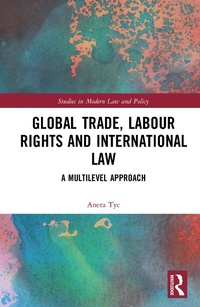
Global Trade, Labour Rights and International Law
A Multilevel Approach
1st Edition
Published on 21. June 2021
242 pages
978-1-000-39592-1 (ISBN)
Description

This book provides a set of proposals for how best to guarantee effective enforcement of labour rights worldwide.
The linkage between labour standards and global trade has been recurrent for some 200 years. At a time when the world is struggling to find a way out of crisis and is striving for economic growth, more than ever there is a need for up-to-date research on how to protect and promote labour rights in the global economy. This book explores the history of the field and also provides an overview of emerging trends and opportunities. It discusses the most recent problems including: the effectiveness and the role of the International Labour Organization (ILO) in the second century of its existence, the World Trade Organization (WTO) and its potential relevance in the protection of labour rights, the effectiveness of the US and the EU Generalised System of Preferences, the impact of corporate social responsibility (CSR) instruments on labour rights, and labour provisions in the international trade agreements concluded by the US and the EU. The book argues, inter alia, that trade agreements seem to be a useful tool to help pave the way out of the crisis and that the United States-Mexico-Canada Agreement (USMCA) can be perceived as a model agreement and a symbol of a shift in perspective from long global supply chains to a focus on regional ones, local production, jobs and a rise in wages.
The book will be essential reading for academics and students in the fields of human rights law, international labour law, industrial relations law, international sustainable development law, international economic law and international trade law. It will also be of interest to practitioners, non-government organisations (NGOs) and policy makers.
The linkage between labour standards and global trade has been recurrent for some 200 years. At a time when the world is struggling to find a way out of crisis and is striving for economic growth, more than ever there is a need for up-to-date research on how to protect and promote labour rights in the global economy. This book explores the history of the field and also provides an overview of emerging trends and opportunities. It discusses the most recent problems including: the effectiveness and the role of the International Labour Organization (ILO) in the second century of its existence, the World Trade Organization (WTO) and its potential relevance in the protection of labour rights, the effectiveness of the US and the EU Generalised System of Preferences, the impact of corporate social responsibility (CSR) instruments on labour rights, and labour provisions in the international trade agreements concluded by the US and the EU. The book argues, inter alia, that trade agreements seem to be a useful tool to help pave the way out of the crisis and that the United States-Mexico-Canada Agreement (USMCA) can be perceived as a model agreement and a symbol of a shift in perspective from long global supply chains to a focus on regional ones, local production, jobs and a rise in wages.
The book will be essential reading for academics and students in the fields of human rights law, international labour law, industrial relations law, international sustainable development law, international economic law and international trade law. It will also be of interest to practitioners, non-government organisations (NGOs) and policy makers.
More details
Series
Edition
1. Auflage
Language
English
Place of publication
London
United Kingdom
Publishing group
Taylor & Francis Ltd
Target group
College/higher education
Product notice
Reflowable
ISBN-13
978-1-000-39592-1 (9781000395921)
Copyright in bibliographic data and cover images is held by Nielsen Book Services Limited or by the publishers or by their respective licensors: all rights reserved.
Schweitzer Classification
Other editions
Additional editions
Book
12/2022
1st Edition
Routledge
€63.30
Shipment within 15-20 days
Book
06/2021
1st Edition
Routledge
€206.40
Shipment within 15-20 days
Domenico Amirante | Silvia Bagni
Global Trade, Labour Rights and International Law
A Multilevel Approach
Book
05/2021
Routledge
Unfortunately, price unknown
Available (delivery time upon request)
Person
Aneta Tyc is Doctor of Law (2015) and Assistant Professor at the Department of European, International and Collective Labour Law at the Faculty of Law and Administration of the University of Lodz. She is author or co-author of 80 publications in the field of labour law in several languages and has authored several dozen papers presented at scientific conferences. She has been Principal Investigator on several research projects and is a winner of many prestigious awards, prizes and scholarships.
Content
Chapter I The history of development of workers' rights in the context of global trade rules
Chapter II The ILO and its effectiveness
Chapter III The WTO needs reforms: is there space for labour rights?
Chapter IV Generalised System of Preferences: The US and the EU Compared
Chapter V The US's and the EU's international trade agreements
Chapter VI Private standard-setting: the impact of CSR instruments on labour rights
Chapter VII Conclusions
Chapter II The ILO and its effectiveness
Chapter III The WTO needs reforms: is there space for labour rights?
Chapter IV Generalised System of Preferences: The US and the EU Compared
Chapter V The US's and the EU's international trade agreements
Chapter VI Private standard-setting: the impact of CSR instruments on labour rights
Chapter VII Conclusions
