

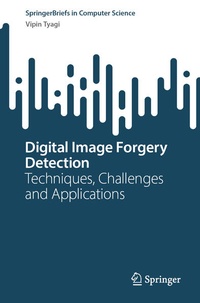
Digital Image Forgery Detection
Description

This book "Digital Image Forgery Detection: Techniques, Challenges and Applications" presents a comprehensive yet concise information related to image forgery detection. The increasing number of manipulated digital images; ranging from simple photo editing to sophisticated computer generated images has raised significant concerns regarding the authenticity of visual information conveyed through images.
This book introduces various types of digital image forgeries and addresses the technical and practical aspects of digital image forgery detection. Traditional and current machine learning-based approaches for forgery detection in digital images have been reviewed.
Targeted at technical students, researchers, forensic analysts, and professionals in the fields of image forensics, cybersecurity, and computer vision, this Springer Briefs will serve as a guide to one of the most important problems in the digital age.
More details
Other editions
Additional editions
Person
Prof. Vipin Tyagi is a distinguished academician, researcher, and author, currently serving as Dean (Academic and Research) at Jaypee University of Engineering and Technology in Guna, Madhya Pradesh, India. His expertise spans across image processing and cyber forensics.
Prof. Tyagi has a prolific publication record, contributing significantly to his fields of interest. His scholarly work includes numerous journal articles, conference papers, and books. Some of his notable publications are in the areas of image forgery detection, image denoising, and content-based image retrieval. He has authored and edited several books and papers in the field of computing and data sciences, such as "Predictive Computing and Information Security" and "Content-Based Image Retrieval: Ideas, Influences, and Current Trends" published by Springer Singapore, "Understanding Digital Image Processing" by CRC Press, Taylor and Francis Group.
His scholarly work has earned him a respectable h-index and numerous citations in the academic community.
In addition to his academic pursuits, Prof. Tyagi has been actively involved in professional societies. He is a senior life member of the Computer Society of India, a Fellow of the IETE, Senior Member-IEEE, and a member of the Indian Science Congress Association, ACM. He was elected as president and recorder of Engineering Science Section of Indian Science Congress Association. He has also served as Hon. National Secretary of the Computer Society of India. Prof. Tyagi is elected as member Board of Governors of Engineering Council of India, third time consecutively (2020-2022, 2022-2024, 2024-2026).
Content
Chapter 1: Introduction to Image Forgery.- Chapter 2: Types of Digital Image Forgery.- Chapter 3: Digital Image forgery detection techniques.- Chapter 4: Datasets and Evaluation.- Chapter 5: Challenges in Image Forgery Detection.- Chapter 6: Applications of Digital mage Forgery Detection.- Chapter 7: Future Directions.
