

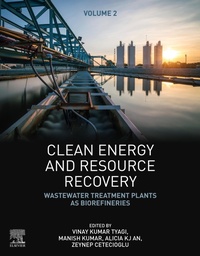
Clean Energy and Resource Recovery
Wastewater Treatment Plants as Biorefineries, Volume 2
Published on 10. November 2021
482 pages
978-0-323-90179-6 (ISBN)
Description

Clean Energy and Resource Recovery: Wastewater Treatment Plants as Bio-refineries, Volume 2, summarizes the fundamentals of various treatment modes applied to the recovery of energy and value-added products from wastewater treatment plants. The book addresses the production of biofuel, heat, and electricity, chemicals, feed, and other products from municipal wastewater, industrial wastewater, and sludge. It intends to provide the readers an account of up-to-date information on the recovery of biofuels and other value-added products using conventional and advanced technological developments. The book starts with identifying the key problems of the sectors and then provides solutions to them with step-by-step guidance on the implementation of processes and procedures. Titles compiled in this book further explore related issues like the safe disposal of leftovers, from a local to global scale. Finally, the book sheds light on how wastewater treatment facilities reduce stress on energy systems, decrease air and water pollution, build resiliency, and drive local economic activity.As a compliment to Volume 1: Biomass Waste Based Biorefineries, Clean Energy and Resource Recovery, Volume 2: Wastewater Treatment Plants as Bio-refineries is a comprehensive reference on all aspects of energy and resource recovery from wastewater. The book is going to be a handy reference tool for energy researchers, environmental scientists, and civil, chemical, and municipal engineers interested in waste-to-energy.
- Offers a comprehensive overview of the fundamental treatments and methods used in the recovery of energy and value-added products from wastewater
- Identifies solutions to key problems related to wastewater to energy/resource recovery through conventional and advanced technologies and explore the alternatives
- Provides step-by-step guidance on procedures and calculations from practical field data
- Includes successful case studies from both developing and developed countries
More details
Other editions
Additional editions
Vinay Kumar Tyagi | Manish Kumar | Alicia K.J. An
Clean Energy and Resource Recovery
Wastewater Treatment Plants as Biorefineries, Volume 2
Book
11/2021
Elsevier
€162.18
Shipment within 15-20 days
Content
1. Wastewater to R3 - resource recovery, recycling, and reuse efficiency in urban wastewater treatment plants2. Energy and resources recovery from wastewater treatment systems3. Water reclamation, recycle, and reuse4. Advanced biological water reclamation and reuse technologies for recirculating aquaculture system5. Hybrid forward/reverse osmosis (HFRO): An approach for optimized operation and sustainable resource recovery7. Energy self-sufficiency in wastewater treatment plants: Perspectives, challenges, and opportunities8. Cellulosic materials recovery from municipal wastewater: From treatment plants to the market9. Assessing algae-based wastewater treatment-a life cycle assessment approach10. Methanotrophic bacterial biorefineries: resource recovery and GHG mitigation through the production of bacterial biopolymers11. Microbial electrochemical technologies for wastewater treatment: insight into theory and reality12. Waste(water) to feed protein: effluent characteristics, protein recovery, and single-cell protein production from food industry waste streams13. Acids (VFAs) and bioplastic (PHA) recovery14. Algal treatment of wastewater for resources recovery15. Polyhydroxyalkanoate production from food industry residual streams using mixed microbial cultures16. Removal of nitrogen and phosphorus from wastewater through the moving bed biofilm reactor17. Wastewater to biogas recovery18. Wastewater to bioactive products: recovery of polysaccharides in activated sludge from sulfate-laden wastewater19. Circular city concept for future biorefineries20. Sludge treatment: an approach toward environmental remediation21. Values added products recovery from sludge22. Biogas recovery from sludge23. Cellulose and extracellular polymer recovery from sludge24. Cambi Thermal Hydrolysis Process (CambiTHP) for sewage sludge treatment25. Reutilization of sludge as fertilizer26. Valorizing sludge: a biorefinery perspective prospecting for sustainable development
