

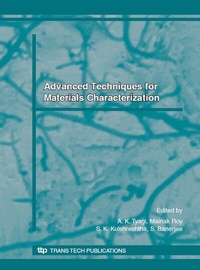
Advanced Techniques for Materials Characterization
Published on 2. January 2009
528 pages
978-3-03813-323-0 (ISBN)
Description

Volume is indexed by Thomson Reuters BCI (WoS).
Nowadays, an impressively large number of powerful characterization techniques is being used by physicists, chemists, biologists and engineers in order to solve analytical research problems; especially those related to the investigation of the properties of new materials for advanced applications. Although there are a few available books which deal with such experimental techniques, they are either too exhaustive and cover very few techniques or are too elementary to provide a solid basis for learning to use the characterization technique. Moreover, such books usually over-emphasize the textbook approach: being full of theoretical concepts and mathematical derivations, and omitting the practical instruction required in order to permit newcomers to use the techniques.
Nowadays, an impressively large number of powerful characterization techniques is being used by physicists, chemists, biologists and engineers in order to solve analytical research problems; especially those related to the investigation of the properties of new materials for advanced applications. Although there are a few available books which deal with such experimental techniques, they are either too exhaustive and cover very few techniques or are too elementary to provide a solid basis for learning to use the characterization technique. Moreover, such books usually over-emphasize the textbook approach: being full of theoretical concepts and mathematical derivations, and omitting the practical instruction required in order to permit newcomers to use the techniques.
More details
Series
Language
English
Place of publication
Zurich-Durnten
Switzerland
Target group
Professional and scholarly
Illustrations
Illustrations
File size
26,32 MB
ISBN-13
978-3-03813-323-0 (9783038133230)
DOI
10.4028/www.scientific.net/MSFo.49-51
Copyright in bibliographic data and cover images is held by Nielsen Book Services Limited or by the publishers or by their respective licensors: all rights reserved.
Schweitzer Classification
Other editions
Additional editions
A.K. Tyagi | Mainak Roy | S.K. Kulshreshtha
Advanced Techniques for Materials Characterization
Book
01/2009
Trans Tech Publications Ltd
€421.12
Shipment within 3-4 weeks
A.K. Tyagi | Mainak Roy | S.K. Kulshreshtha
Advanced Techniques for Materials Characterization
Software
01/2009
Trans Tech Publications Ltd
€380.64
Shipment within 3-4 weeks
Content
Preface
Dr. A.K. Tyagi
Dr. Mainak Roy
Dr. S.K. Kulshreshtha
Dr. S. Banerjee
1. Diffraction Techniques
1.1 Characterization of Crystalline Materials with Powder X-Ray Diffraction (XRD)
1.2 Study of Nuclear (Chemical) and Magnetic Structures Using Neutron Scattering
1.3 Use of SANS and SAXS in Studying Nanoparticles
2. Spectroscopic Techniques
2.1 IR Spectroscopy: Applications in Material Characterization
2.2 Raman Spectroscopic Technique for Materials Characterization
2.3 Structural Aspects of Zeolites and Oxide Glasses: Insights from Solid State Nuclear Magnetic Resonance
2.4 Electron Paramagnetic Resonance (EPR) Spectroscopy in Material Characterization
2.5 Positron Annihilation Spectroscopy
2.6 Moessbauer Spectroscopy and its Applications
3. Compositional Characterization Techniques
3.1 Mass Spectrometry for Characterization of Materials
3.2 Neutron Activation Analysis and Applications
3.3 Atomic Absorption, Emission and Mass Quantification in the Elemental Characterization of Materials
3.4 Microanalysis by Electron Beam
3.5 Compositional Characterization of Surfaces with Ion Beam Analysis
4. Synchroton and Surface Techniques
4.1 Synchrotron Radiation and its Application for Material Characterization
4.2 Materials Characterization Using Surface Analytical Techniques: X-ray Photoelectron Spectroscopy
5. Microscopic Techniques
5.1 Atomic Force Microscope (AFM) in Chemistry, Biology and Material Science
5.2 Particle Characterization by Light Scattering
5.3 Characterization of Nanostructures by Transmission Electron Microscopy
5.4 Principles and Applications of SEM and EDAX
Dr. A.K. Tyagi
Dr. Mainak Roy
Dr. S.K. Kulshreshtha
Dr. S. Banerjee
1. Diffraction Techniques
1.1 Characterization of Crystalline Materials with Powder X-Ray Diffraction (XRD)
1.2 Study of Nuclear (Chemical) and Magnetic Structures Using Neutron Scattering
1.3 Use of SANS and SAXS in Studying Nanoparticles
2. Spectroscopic Techniques
2.1 IR Spectroscopy: Applications in Material Characterization
2.2 Raman Spectroscopic Technique for Materials Characterization
2.3 Structural Aspects of Zeolites and Oxide Glasses: Insights from Solid State Nuclear Magnetic Resonance
2.4 Electron Paramagnetic Resonance (EPR) Spectroscopy in Material Characterization
2.5 Positron Annihilation Spectroscopy
2.6 Moessbauer Spectroscopy and its Applications
3. Compositional Characterization Techniques
3.1 Mass Spectrometry for Characterization of Materials
3.2 Neutron Activation Analysis and Applications
3.3 Atomic Absorption, Emission and Mass Quantification in the Elemental Characterization of Materials
3.4 Microanalysis by Electron Beam
3.5 Compositional Characterization of Surfaces with Ion Beam Analysis
4. Synchroton and Surface Techniques
4.1 Synchrotron Radiation and its Application for Material Characterization
4.2 Materials Characterization Using Surface Analytical Techniques: X-ray Photoelectron Spectroscopy
5. Microscopic Techniques
5.1 Atomic Force Microscope (AFM) in Chemistry, Biology and Material Science
5.2 Particle Characterization by Light Scattering
5.3 Characterization of Nanostructures by Transmission Electron Microscopy
5.4 Principles and Applications of SEM and EDAX
