

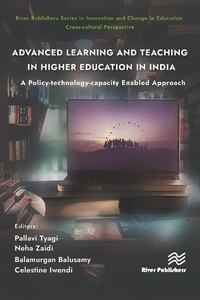
Advanced Learning and Teaching in Higher Education in India: A Policy-technology-capacity Enabled Approach
1st Edition
Published on 12. April 2024
356 pages
978-1-003-81159-6 (ISBN)
Description

This book comprehensively covers the evolution of advanced learning pedagogy and innovative technologies like open educational resources and blended learning models. It specifically talks about the future of technology-enhanced learning and how advanced technology and government policies together are trying to impact learning outcomes globally. Nowadays in a flexible learning environment, technology plays a significant role in higher education systems. Both educators and students are playing prominent roles in its successful implementation. Advanced learning pedagogy by using technology has not only changed teaching procedures but has also evolved the relationship among multiple stakeholders.
The content of the book is neatly segregated into four parts. Part I covers the concept and evolution of digital learning and education technology. This part examines the role of technology in higher education and proposes a toolkit for personalized learning and continuous assessment.
Parts II and III creatively represent the innovative teaching techniques and learning models under advance learning pedagogy. Chapters under parts II and III are specially designed to present the more simplistic view of various technology-based advanced learning models and resources like flipped classes, gaming designs for e-learning, etc. Part III of the book also extensively covers various case studies/instructor's stories of technology enabled learning experiences.
Part IV focuses on the evaluation of advance learning pedagogy and tools. It also covers the future of information in learning (like formative analytics) and improved learning outcomes using technology and government initiatives in the form of various future oriented education policies like the Digital Action Education Plan (2021-2027).
The wide-ranging content also covers the challenges of implementation of advanced learning pedagogy and offers recommendations to overcome such challenges. The book will grab the attention of the modern (IT-enabled) instructor's fraternity, and students and researchers in the area of technology and education. The book can be further used by policymakers and educational-technology startups to formulate and design technology-based higher education teaching policies and procedures which are indeed helpful in measuring learning outcomes.
The content of the book is neatly segregated into four parts. Part I covers the concept and evolution of digital learning and education technology. This part examines the role of technology in higher education and proposes a toolkit for personalized learning and continuous assessment.
Parts II and III creatively represent the innovative teaching techniques and learning models under advance learning pedagogy. Chapters under parts II and III are specially designed to present the more simplistic view of various technology-based advanced learning models and resources like flipped classes, gaming designs for e-learning, etc. Part III of the book also extensively covers various case studies/instructor's stories of technology enabled learning experiences.
Part IV focuses on the evaluation of advance learning pedagogy and tools. It also covers the future of information in learning (like formative analytics) and improved learning outcomes using technology and government initiatives in the form of various future oriented education policies like the Digital Action Education Plan (2021-2027).
The wide-ranging content also covers the challenges of implementation of advanced learning pedagogy and offers recommendations to overcome such challenges. The book will grab the attention of the modern (IT-enabled) instructor's fraternity, and students and researchers in the area of technology and education. The book can be further used by policymakers and educational-technology startups to formulate and design technology-based higher education teaching policies and procedures which are indeed helpful in measuring learning outcomes.
More details
Edition
1. Auflage
Language
English
Place of publication
London
United Kingdom
Publishing group
Taylor & Francis Ebooks
Target group
College/higher education
Professional and scholarly
Illustrations
39 Tables, black and white; 38 Illustrations, color; 4 Illustrations, black and white
ISBN-13
978-1-003-81159-6 (9781003811596)
Copyright in bibliographic data and cover images is held by Nielsen Book Services Limited or by the publishers or by their respective licensors: all rights reserved.
Schweitzer Classification
Other editions
Additional editions
Pallavi Tyagi | Neha Zaidi | Balamurgan Balusamy
Advanced Learning and Teaching in Higher Education in India: A Policy-technology-capacity Enabled Approach
A Policy-technology-capacity Enabled Approach
Book
04/2024
1st Edition
River Publishers
€147.90
Article not available for order
Persons
Dr. Pallavi Tyagi is a passionate human resource professional with more than 11 years of experience in HR Research and Academia. She has completed an MBA in Human Resource Management from the reputed Banasthali University in 2008 and awarded UGC NET certification in 2011 in Labour laws and personnel management. She gained her doctorate degree in the area of employee empowerment and organization performance. She is currently working on multiple impactful research projects including several edited books, patents and manuscripts. Her major areas of interest are employee empowerment practices, HR and AI, sustainability, social entrepreneurship, role of artificial intelligence in human resource management and sustainability.
Neha Zaidi is currently engaged in the capacity of an Assistant Professor (Marketing) with School of Business Studies, Sharda University. She has more than 10 years' experience in academics and research having worked with reputed management institutions. She has been awarded for her research work at various international conferences and has extensively published research papers and case studies in Scopus indexed and ABDC journals in the areas of travel and tourism, sustainable marketing, social media marketing, and services marketing which remain her prime interest domains of research.
Professor Balamurugan Balusamy has served up to the position of Associate Professor in his stint of 14 years of experience with VIT University, Vellore. He completed his Bachelors, Masters and Ph.D. degrees from top premier institutions in India. His passion is teaching and he adapts different design thinking principles while delivering his lectures. He has published 30+ books on various technologies and visited 15 plus countries for his technical course. He has several top-notch conferences in his resume and has published over 150 quality journal articles, conference papers and book chapters combined. He serves on the advisory committee for several startups and forums and does consultancy work for industry on Industrial IOT. He has given over 175 talks at various events and symposia. He is currently working as a Professor and Associate Dean in Student Engagement at Shiv Nadar University, and teaches students, and does research on Blockchain and IOT.
Celestine Iwendi is a visiting Professor with Coal City University Enugu, Nigeria and Associate Professor (Senior Lecturer) with the School of Creative Technologies, University of Bolton, United Kingdom. He is also a Fellow of the Higher Education Academy, United Kingdom and a Fellow of the Institute of Management Consultants. Other assignments include Adjunct Professor Delta State Polytechnic, Nigeria. His past assignments include Associate Professor, Bangor College China, Senior Researcher, WSN Consults Ltd, United Kingdom, Electronics and Sensor Researcher, University of Aberdeen, United Kingdom, Lead Electronics Engineer, Inscentinel Ltd, United Kingdom, Electronics Engineer, Nitel, Nigeria and College Lecturer, Federal Girls Technical College, Uyo, Nigeria. He received his Ph.D. in Electronics from University of Aberdeen, United Kingdom, his M.Sc. from Uppsala University, Sweden, M.Sc. from Nnamdi Azikiwe Nigeria and B.Sc. from Nnamdi Azikiwe University, Nigeria. He is supervising/co-supervising several graduate (M.Sc. and Ph.D.) students and is a mentor to ACM student members at SAGE University Indore, Indian. His research interests include artificial intelligence, internet of things, wireless sensor networks, network/cybersecurity, machine learning, data networks, etc. He has authored over 60 peer-reviewed articles. He has served as a chair (program, publicity, and track) on top conferences and workshops. He has delivered over 25 invited and keynote talks in five countries.
Neha Zaidi is currently engaged in the capacity of an Assistant Professor (Marketing) with School of Business Studies, Sharda University. She has more than 10 years' experience in academics and research having worked with reputed management institutions. She has been awarded for her research work at various international conferences and has extensively published research papers and case studies in Scopus indexed and ABDC journals in the areas of travel and tourism, sustainable marketing, social media marketing, and services marketing which remain her prime interest domains of research.
Professor Balamurugan Balusamy has served up to the position of Associate Professor in his stint of 14 years of experience with VIT University, Vellore. He completed his Bachelors, Masters and Ph.D. degrees from top premier institutions in India. His passion is teaching and he adapts different design thinking principles while delivering his lectures. He has published 30+ books on various technologies and visited 15 plus countries for his technical course. He has several top-notch conferences in his resume and has published over 150 quality journal articles, conference papers and book chapters combined. He serves on the advisory committee for several startups and forums and does consultancy work for industry on Industrial IOT. He has given over 175 talks at various events and symposia. He is currently working as a Professor and Associate Dean in Student Engagement at Shiv Nadar University, and teaches students, and does research on Blockchain and IOT.
Celestine Iwendi is a visiting Professor with Coal City University Enugu, Nigeria and Associate Professor (Senior Lecturer) with the School of Creative Technologies, University of Bolton, United Kingdom. He is also a Fellow of the Higher Education Academy, United Kingdom and a Fellow of the Institute of Management Consultants. Other assignments include Adjunct Professor Delta State Polytechnic, Nigeria. His past assignments include Associate Professor, Bangor College China, Senior Researcher, WSN Consults Ltd, United Kingdom, Electronics and Sensor Researcher, University of Aberdeen, United Kingdom, Lead Electronics Engineer, Inscentinel Ltd, United Kingdom, Electronics Engineer, Nitel, Nigeria and College Lecturer, Federal Girls Technical College, Uyo, Nigeria. He received his Ph.D. in Electronics from University of Aberdeen, United Kingdom, his M.Sc. from Uppsala University, Sweden, M.Sc. from Nnamdi Azikiwe Nigeria and B.Sc. from Nnamdi Azikiwe University, Nigeria. He is supervising/co-supervising several graduate (M.Sc. and Ph.D.) students and is a mentor to ACM student members at SAGE University Indore, Indian. His research interests include artificial intelligence, internet of things, wireless sensor networks, network/cybersecurity, machine learning, data networks, etc. He has authored over 60 peer-reviewed articles. He has served as a chair (program, publicity, and track) on top conferences and workshops. He has delivered over 25 invited and keynote talks in five countries.
Content
Part I: Prologue 1. A Review Of Technological Interventions For Enhancing Student Engagement In Online Education 2. Exploring the Importance of Simulation based Education in the Context of India's NEP-2020 3. The Repercussions of Teaching in the Digital Era: A Boon or Bane 4. Changing Education Dimensions Through Technology Intervention 5. Learning In Digital Era Part II: Pedagogical Innovations for Advance Learning 6. Challenges for Promoting Self-Regulated Learning in an Online Environment 7. Innovation, Opportunities, Challenges, and Sustainability in Online Education 8. Technology Enabled Advanced Learning Resources 9. Emerging pedagogy of Gamification: A Bibliometric Study Part III: Technology Enabled Advance Learning Models 10. Blended Learning Model 11. Social Presence: EFL Lecturers' Perception and Experiences in Instructional Design and Delivery of LMS Courses 12. Factors Impacting the Effectiveness of Student's Online Learning Outcomes in Management Education: An Empirical Study Using Vroom's Expectancy Theory on Smart PLS 4 13. New Era of ICT in Education Systems Part IV: Advance Learning Pedagogy Evaluation 14. Determining the Impact of Technology Enabled Learning Resources and University initiatives to enhance perceived employability - A PLS-SEM Approach 15. Online Education: Issues, Concerns and Benefits 16. Sensemaking of Online Digital Platform as Business Model Reengineering in Management Education During the Covid-19 Pandemic Through 'Sociomateriality' View of Technology 17. Evolution of Educational Technology
