

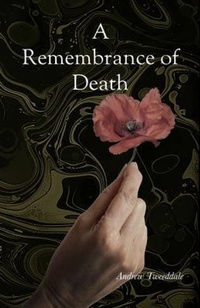
A Remembrance of Death
Description

A Remembrance of Death by Andrew Tweeddale is a poignant exploration of mortality and the human experience. The book delves into themes of loss, memory, and the interplay between life and death, inviting readers to reflect on their own relationships and experiences with grief.
Tweeddale's writing is both lyrical and thought-provoking, blending anecdotes with philosophical insights. The narrative is rich with vivid imagery and emotional depth, drawing readers into the author's contemplative journey. There is a seamless flow between different reflections, making it both accessible and engaging. It encourages readers to confront their own fears and acceptance of death, while also celebrating the beauty of life and the connections we forge with others.
A Remembrance of Death is a thought-provoking read that compels us to appreciate the fleeting nature of existence. Tweeddale's sensitivity and insight make this book a valuable resource for anyone grappling with the complexities of mortality and the memories we hold dear. Highly recommended for readers seeking a deeper understanding of life and death and the turbulence of relationships.
Spanning forty years, the story examines the relationship between Basil Drewe and Celia Lutyens, and how love like rain cannot choose the grass on which it falls. As he arrives at Oxford in 1917, Basil is coming to terms with the recent death of his brother Adrian in the Great War. Meanwhile at Ojai in America, Celia and her illegitimate son Robert struggle to find their place in a foreign country. On returning to England, Celia renews her acquaintance with Basil and finds she must deal with the mistakes of her past and the constraints placed upon her by society and its expectations. Their journey takes them to India, Vienna, London, Nuremberg and Kenya. Finally, they return to Castle Drogo, the place where they first met, however, the castle no longer represents the ideal it once did for Celia but is now a mausoleum.
Shortlisted for the Yeovil Literary Prize 2024, A Remembrance of Death is a must read novel.
All prices
More details
Other editions
Additional editions
Content
Chapter 2
While nearly every freshman would depend solely on their scout's experience in the first few weeks of university, that was not the case with Jonathan Bruton. While other freshers had to call for their scout to explain to them roll calls and chapels, Bruton seemed either to instinctively know what was needed or did not care. He knew where he should be and when. Tailors, tobacconists, and wine merchants came and set up accounts with him in the first week. He ignored most of the fresher clubs, only joining the polo club and the Oxford University Officer Training Corps. By the end of his third day at Keble, Bruton knew the names of each of the freshers in Pusey and was on nodding acquaintance with some of the less stuffy third years. As he walked into Pusey, he would shout to Scoley to arrange an innumerable number of matters, which in the first week included having flowers sent to a local girl and the booking of a room in his name at the Randolph Hotel as, he explained, his parents would be visiting from South Africa. Bruton was one of those students that Scoley would soon describe as 'most demanding, unfortunately'.
Basil first met Bruton on the last day of freshers week. As he slowly climbed down the winding stone staircase, he heard Bruton shouting for Scoley to order more wine from Loeb's.
"That wine merchant's an imbecile," Bruton shouted. "When I asked for six Bordeaux, I meant cases, not bottles."
"Good morning," said Basil.
"You must be Drewe," responded Bruton.
"Yes, Basil Drewe." Basil extended his hand.
"Jonathan Bruton," came the reply. "And before you ask, the accent is South African. I think my room is under yours, so I better apologise for the noise."
"Yes, I was going to come and have a quiet word about that," said Basil.
"Sorry, but it might also be a bit rowdy this evening, as I'm having some officers over who are billeted here. We're planning to dine together and then have a few drinks in my room. Join us and make up an eight?"
As it was a Friday and lectures were not starting until the following week, Basil agreed. "How did you know my name?"
"Scoley gave me a rundown of everyone in your corridor. Apart from you and Choudhury, I think I have met everyone, and I rather guessed by your complexion you weren't Choudhury."
"So, I'll see you at seven?"
"Seven is perfect," said Bruton, "and would you mind bringing a bottle or two? Unfortunately, I've been rather let down by Loeb's."
Basil watched as Bruton casually wandered towards the main gate and then put his head in the porter's lodge. A few seconds later he could hear the irascible porter laughing. Basil immediately warmed to the gregarious Bruton. He, on the other hand, had been there for five days and still hardly knew anyone. Basil turned and went and got his bike. He leant down and put his bicycle clips around the bottom of his suit trousers, lifted his leg over the crossbar and rang the metal bell for good measure. He pushed himself forward with his good leg and started pedalling slowly until he heard the porter shouting at him not to cycle in the quad. After dismounting, he pushed the bike slowly towards the gate, feeling that he was being watched by every underporter and scout in Keble. Outside on the street, he again mounted his bicycle. He hadn't ridden a bike for over six years since the accident with his leg but had decided to buy this from a third-year law student who took Basil's money, shook his hand firmly and completed the sale with the words "Caveat emptor".
From the college, Basil turned left and left again, heading for Jericho and then out to Port Meadow, which was the old common that stretched to the village of Wolvercote. The bicycle gave him a newfound sense of freedom that he had not felt for a long time. Someone had suggested that while at Oxford he visit Godstow Abbey and then stop at the Perch Inn for a spot of lunch and an afternoon beer. It was only three miles away and with his bicycle, it seemed possible. But after five minutes of cycling, his left leg began to ache, and he compensated by peddling harder with his right leg and letting his left leg do less.
Godstow Abbey had been built nearly eight hundred years before and was the final resting place of The Fair Rosamund, the mistress of Henry II. When he was much younger Basil had been told a story that the king had abducted Rosamund from Basil's ancestor, Drogo de Teigne. When Rosamund was poisoned, the king blamed Drogo and had him pursued across Dartmoor and chased him down with his hounds. Basil had thought the story nonsense but a distant relative of his, the rector Archibald Drew, insisted it was true. Archibald had also told him about Godstow Abbey.
"I came up to Oxford, borrowed a bicycle," Archibald said, "cycled out there and spent an afternoon searching for the grave of Rosamund. I discovered that in the sixteenth century, a German traveller had found the gravestone and written: 'Here in the tomb lies a rose of the world, not a pure rose; She who used to smell sweet, still smells - but not sweet.'" Archibald had stifled a laugh, almost embarrassed by the story that he was telling a young boy. "So," he continued, "if you decide to go to Oxford, you should take the time to visit the old abbey. It's one of the most tranquil places I know, but you must search for the grave of Rosamund. After all, your family history and hers are tied together."
Basil leant his bike up against the ruined church and sat on a broken-down wall. He rubbed his leg for a good ten minutes before deciding to slowly walk around the graveyard. He wondered whether he would be able to sense the presence of Rosamund, and then smiled to himself, realising the stupidity of that thought. After ten minutes of walking, he sensed nothing except the aching pain in his left leg and sat once again on the old dry-stone wall and looked across the churchyard for an hour or two. In this rich, green field the derelict abbey, with its roof long since fallen in, had become a part of the landscape. Grass grew out of the stone walls where the mortar had fallen out over time. Birds sat quietly on the topmost parts of the church viewing below them the fields, where, on occasion, voles and field mice might be caught. Across the fields and through a copse of trees was the river and Godstow Bridge. The sun, high in the heavens, reflected the colours of autumnal trees onto the river. A single mallard swam under the bridge and as the water parted between its paddling palmate feet, Basil got up, let out a deep sigh, mounted his bicycle and cycled back along the towpath in the direction of Oxford. He did not want silence and tranquillity; he had a life to live. It was why he had decided to come to Oxford and get away from his parents who were in perpetual mourning for his dead brother Adrian.
He would have loved to have come here at another time with Adrian and his other brother Christian. He would have loved to come before the war and the devastation that it wrought on his family and before his injury. He imagined that Adrian would have done something similar at Cambridge when he was a student, rowing up the river with friends and spending an afternoon lying on the banks, drinking champagne.
The Perch Inn was in the village of Binsey, which was on the opposite side of the river from Port Meadow. It was a traditional white plastered building with thatched roof, and once had a row of riverside aspens beside it. They had been cut down nearly forty years earlier, which had appalled the great poet, Gerald Manley Hopkins, so much that it forced him to write:
'My aspens dear, whose airy cages quelled,
Quelled or quenched in leaves the leaping sun,
All felled, felled, are all felled;
Of a fresh and following folded rank
Not spared, not one.'
Basil had been taught the poem when he was at school, but it now seemed more profound with the fallen lights of Oxford's student soldiers. Outside, in the garden of the inn, were benches and tables, where on clement days dons, masters and students alike would walk down the weed-winding bank of the river to lunch. However, the garden was almost empty. Basil placed his bicycle beside one of the empty tables and went in and ordered a glass of wine and poached salmon.
As Basil cycled along the footpath later that afternoon, he could make out, across the river, a polo match taking place. He pulled on his brake as hard as he could to stop and watched the two teams of four charging backwards and forwards between the goals. Basil knew that with the metal plates in his left leg, he would never be able to ride a horse again, and his heart ached. Of all the things that he loved, before his accident, it was horse riding that he missed the most. A battered bicycle with bad brakes was hardly any substitute.
***
"Were you watching our polo practice from across the river?" asked Bruton later that evening as the waiting staff poured coffee.
"Yes," said Basil.
"Do you ride?" asked Bruton.
"Not anymore, not since my accident."
"Tell me to mind my own business," said Bruton, who was tapped on his shoulder by the person sitting on his other side and at once passed the port to his...
