

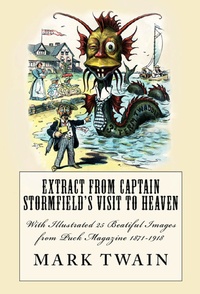
Extract from Captain Stormfield's Visit to Heaven
1st Edition
Published on 29. December 2016
44 pages
978-605-9654-97-5 (ISBN)
Description

Well, when I had been dead about thirty years I begun to get a little anxious. Mind you, had been whizzing through space all that time, like a comet. Like a comet! Why, Peters, I laid over the lot of them! Of course there warn't any of them going my way, as a steady thing, you know, because they travel in a long circle like the loop of a lasso, whereas I was pointed as straight as a dart for the Hereafter; but I happened on one every now and then that was going my way for an hour or so, and then we had a bit of a brush together.
But it was generally pretty one-sided, because I sailed by them the same as if they were standing still. An ordinary comet don't make more than about 200,000 miles a minute. Of course when I came across one of that sort-like Encke's and Halley's comets, for instance-it warn't anything but just a flash and a vanish, you see.
You couldn't rightly call it a race. It was as if the comet was a gravel-train and I was a telegraph despatch. But after I got outside of our astronomical system, I used to flush a comet occa-sionally that was something like. We haven't got any such comets-ours don't begin. One night I was swinging along at a good round gait, everything taut and trim, and the wind in my favor-I judged I was going about a million miles a minute-it might have been more, it couldn't have been less-when I flushed a most uncom-monly big one about three points off my starboard bow.
By his stern lights I judged he was bearing about northeast-and-by-north-half-east. Well, it was so near my course that I wouldn't throw away the chance; so I fell off a point, steadied my helm, and went for him. You should have heard me whiz, and seen the electric fur fly!
In about a minute and a half I was fringed out with an electrical nimbus that flamed around for miles and miles and lit up all space like broad day. The comet was burning blue in the distance, like a sickly torch, when I first sighted him, but he begun to grow bigger and bigger as I crept up on him. I slipped up on him so fast that when I had gone about 150,000,000 miles I was close enough to be swallowed up in the phosphorescent glory of his wake, and I couldn't see anything for the glare. Thinks I, it won't do to run into him, so I shunted to one side and tore along. By and by I closed up abreast of his tail. Do you know what it was like? It was like a gnat closing up on the continent of America. I forged along.
By and by I had sailed along his coast for a little upwards of a hundred and fifty million miles, and then I could see by the shape of him that I hadn't even got up to his waistband yet. Why, Peters, we don't know anything about comets, down here. If you want to see comets that are comets, you've got to go outside of our solar system-where there's room for them, you understand. My friend, I've seen comets out there that couldn't even lay down inside the orbits of our noblest comets without their tails hanging over.
But it was generally pretty one-sided, because I sailed by them the same as if they were standing still. An ordinary comet don't make more than about 200,000 miles a minute. Of course when I came across one of that sort-like Encke's and Halley's comets, for instance-it warn't anything but just a flash and a vanish, you see.
You couldn't rightly call it a race. It was as if the comet was a gravel-train and I was a telegraph despatch. But after I got outside of our astronomical system, I used to flush a comet occa-sionally that was something like. We haven't got any such comets-ours don't begin. One night I was swinging along at a good round gait, everything taut and trim, and the wind in my favor-I judged I was going about a million miles a minute-it might have been more, it couldn't have been less-when I flushed a most uncom-monly big one about three points off my starboard bow.
By his stern lights I judged he was bearing about northeast-and-by-north-half-east. Well, it was so near my course that I wouldn't throw away the chance; so I fell off a point, steadied my helm, and went for him. You should have heard me whiz, and seen the electric fur fly!
In about a minute and a half I was fringed out with an electrical nimbus that flamed around for miles and miles and lit up all space like broad day. The comet was burning blue in the distance, like a sickly torch, when I first sighted him, but he begun to grow bigger and bigger as I crept up on him. I slipped up on him so fast that when I had gone about 150,000,000 miles I was close enough to be swallowed up in the phosphorescent glory of his wake, and I couldn't see anything for the glare. Thinks I, it won't do to run into him, so I shunted to one side and tore along. By and by I closed up abreast of his tail. Do you know what it was like? It was like a gnat closing up on the continent of America. I forged along.
By and by I had sailed along his coast for a little upwards of a hundred and fifty million miles, and then I could see by the shape of him that I hadn't even got up to his waistband yet. Why, Peters, we don't know anything about comets, down here. If you want to see comets that are comets, you've got to go outside of our solar system-where there's room for them, you understand. My friend, I've seen comets out there that couldn't even lay down inside the orbits of our noblest comets without their tails hanging over.
More details
Persons
Mark Twain, born Samuel Langhorne Clemens in Florida, Missouri in 1835, grew up in Hannibal. He was a steamboat pilot on the Mississippi River. Throughout his career, Twain served as a writer, lecturer, reporter, editor, printer, and prospector. Twain took his pen name from an alert cry used on his steamboat - "by the mark, twain".
