

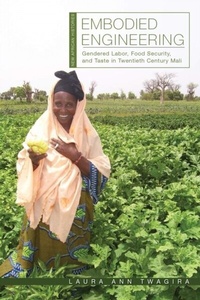
Embodied Engineering
Gendered Labor, Food Security, and Taste in Twentieth-Century Mali
1st Edition
Published on 3. August 2021
344 pages
978-0-8214-4733-8 (ISBN)
Available for download
Description

Foregrounding African women's ingenuity and labor, this pioneering case study shows how women in rural Mali have used technology to ensure food security through the colonial period, environmental crises, and postcolonial rule.
By advocating for an understanding of rural Malian women as engineers, Laura Ann Twagira rejects the persistent image of African women as subjects without technological knowledge or access and instead reveals a hidden history about gender, development, and improvisation. In so doing, she also significantly expands the scope of African science and technology studies.
Using the Office du Niger agricultural project as a case study, Twagira argues that women used modest technologies (such as a mortar and pestle or metal pots) and organized female labor to create, maintain, and reengineer a complex and highly adaptive food production system. While women often incorporated labor-saving technologies into their work routines, they did not view their own physical labor as the problem it is so often framed to be in development narratives. Rather, women's embodied techniques and knowledge were central to their ability to transform a development project centered on export production into an environmental resource that addressed local taste and consumption needs.
By advocating for an understanding of rural Malian women as engineers, Laura Ann Twagira rejects the persistent image of African women as subjects without technological knowledge or access and instead reveals a hidden history about gender, development, and improvisation. In so doing, she also significantly expands the scope of African science and technology studies.
Using the Office du Niger agricultural project as a case study, Twagira argues that women used modest technologies (such as a mortar and pestle or metal pots) and organized female labor to create, maintain, and reengineer a complex and highly adaptive food production system. While women often incorporated labor-saving technologies into their work routines, they did not view their own physical labor as the problem it is so often framed to be in development narratives. Rather, women's embodied techniques and knowledge were central to their ability to transform a development project centered on export production into an environmental resource that addressed local taste and consumption needs.
Reviews / Votes
"Through vivid stories of individual innovation and strategies of survival, Twagira offers a new perspective on twentieth-century biopolitics in Mali. Embodied Engineering adds important critical nuance to understandings of environmental crisis, cultural value, and gendered knowledge production in West Africa." - Emily S. Burrill, author of States of Marriage: Gender, Justice, and Rights in Colonial Mali "By focusing on gender ideology, food technologies, and development initiatives, Twagira encourages readers to consider the "lived material bodies" of women in twentieth-century rural Mali.... Summing up: Recommended." (Choice 59, no. 10 (June 2022)) "A fantastic contribution to multiple fields of study, both within and beyond the academy. Twagira fulfills her stated objectives, particularly that of addressing the prevalent assumptions of African women as without access to technology and static in their work. Her research shows the immense agency and importance of Malian women in their capacity to cultivate embodied relationships with the natural world through the cultivation, collection, and cooking of food." - Inigo Acosta (H-Sci-Med-Tech / H-Net Reviews) Twagira draws on a rich corpus of archival documents, but it is her impressive use of folktales, oral histories, and conversations with Office du Niger residents that allows her to challenge the highly idealized narratives of the project presented in the colonial and postcolonial bureaucratic documents. (Technology and Culture)More details
Series
Language
English
Place of publication
Athens
United States
Target group
Professional and scholarly
ISBN-13
978-0-8214-4733-8 (9780821447338)
Copyright in bibliographic data and cover images is held by Nielsen Book Services Limited or by the publishers or by their respective licensors: all rights reserved.
Schweitzer Classification
Other editions
Additional editions
Laura Ann Twagira
Embodied Engineering
Gendered Labor, Food Security, and Taste in Twentieth-Century Mali
Book
08/2021
Ohio University Press
€102.94
Article exhausted; check different version
Person
Laura Ann Twagira is an associate professor of history at Wesleyan University. She edited the "Africanizing Technology" special issue for the journal Technology and Culture and was a scholar in residence at the Schomburg Center for Research in Black Culture in New York City.
Content
List of Illustrations
Acknowledgments
A Note on Language
Abbreviations
Introduction
Chapter 1 Making the Generous Cooking Pot, ca. 1890-1920
Chapter 2 Body Politics, Taste Matters, and the Creation of the
Office du Niger, ca. 1920-44
Chapter 3 "We Farmed Money": Reshaping the Office and
Reclaiming Taste
Chapter 4 Reengineering the Office: Cooking with Metal Pots
and Threshing Machines
Chapter 5 Rice Babies and Food Aid: Reengineering Women's
Labor and Taste during the Great Sahel Drought
Conclusion
Notes
Bibliography
Index
Acknowledgments
A Note on Language
Abbreviations
Introduction
Chapter 1 Making the Generous Cooking Pot, ca. 1890-1920
Chapter 2 Body Politics, Taste Matters, and the Creation of the
Office du Niger, ca. 1920-44
Chapter 3 "We Farmed Money": Reshaping the Office and
Reclaiming Taste
Chapter 4 Reengineering the Office: Cooking with Metal Pots
and Threshing Machines
Chapter 5 Rice Babies and Food Aid: Reengineering Women's
Labor and Taste during the Great Sahel Drought
Conclusion
Notes
Bibliography
Index

