

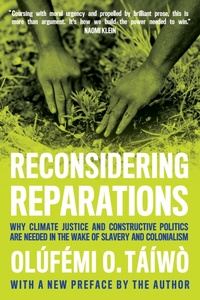
Reconsidering Reparations
Description

A pathbreaking book about world history, global justice, and the climate crisis-featuring a new preface by the author.
"Coursing with moral urgency and propelled by brilliant prose, this is more than argument. It's how we build the power needed to win."
-Naomi Klein
A clear, new case for reparations as a "constructive," future-oriented project that responds to the weight of history's injustices with the equitable distribution of benefits and burdens. Centuries ago, Táíwò explains, European powers engineered the systems through which advantages and disadvantages still flow. Colonialism and transatlantic slavery forged schemes of injustice on an unprecedented scale, a world order he calls "global racial empire." The project of justice must meet the same scope.
Táíwò's analysis not only discourages despair, it demands global resistance. Reconsidering Reparations suggests policies, goals, and organizing strategies. And it leaves readers with clear and powerful advice: act like an ancestor. Do what we can to shape the world we want our moral descendants to inherit, and have faith that they will continue the long struggle for justice. This understanding, Táíwò shows, has deep roots in the thought of Black political thinkers such as James Baldwin, Martin Luther King, Jr., Cedric Robinson, and Nkechi Taifa.
Reconsidering Reparations is a book with profound implications for our views of justice, racism, the legacies of slavery and colonialism, and climate change policy.
More details
Other editions
Additional editions
Person
Olúf¿¿mi O. Táíwò is Associate Professor of Philosophy at Georgetown University and a fellow at the Climate and Community Institute. He is the author of the critically acclaimed book Elite Capture, a contributor to Greta Thunberg's The Climate Book, and a past recipient of a Marguerite Casey Freedom Scholar fellowship. Táíwò's public philosophy, including articles exploring intersections of climate justice and colonialism, has been featured in The Guardian, The New Yorker, The New Republic, The Nation, Boston Review, Dissent, Al Jazeera, Foreign Policy, Hammer & Hope (where he is a member of the Editorial Team). His writings have been translated into Brazilian Portuguese, French, German, Italian, and Korean, among other languages.
Content
Chapter 1: Introduction
Chapter 2: Reconsidering World History
Chapter 3: The Constructive View
Chapter 4: What's Missing
Chapter 5: What's Next
Chapter 6: The Arc of the Moral Universe
Appendix A: The Malê Revolt
Appendix B: Colonialism and Climate Vulnerability
