

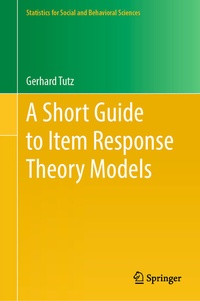
A Short Guide to Item Response Theory Models
Description

This book presents foundational concepts, essential principles, and practical applications of Item Response Theory (IRT). It provides a structured survey of diverse models that have been put forth, emphasizing both their differences and commonalities.
The main focus is on modern latent trait theory models which provide measurement tools that clearly separate between person abilities and item parameters. The topics covered include the binary Rasch model, its extensions and alternative binary models, ordinal models and their extensions that account for response styles, the thresholds model, classical test theory, response models for count data, differential item functioning, and explanatory item response models. Tree-based item response models, typically not found in classical IRT textbooks, are also addressed.
Applications of the models are illustrated on several data sets from differing areas, showing how models can be fitted and compared. All examples have been computed using R. Code snippets are provided, and the full R code for most of the examples is available online.
The book is aimed at graduate students, applied statisticians, and researchers working in psychometrics, educators, and anyone curious about modeling strategies that enhance the precision and validity of their measurement tools. It serves as an introductory guide for beginners while also providing a resource for those seeking an overview of the plethora of available IRT models.
More details
Other editions
Additional editions
Person
Gerhard Tutz is Professor Emeritus at the Department of Statistics, LMU Munich, Germany. His research interests include multivariate statistics, item response theory and categorical data analysis.
Content
Preface.- Introduction.- The Binary Rasch Model.- Extensions of the Rasch Model and Alternative Binary Models.- Ordinal Models.- Extended Ordinal Models Accounting for Response Styles.- The Thresholds Model a Common Framework for Discrete and Continuous Responses.- Classical Test Theory.- Response Models for Count Data.- Tree-Based Item Response Models.- Differential Item Functioning.- Explanatory Item Response Models.- R Packages.- Examples.- Bibliography.
