

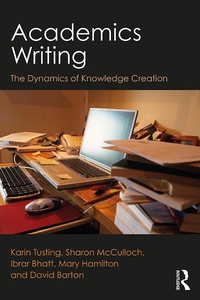
Academics Writing
The Dynamics of Knowledge Creation
1st Edition
Published on 14. March 2019
178 pages
978-0-429-58449-7 (ISBN)
Description

Academics Writing recounts how academic writing is changing in the contemporary university, transforming what it means to be an academic and how, as a society, we produce academic knowledge. Writing practices are changing as the academic profession itself is reconfigured through new forms of governance and accountability, increasing use of digital resources, and the internationalisation of higher education. Through detailed studies of writing in the daily life of academics in different disciplines and in different institutions, this book explores:
the space and time of academic writing;
tensions between disciplines and institutions around genres of writing;
the diversity of stances adopted towards the tools and technologies of writing, and towards engagement with social media; and
the importance of relationships and collaboration with others, in writing and in ongoing learning in a context of constant change.
Drawing out implications of the work for academics, university management, professional training, and policy, Academics Writing: The Dynamics of Knowledge Creation is key reading for anyone studying or researching writing, academic support, and development within education and applied linguistics.
the space and time of academic writing;
tensions between disciplines and institutions around genres of writing;
the diversity of stances adopted towards the tools and technologies of writing, and towards engagement with social media; and
the importance of relationships and collaboration with others, in writing and in ongoing learning in a context of constant change.
Drawing out implications of the work for academics, university management, professional training, and policy, Academics Writing: The Dynamics of Knowledge Creation is key reading for anyone studying or researching writing, academic support, and development within education and applied linguistics.
Reviews / Votes
"Through a detailed examination of academics' writing practices, the authors both ground and critique higher education in its present social and cultural context. This provides the springboard for their exploration of digital scholarship and its implications for academic identity work and knowledge production in an age of social media."Honorary Associate Mary Lea, The Open University, UK
More details
Edition
1. Auflage
Language
English
Place of publication
London
United Kingdom
Publishing group
Taylor & Francis Ltd
Target group
College/higher education
Illustrations
5 Halftones, black and white; 5 Illustrations, black and white
File size
4,22 MB
ISBN-13
978-0-429-58449-7 (9780429584497)
Copyright in bibliographic data and cover images is held by Nielsen Book Services Limited or by the publishers or by their respective licensors: all rights reserved.
Schweitzer Classification
Other editions
Additional editions
Book
03/2019
1st Edition
Routledge
€62.80
Shipment within 15-20 days
Book
03/2019
1st Edition
Routledge
€207.20
Shipment within 15-20 days
Persons
Karin Tusting is a senior lecturer in the Department of Linguistics and English Language at Lancaster University. Her research interests lie in workplace literacies and accountability practices, and linguistic ethnography. She has published on academics, writing practices, digital literacies, workplace literacies and audit society, and linguistic ethnography.
Sharon McCulloch is a senior lecturer in the School of Language and Global Studies at the University of Central Lancashire. Her research interests lie mainly in L2 writing and academic discourse; in particular how students engage with reading, use source material in their writing, and develop their authorial voice. She is also interested in professional academic writing practices and how institutional and social contexts affect writers.
Ibrar Bhatt is a lecturer in the School of Social Sciences, Education and Social Work at Queen's University Belfast (Northern Ireland, UK). His research and teaching interests are in the fields of applied linguistics (including TESOL), literacy studies, and educational research with new media. He is also a member of the Governing Council of the Society for Research into Higher Education (SRHE), and a convener of its "Digital University Network".
Mary Hamilton is Professor Emerita of Adult Learning and Literacy in the Department of Educational Research at Lancaster University, UK. She has a long-standing interest in informal, vernacular learning and how communicative and learning resources are built across the life span. Her current research is in literacy policy and governance, socio-material theory, academic literacies, and change.
David Barton is Professor in the Department of Linguistics at Lancaster University, England, and erstwhile Director of the Lancaster Literacy Research Centre. His most recent books, both co-authored and published by Routledge, are Language Online (2013) and Researching Language and Social Media (2014).
Sharon McCulloch is a senior lecturer in the School of Language and Global Studies at the University of Central Lancashire. Her research interests lie mainly in L2 writing and academic discourse; in particular how students engage with reading, use source material in their writing, and develop their authorial voice. She is also interested in professional academic writing practices and how institutional and social contexts affect writers.
Ibrar Bhatt is a lecturer in the School of Social Sciences, Education and Social Work at Queen's University Belfast (Northern Ireland, UK). His research and teaching interests are in the fields of applied linguistics (including TESOL), literacy studies, and educational research with new media. He is also a member of the Governing Council of the Society for Research into Higher Education (SRHE), and a convener of its "Digital University Network".
Mary Hamilton is Professor Emerita of Adult Learning and Literacy in the Department of Educational Research at Lancaster University, UK. She has a long-standing interest in informal, vernacular learning and how communicative and learning resources are built across the life span. Her current research is in literacy policy and governance, socio-material theory, academic literacies, and change.
David Barton is Professor in the Department of Linguistics at Lancaster University, England, and erstwhile Director of the Lancaster Literacy Research Centre. His most recent books, both co-authored and published by Routledge, are Language Online (2013) and Researching Language and Social Media (2014).
Content
List of illustrations
Preface
Acknowledgements
Chapter 1: Introduction and context for the study
Chapter 2: Theories and methods for studying academics writing
Chapter 3: Days in the lives of academics, writing
Chapter 4: Academics writing in space and time
Chapter 5: Disciplines, genres and writing
Chapter 6: Changing tools and technologies in academics' writing lives
Chapter 7: New social media genres: marketing the academic self
Chapter 8: Relationships and collaboration in academic writing
Chapter 9: Learning academic writing: an ongoing process
Chapter 10: The futures of writing: Conclusions and implications
References
Index
Preface
Acknowledgements
Chapter 1: Introduction and context for the study
Chapter 2: Theories and methods for studying academics writing
Chapter 3: Days in the lives of academics, writing
Chapter 4: Academics writing in space and time
Chapter 5: Disciplines, genres and writing
Chapter 6: Changing tools and technologies in academics' writing lives
Chapter 7: New social media genres: marketing the academic self
Chapter 8: Relationships and collaboration in academic writing
Chapter 9: Learning academic writing: an ongoing process
Chapter 10: The futures of writing: Conclusions and implications
References
Index
