

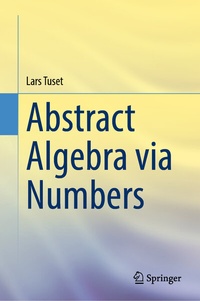
Abstract Algebra via Numbers
Description

This book is a concise, self-contained treatise on abstract algebra with an introduction to number theory, where students normally encounter rigorous mathematics for the first time. The authors build up things slowly, by explaining the importance of proofs. Number theory with its focus on prime numbers is then bridged via complex numbers and linear algebra, to the standard concepts of a course in abstract algebra, namely groups, representations, rings, and modules.
The interplay between these notions becomes evident in the various topics studied. Galois theory connects field extensions with automorphism groups. The group algebra ties group representations with modules over rings, also at the level of induced representations. Quadratic reciprocity occurs in the study of Fourier analysis over finite fields. Jordan decomposition of matrices is obtained by decomposition of modules over PID's of complex polynomials. This latter example is just one of many stunning generalizations of the fundamental theorem of arithmetic, which in its various guises penetrates abstract algebra and figures multiple times in the extensive final chapter on modules.
Reviews / Votes
"The textbook under review is a concise, self-contained treatise on abstract algebra with an introduction to number theory . . It contains nine chapters and Appendix followed by valuable introductions. ... Is easily accessible to beginning students and is given in student-oriented writing style. The exposition is clear and conversational throughout. The book presents a pathway to algebraic thinking in a semester- or year-long algebra course and is useful for undergraduate and graduated students and beginner algebra lecturers as well." (Marek Golasinski, zbMATH 1562.13001, 2025)
More details
Other editions
Additional editions
Person
Lars Tuset has been a full professor of mathematics at the Oslo Metropolitan University since 2005. He took his formal education at the Norwegian University of Science and Technology and spent several years as postdoc at University II in Rome and at University College Cork in Ireland.
He has published extensively within the areas of quantum groups, operator algebras, and noncommutative geometry and has had many international collaborators. In 2022, he published a comprehensive Springer volume on analysis and locally compact quantum groups. He wrote another monograph (with a colleague) in 2013 for the French Mathematical Society, expanding then on quantum groups and their representation categories.
Content
Chapter 1. Number theory.- Chapter 2. Construction of numbers.- Chapter 3. Linear algebra.- Chapter 4. Groups.- Chapter 5. Representations of finite groups.- Chapter 6. Rings.- Chapter 7. Field extensions.- Chapter 8. Galois theory.- Chapter 9. Modules.- Chapter 10. Appendix.
