

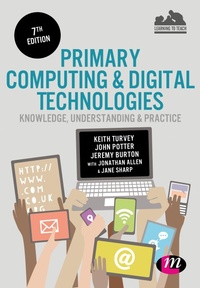
Primary Computing and Digital Technologies: Knowledge, Understanding and Practice
7th Edition
Published on 14. September 2016
328 pages
978-1-4739-9507-9 (ISBN)
Description

What do you need to know to teach computing in primary schools? How do you teach it?
This book offers practical guidance on how to teach the computing curriculum in primary schools, coupled with the subject knowledge needed to teach it.
This Seventh Edition is a guide to teaching the computing content of the new Primary National Curriculum. It includes many more case studies and practical examples to help you see what good practice in teaching computing looks like. It also explores the use of ICT in the primary classroom for teaching all curriculum subjects and for supporting learning in every day teaching. New chapters have been added on physical computing and coding and the importance of web literacy, bringing the text up-to-date.
Computing is both a subject and a powerful teaching and learning tool throughout the school curriculum and beyond into many areas of children's learning lives. This book highlights the importance of supporting children to become discerning and creative users of digital technologies as opposed to passive consumers.
This book offers practical guidance on how to teach the computing curriculum in primary schools, coupled with the subject knowledge needed to teach it.
This Seventh Edition is a guide to teaching the computing content of the new Primary National Curriculum. It includes many more case studies and practical examples to help you see what good practice in teaching computing looks like. It also explores the use of ICT in the primary classroom for teaching all curriculum subjects and for supporting learning in every day teaching. New chapters have been added on physical computing and coding and the importance of web literacy, bringing the text up-to-date.
Computing is both a subject and a powerful teaching and learning tool throughout the school curriculum and beyond into many areas of children's learning lives. This book highlights the importance of supporting children to become discerning and creative users of digital technologies as opposed to passive consumers.
More details
Series
Edition
Seventh Edition
Language
English
Place of publication
London
United Kingdom
Publishing group
Sage Publications Ltd
Target group
College/higher education
Product notice
Reflowable
File size
4,22 MB
ISBN-13
978-1-4739-9507-9 (9781473995079)
Copyright in bibliographic data and cover images is held by Nielsen Book Services Limited or by the publishers or by their respective licensors: all rights reserved.
Schweitzer Classification
Other editions
Additional editions
Keith Turvey | John Potter | Jeremy Burton
Primary Computing and Digital Technologies: Knowledge, Understanding and Practice
Knowledge, Understanding and Practice
Book
09/2016
7th Edition
Learning Matters Ltd
€68.30
Shipment within 15-20 days
Keith Turvey | John Potter | Jeremy Burton
Primary Computing and Digital Technologies: Knowledge, Understanding and Practice
Knowledge, Understanding and Practice
Book
09/2016
7th Edition
Learning Matters Ltd
€134.30
Shipment within 15-20 days
Persons
Keith Turvey is Principal Lecturer in Education at the Education Research Centre in the School of Education, University of Brighton. He teaches on a range of undergraduate and postgraduate courses, and plays a leading role in the MA Education course. As a primary school teacher of 15 years he led successfully a range of subjects, including music, ICT and mathematics, and took on a number of senior management roles both in the UK and abroad. Since joining the University of Brighton in 2003, he has researched and published widely in the fields of digital technologies, pedagogy and teacher education. He completed a PhD in 2011 focusing on teachers' professional learning and digital technologies. Keith has provided research, CPD and consultancy on digital technologies in education, and on primary computing for a number of national and international agencies including local authorities, schools, the European Commission and UNESCO.
Prof John Potter is Professor of Media in Education at University College London Institute of Education. His research, teaching and publications are in: new literacies, media education, play on and offscreen, curation and agency in social media, and the changing nature of teaching and learning in the context of digital media. He is a founder member of the DARE research centre at UCL, recently re-launched as ReMAP (Researching Media, Arts and Play) and is currently directing the ESRC funded National Observatory of Children's Play Experiences during COVID-19.
Jeremy Burton is Senior Lecturer in Computing Education in the School of Education, University of Brighton. He leads the computing subject group and teaches on both undergraduate and postgraduate courses. While working as a primary school teacher and ICT co-ordinator, Jeremy developed a passion for digital media education. A self-taught web designer and developer, he coded his school's first website in 1998 and has since worked freelance for private clients. His experience in this area, and in digital media production more broadly, has informed his teaching of ICT/computing to student teachers. Jeremy is a co-founder of NumeracyReady (a web-based tuition package that prepares candidates for the Numeracy Skills Test) and Staffrm (an online professional network for teachers).
Jonathan Allen is Strategic Lead for Teacher Education at the UCL Institute of Education. He was previously Director for Initial Teacher Education, involved across Primary, Secondary and Post-compulsory programmes, as well as in e-learning projects. Before joining the IOE Jonathan held posts responsible for Primary ICT in teacher education at University of Reading and Oxford Brookes University.
Jane Sharp is a Learning Development Tutor at Bishop Grosseteste University, working with students at all levels to develop the academic practices, skills and attributes needed for effective study at university. Her current research centres on the academic writing experiences of students studying education at university. Jane was formerly Senior Lecturer in Primary Education and ICT at the University of Winchester and a researcher at the University of Exeter involved in innovative and largescale computing projects in schools.
Prof John Potter is Professor of Media in Education at University College London Institute of Education. His research, teaching and publications are in: new literacies, media education, play on and offscreen, curation and agency in social media, and the changing nature of teaching and learning in the context of digital media. He is a founder member of the DARE research centre at UCL, recently re-launched as ReMAP (Researching Media, Arts and Play) and is currently directing the ESRC funded National Observatory of Children's Play Experiences during COVID-19.
Jeremy Burton is Senior Lecturer in Computing Education in the School of Education, University of Brighton. He leads the computing subject group and teaches on both undergraduate and postgraduate courses. While working as a primary school teacher and ICT co-ordinator, Jeremy developed a passion for digital media education. A self-taught web designer and developer, he coded his school's first website in 1998 and has since worked freelance for private clients. His experience in this area, and in digital media production more broadly, has informed his teaching of ICT/computing to student teachers. Jeremy is a co-founder of NumeracyReady (a web-based tuition package that prepares candidates for the Numeracy Skills Test) and Staffrm (an online professional network for teachers).
Jonathan Allen is Strategic Lead for Teacher Education at the UCL Institute of Education. He was previously Director for Initial Teacher Education, involved across Primary, Secondary and Post-compulsory programmes, as well as in e-learning projects. Before joining the IOE Jonathan held posts responsible for Primary ICT in teacher education at University of Reading and Oxford Brookes University.
Jane Sharp is a Learning Development Tutor at Bishop Grosseteste University, working with students at all levels to develop the academic practices, skills and attributes needed for effective study at university. Her current research centres on the academic writing experiences of students studying education at university. Jane was formerly Senior Lecturer in Primary Education and ICT at the University of Winchester and a researcher at the University of Exeter involved in innovative and largescale computing projects in schools.
Content
Organising digital technologies in your classroom
Planning for digital technologies across the curriculum
Planning to use digital technologies in the Early Years Foundation Stage
Digital display technologies
Mobile technologies
Planning for primary computing as a subject
Assessment in primary computing
Computational thinking and programming
Physical computing
Web literacy (including coding for the web)
Digital media/digital literacies
Writing with digital technologies
Social media - tools for communicating, collaborating and publishing
Graphing programs
Databases and spreadsheets
Professional use of digital technologies
Safety; online and off
Ethical and legal issues
Planning for digital technologies across the curriculum
Planning to use digital technologies in the Early Years Foundation Stage
Digital display technologies
Mobile technologies
Planning for primary computing as a subject
Assessment in primary computing
Computational thinking and programming
Physical computing
Web literacy (including coding for the web)
Digital media/digital literacies
Writing with digital technologies
Social media - tools for communicating, collaborating and publishing
Graphing programs
Databases and spreadsheets
Professional use of digital technologies
Safety; online and off
Ethical and legal issues
