

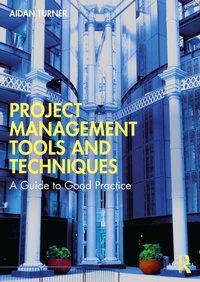
Project Management Tools and Techniques
A Guide to Good Practice
Published on 22. September 2025
222 pages
978-1-040-43430-7 (ISBN)
Description

Project Management Tools and Techniques: A Guide to Good Practice presents a unique approach to the teaching of project management by blending theory, application, and case studies. Each chapter focuses on a specific tool or technique used by the project manager in a practical and applied way. The chapters approach this by addressing the following questions:
? What does the tool or technique provide for the project?
? How is the tool/technique delivered, managed, and used?
? A case study of the tool or technique in use
? The historical context and development of the tool
This book covers core tproject management opics such as project feasibility, lifecycle, scheduling, budgets, risk, complexity, leadership, handover and much more. Together the four sections of each chapter look at the benefits of using the PM process, or 'why the process is used' followed by 'how it is delivered' and then address 'what can go wrong if it is ignored' before noting its development as a tool within Modern Project Management. Each chapter includes a discussion of how each tool has developed using examples of landmark projects throughout the world to enable the reader to bring the theoretical and practical elements together. This new textbook covers essential skills required for successful project management, allowing both students and practitioners to apply the topics discussed directly to their environment, heightening understanding of the what, how, and why of project management. This book is suitable for use on a variety of global project management courses in disciplines across engineering, built environment, and business. It is also a useful reference for newly established PMs looking for a handy toolkit.
? What does the tool or technique provide for the project?
? How is the tool/technique delivered, managed, and used?
? A case study of the tool or technique in use
? The historical context and development of the tool
This book covers core tproject management opics such as project feasibility, lifecycle, scheduling, budgets, risk, complexity, leadership, handover and much more. Together the four sections of each chapter look at the benefits of using the PM process, or 'why the process is used' followed by 'how it is delivered' and then address 'what can go wrong if it is ignored' before noting its development as a tool within Modern Project Management. Each chapter includes a discussion of how each tool has developed using examples of landmark projects throughout the world to enable the reader to bring the theoretical and practical elements together. This new textbook covers essential skills required for successful project management, allowing both students and practitioners to apply the topics discussed directly to their environment, heightening understanding of the what, how, and why of project management. This book is suitable for use on a variety of global project management courses in disciplines across engineering, built environment, and business. It is also a useful reference for newly established PMs looking for a handy toolkit.
More details
Language
English
Place of publication
London
United Kingdom
Publishing group
Taylor & Francis Ltd
Target group
College/higher education
Professional and scholarly
Illustrations
13 Tables, black and white; 114 Halftones, black and white; 114 Illustrations, black and white
File size
18,75 MB
ISBN-13
978-1-040-43430-7 (9781040434307)
Copyright in bibliographic data and cover images is held by Nielsen Book Services Limited or by the publishers or by their respective licensors: all rights reserved.
Schweitzer Classification
Other editions
Additional editions
Book
09/2025
1st Edition
Routledge
€76.30
Shipment within 10-20 days
Book
09/2025
1st Edition
Routledge
€231.60
Shipment within 10-20 days
Person
Aidan Turner, PhD, has worked within project and programme management for more than 30 years both in the banking, insurance, and estates sectors as well as within education. He ran Masters' level Project Management degrees at Cranfield University and currently leads undergraduate programmes within UWE's department of Architecture and the Built Environment, teaching on both these and on Masters' level programmes. His courses have been accredited by both the Association of Project Management and the Chartered Institute of Building.
Content
Introduction
CHAPTER 1: PROJECTS AND ORGANISATIONAL STRATEGY
CHAPTER 2: THE BUSINESS CASE & INVESTMENT APPRAISAL
CHAPTER 3: PROJECT FEASIBILITY AND SUSTAINABILITY
CHAPTER 4: THE PROJECT LIFECYCLE
CHAPTER 5: PROJECT ROLES & ORGANISATION
CHAPTER 6: PROJECT LEADERSHIP & SOFT SKILLS
CHAPTER 7: ESTIMATING
CHAPTER 8: SCHEDULING
CHAPTER 9: THE MANAGEMENT OF RISK
CHAPTER 10: THE PROJECT BUDGET AND CASHFLOW
CHAPTER 11: PROGRESS MONITORING AND CONTROL
CHAPTER 12: BENEFIT MANAGEMENT, CHANGE CONTROL, CLIENT SATISFACTION AND PROJECT SUCCESS
CHAPTER 13: BUSINESS READINESS AND PROJECT CLOSURE
CHAPTER 14: PROJECT FAILURE AND COMPLEXITY
Glossary
CHAPTER 1: PROJECTS AND ORGANISATIONAL STRATEGY
CHAPTER 2: THE BUSINESS CASE & INVESTMENT APPRAISAL
CHAPTER 3: PROJECT FEASIBILITY AND SUSTAINABILITY
CHAPTER 4: THE PROJECT LIFECYCLE
CHAPTER 5: PROJECT ROLES & ORGANISATION
CHAPTER 6: PROJECT LEADERSHIP & SOFT SKILLS
CHAPTER 7: ESTIMATING
CHAPTER 8: SCHEDULING
CHAPTER 9: THE MANAGEMENT OF RISK
CHAPTER 10: THE PROJECT BUDGET AND CASHFLOW
CHAPTER 11: PROGRESS MONITORING AND CONTROL
CHAPTER 12: BENEFIT MANAGEMENT, CHANGE CONTROL, CLIENT SATISFACTION AND PROJECT SUCCESS
CHAPTER 13: BUSINESS READINESS AND PROJECT CLOSURE
CHAPTER 14: PROJECT FAILURE AND COMPLEXITY
Glossary
