

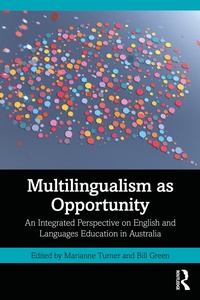
Multilingualism as Opportunity
An Integrated Perspective on English and Languages Education in Australia
Published on 22. September 2025
244 pages
978-1-040-42915-0 (ISBN)
Description

This book addresses how language is conceptualised in Australian schooling
to deliver a better understanding of how multilingualism can be incorporated
into everyday teaching and learning, practice, and policy.
By integrating different educational domains - namely, subject English,
teaching English to speakers of other languages (TESOL), Languages as a
subject area, and the learning of languages across the curriculum - the text
(re-)frames language(s) learning for all students, including first-generation
immigrants, international students, students born in Australia to immigrant
parents, Indigenous students, and students with no exposure to other languages at home. It
is distinctive in that it brings together scholars from across the L1 and L2
fields. Presenting a novel framework that addresses the positioning of both
language and opportunity across different domains at school, this book offers
a multilingual vision for all teachers. The Australian setting depicted serves as
a rich example for similar contexts worldwide.
This is an invaluable resource for students and academics in disciplines
related to language(s) and education, as well as teacher educators, school
leaders, and practitioners.
to deliver a better understanding of how multilingualism can be incorporated
into everyday teaching and learning, practice, and policy.
By integrating different educational domains - namely, subject English,
teaching English to speakers of other languages (TESOL), Languages as a
subject area, and the learning of languages across the curriculum - the text
(re-)frames language(s) learning for all students, including first-generation
immigrants, international students, students born in Australia to immigrant
parents, Indigenous students, and students with no exposure to other languages at home. It
is distinctive in that it brings together scholars from across the L1 and L2
fields. Presenting a novel framework that addresses the positioning of both
language and opportunity across different domains at school, this book offers
a multilingual vision for all teachers. The Australian setting depicted serves as
a rich example for similar contexts worldwide.
This is an invaluable resource for students and academics in disciplines
related to language(s) and education, as well as teacher educators, school
leaders, and practitioners.
Reviews / Votes
"How and why language matters in and for (Australian) education - this book's organising question - makes its publication timely and profoundly important, especially for a colonial-settler, migration-destination country such as Australia. The topics are comprehensive and essential reading for anyone interested in multilingualism and the opportunities it presents for schooling and education."Margaret Kettle, Professor, Central Queensland University, Australia
More details
Language
English
Place of publication
London
United Kingdom
Publishing group
Taylor & Francis Ltd
Target group
College/higher education
Professional and scholarly
Illustrations
3 Tables, black and white; 2 Line drawings, black and white; 10 Halftones, black and white; 12 Illustrations, black and white
File size
3,77 MB
ISBN-13
978-1-040-42915-0 (9781040429150)
Copyright in bibliographic data and cover images is held by Nielsen Book Services Limited or by the publishers or by their respective licensors: all rights reserved.
Schweitzer Classification
Other editions
Additional editions
Marianne Turner | Bill Green
Multilingualism as Opportunity
An Integrated Perspective on English and Languages Education in Australia
Book
09/2025
1st Edition
Routledge
€206.40
Shipment within 10-20 days
Marianne Turner | Bill Green
Multilingualism as Opportunity
An Integrated Perspective on English and Languages Education in Australia
Book
09/2025
1st Edition
Routledge
€67.40
Shipment within 10-20 days
Persons
Marianne Turner is an Associate Professor in the Education Faculty at Monash University. She researches multilingualism and equity in education, with a focus on situated approaches to the leveraging of students' linguistic and cultural resources in the classroom, and the integration of language(s) and content more generally.
Bill Green is Emeritus Professor of Education at Charles Sturt University, Bathurst Campus, New South Wales. He has longstanding research interests in literacy studies and curriculum inquiry, with a particular focus on English curriculum history and theory, and has published widely in these areas.
Bill Green is Emeritus Professor of Education at Charles Sturt University, Bathurst Campus, New South Wales. He has longstanding research interests in literacy studies and curriculum inquiry, with a particular focus on English curriculum history and theory, and has published widely in these areas.
Content
1. Introduction: English, Language(s), and Australian Education
Part One
2. Exploring Context and Possibility in Education Through the Understanding and Undoing of Language
3. On Language and Hospitality: A Practice-Ontological Perspective
4. English in Australia - A Multilingual Subject?
5. Home Languages are Everyone's Business
Part Two
6. Subject English, Multilingualism and Critical Cultural Studies: Relanguaging English Education in Australia towards Postcolonial Possibility
7. Teaching Literature in the Contact Zone: Knowledge, Language and Meaning-Making in Plurilingual Classrooms
8. From EAL Students to Multilingual Learners: Privileging Existing Language Knowledge in Australian Classrooms
9. Rethinking Digital Multimodal Composing by Embracing Linguistic and Cultural Diversity in the Classroom
Part Three
10. 'Teachers as Co-Learners' of Languages: Recurricularising Language and Literacy Learning as a Multilingual and Collaborative Endeavour
11. Bringing Reciprocal Multilingual Awareness to Australian Language(s) Education
12. Teaching about Honeybees: Embracing Indigenous Language, Culture, and Content through 'On Country Learning'
13. Multilingualism and Intercultural Development: Transformative Identity within Languages Curriculum
14. Conclusion: Multilingualism as Opportunity
Part One
2. Exploring Context and Possibility in Education Through the Understanding and Undoing of Language
3. On Language and Hospitality: A Practice-Ontological Perspective
4. English in Australia - A Multilingual Subject?
5. Home Languages are Everyone's Business
Part Two
6. Subject English, Multilingualism and Critical Cultural Studies: Relanguaging English Education in Australia towards Postcolonial Possibility
7. Teaching Literature in the Contact Zone: Knowledge, Language and Meaning-Making in Plurilingual Classrooms
8. From EAL Students to Multilingual Learners: Privileging Existing Language Knowledge in Australian Classrooms
9. Rethinking Digital Multimodal Composing by Embracing Linguistic and Cultural Diversity in the Classroom
Part Three
10. 'Teachers as Co-Learners' of Languages: Recurricularising Language and Literacy Learning as a Multilingual and Collaborative Endeavour
11. Bringing Reciprocal Multilingual Awareness to Australian Language(s) Education
12. Teaching about Honeybees: Embracing Indigenous Language, Culture, and Content through 'On Country Learning'
13. Multilingualism and Intercultural Development: Transformative Identity within Languages Curriculum
14. Conclusion: Multilingualism as Opportunity
