

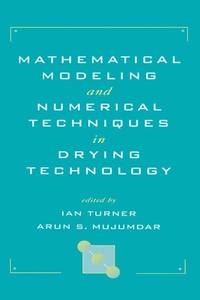
Mathematical Modeling and Numerical Techniques in Drying Technology
Published on 19. September 1996
696 pages
978-1-4822-9219-0 (ISBN)
Description

Offers information necessary for the development of mathematical models and numerical techniques to solve specific drying problems. The book addresses difficult issues involved with the drying equations of numerical analysis, including mesh generation, discretinization strategies, the nonlinear equation set and the linearized algebraic system, convergance criteria, time step control, experimental validation, optimum methods of visualization results, and more.
More details
Language
English
Place of publication
London
United Kingdom
Publishing group
Taylor & Francis Ltd
Target group
Professional and scholarly
File size
25,71 MB
ISBN-13
978-1-4822-9219-0 (9781482292190)
Copyright in bibliographic data and cover images is held by Nielsen Book Services Limited or by the publishers or by their respective licensors: all rights reserved.
Schweitzer Classification
Other editions
Additional editions
Ian Turner | Arun S. Mujumdar
Mathematical Modeling and Numerical Techniques in Drying Technology
Book
09/1996
1st Edition
CRC Press
€569.10
Shipment within 15-20 days
Persons
Content
Fundamentals: a synopsis of the strategies and efficient resolution techniques used for modelling and numerically simulating the drying process; the use of macroscopic equations to simulate heat and mass transfer in porous media; modelling and simulating simultaneous liquid and vapour transport in partially saturated porous materials. Drying wood: high- temperature kiln drying of softwood timber: the role of mathematical modelling; modelling the effect of heterogeneity on wood drying; a numerical prediction of the effect of airflow and wet bulb temperature on the stress development during convective wood drying. Drying of granular and particulate solids: modelling heat and mass transfer in coupled systems during absorption and desorption; finite element modelling of grain drying; a mathematical model for constant and intermittent batch drying of grains in a novel rotating jet spouted bed; theoretical study of heat and mass transfer during frying of granular products; modelling convective drying of granular materials application to natural rubber. Miscellaneous applications: mathematical modelling of dielectrically-enhanced drying; mathematical models for the primary and secondary drying stages of the freeze-drying of pharmaceutical on trys and in vials; a model for superheated steam drying of particles in an impinging stream dryer; mathematical modelling of kiln and on-site drying of concrete; mathematical modelling and numerical techniques for multi-cylinder paper dryers.
