

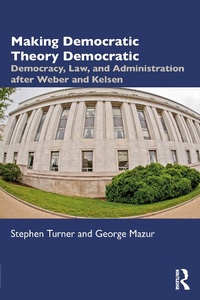
Making Democratic Theory Democratic
Description

The chapters explain the realities that administration poses for democratic theory. Topics include the political value of accountability, the antinomic character of political values, the relation between ultimate ends and the intermediate ends that are sought by constitutions, and a reconsideration of the meaning of the rule of law itself. The essays are inspired by the demystifying realism of Max Weber and Hans Kelsen, including explications of their views on law, constitutions, and the rule of law.
The book will be of interest to social and political theorists, philosophers of law, and legal theorists, and for discussions of democratic theory, the administrative state, constitutionalism, and justice, as well as to readers of Weber and Kelsen.
Reviews / Votes
"A very important contribution. The contestation over value and essence of democracy is here to stay for the foreseeable future, both domestically, notably in the West, and internationally in terms of what makes world order. The book's theme speaks to most fundamental themes in the study of politics, government, and international affairs: What is democracy? How do we defend democracy? What's the relation between law and democracy? What does rule of law really mean? Thus, it deals with topics and questions that are central to any political science curriculum."-Robert Schuett, University of Durham, UK
"Turner and Mazur's approach to the topic of democracy is original and, to my mind, persuasive; it departs insistently from theories that rest on idealized and normative notions of democracy. Instead of proceeding in this philosophical vein, the authors ground their alternative approach in political contingencies. The argument is conducted at a very high intellectual level. Connecting the authors' arguments to those of Max Weber and Hans Kelsen adds a history of ideas dimension to the book's theoretical heft."
-Peter Baehr, author of The Unmasking Style in Social Theory
More details
Other editions
Additional editions
Persons
Stephen Turner is Distinguished University Professor at the Department of Philosophy, University of South Florida, where he is also Director of the Center for Social and Political Thought. He has written extensively on issues in social and political theory, especially related to Max Weber and his critics and successors, on liberal democracy and expertise, on Durkheim, on the history of social science, and on cognitive science and tacit knowledge, complex organizations, the history and philosophy of quantification, international relations, legal theory, and normativity.
George Mazur is a scholar in international law, trained in Russia, who is presently an independent research scholar at the Newberry Library, Chicago. He has edited two memorial volumes on Morgenthau: One Hundred Year Commemoration to the Life of Hans Morgenthau (1904-2004), 2004, and Twenty-Five Year Memorial Commemoration to the Life of Hans Morgenthau (1904-2005), 2006, among other works, including (with Stephen Turner) "Morgenthau as a Weberian Methodologist," European Journal of International Relations, 2009.
Content
1. Democracy, Liberalism, and Discretion: The Political Puzzle of the Administrative State.
2. "Improving on Democracy."
3. What are Democratic Values? A Twenty-First-Century Kelsenian Approach
4. The Ideology of Anti-Populism and the Administrative State
Free Speech, Pluralism, and Toleration
5. Religious Pluralism, Toleration, and Liberal Democracy: Past, Present, and Future
6. The End of Clear Lines: Academic Freedom and Administrative Law
Fundamental Political Theory
7. The Method of Antinomies: Oakeshott and Others
8. Decisionism and Politics: Weber as Constitutional Theorist
9. The Rule of Law Deflated: Weber and Kelsen
