

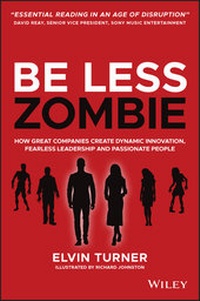
Be Less Zombie
Description

* De-risk bolder, more profitable innovation
* Make innovation a predictable and measurable capability
* Equip managers with essential tools and skills for leading innovation and transformation
* Help teams find new capacity and energy to deliver today's business whilst discovering tomorrow's
Turner's research also delves beyond the business world. He brings insights from a wide range of unexpected, expert sources including a guerrilla negotiator, a cage-fighter trainer, an X-Factor coach, a senior emergency room doctor, and a fashion designer.
His 'Turn It On' innovation framework gives leaders and managers tools, processes and pathways to make bolder and more profitable innovation an inevitability, not an anomaly.
This book is for:
* CEOs who need a better, more continuous pipeline of profitable innovation
* Senior leaders who need more ideas, collaboration and energy across their divisions
* Finance executives who want to resource innovation and yet measure it effectively
* Strategy, change and transformation managers charged with delivering greater organisational agility and differentiation
* HR executives who are trying to resource and equip leaders and employees with innovation capabilities
* Organisational development managers tasked with shaping more agile and innovative ways of working
* Team leaders who need to help their people find new capacity and energy to deliver bolder ideas
* Individual employees who want their managers to stop blocking their best ideas
Elvin Turner is an award-winning innovation advisor to global corporations, government bodies, not-for-profit organisations, and start-ups around the world. He is also an associate professor at several business schools. For more information visit www.elvinturner.com.
"A must-read for anyone - in any business sector, at any career level - who is passionate about the serious business of innovation. A practical guide to curating a culture of innovation and navigating against the headwinds of organizational status quo."
Simon Collins, Senior Vice President, Mastercard
"Most leaders struggle to get the innovation performance they need. This is the practical playbook they've been waiting for."
Andy Billings, Vice President Profitable Creativity, Electronic Arts
More details
Other editions
Additional editions

Persons
Elvin Turner is an award-winning advisor to global corporations, government bodies, not-for-profit organisations, and start-ups around the world.
Content
About the Author xv
Acknowledgements xvii
Introduction: Unicorns vs Zombies xix
Part One Innovation Strategy For Pragmatists 1
Innovation is an argument inside most companies -frail, new ideas versus the overwhelming power of the status quo. An innovation strategy helps create an environment where new ideas can emerge and thrive. It is the single-most important way to build and sustain innovation performance. And it doesn't have to be difficult.
1 The Power of Strategic Intentionality 3
2 The Do-Or-Die Issue of Innovation Performance 8
3 Money Talks 12
4 The Innovation that Customers Buy 15
5 HowMuch Innovation is Enough? 17
6 The Future is Coming Ready or Not 27
7 DetectingWeak Signals from the Future 29
8 Blurred Vision 38
9 What Does the Future Actually Mean? 41
10 The Future and Its Naysayers 47
11 Leading from the Future 49
12 Innovation Strategy: Turn It On 51
13 Quick-Start Innovation StrategyWorkshop 53
Part Two Turning on a Fast-Track Innovation Process 59
Great innovation rarely happens without a clear and effective process. This section shares the practical tools used by global innovation leaders that your team can begin using today.
14 Why Zombies Hate Innovation Process 61
15 Starting with Insight: The Innovation Particle 65
16 'Why' MattersMoreThan 'What' with Customer Insight 72
17 Working with Customer 'Progress' Insights 81
18 Framing Great Opportunities 93
19 Catalytic Questions 100
20 Hot Love 109
21 Preparing for Greatness 111
22 Running a Creative Session 122
23 How to Choose the Right Ideas 126
24 The 'Five-Day Brainstorm' 134
25 Tracking Idea Progress 137
26 Overcoming the Execution Problem 140
27 Innovation Rocket Fuel 144
28 Innovation Trapdoors 149
29 If You Only Read One Chapter... 166
30 ShowMe theMoney? 191
31 Dead on Arrival 198
32 Your Great Idea Isn't Enough 224
Part Three Building Your People's Innovation Capabilities 235
Most organisations want more innovation but few equip their people to actually deliver it. This section provides practical strategies, roadmaps and case studies to help your people out-innovate your competitors.
33 Enabling Ingenuity 237
Part Four Time,Money and Talent: How to Resource Innovation 249
Business-as-usual makes little provision for bolder innovation.This section helps you rethink how resources are managed and allocated so that the future has a greater chance of showing up.
34 Who Does It and Who Pays for It? 251
Part Five Innovation Culture for Realists 267
Culture has been defined as 'what is ordinary'. Yet most companies demand extraordinary innovation to emerge from their status quo set-ups. This section shows how to move beyond a one-size-fits-all culture to where bigger ideas can emerge and thrive on a repeatable basis.
35 Calibrating Culture to Outcome 269
36 BeMore Human 275
37 If Culture Feels tooWoolly, Switch to 'Space' 279
38 Bold Ideas aren't Born on Stage 283
39 Next-Level Creative Culture 292
40 Innovation Fight Club 309
41 Driving with the Handbrake On 317
Part Six Leading an Innovation Reformation 325
Innovation is regularly cited as a top three priority amongst leaders, yet the vast majority of their training and experience is in business-as-usual management. This section provides practical tools for leaders who need to lead their organisations to a new level of innovation performance.
42 The Innovation LeadershipMandate 327
43 Innovation Never 'Just Happens' 329
44 Mapping the Leadership Territory 332
45 To Boldly Grow 339
46 It Takes a Leader 341
47 You are a User Experience 344
48 Confronting Personal Relevance 352
49 Enduring the Bumps 356
Part Seven Turn It On, Turn It Up 359
You've read the book and are ready to start. But where do you begin? What does 'Day One' look like? This section provides some pragmatic starting points to turn on and turn up your innovation performance.
50 Turning It On 361
Index 369
INTRODUCTION: UNICORNS VS ZOMBIES
© Richard Johnston.
It was a perfect day to meet zombies.
Inside the idyllic rural campus of England's prestigious Henley Business School, 40 executives were jostling for position along a line that I had marked out on the floor:
'More unicorn' at one end, a term that's come to mean a hot, most-wanted, $1bn innovation powerhouse.
'More zombie' at the other, meaning a decaying monolith staggering into the future.
The task: Stand in the place on that spectrum that best describes your organisation.
There were a lot of self-declared zombies out that day.
But the truth is there are a lot of zombies out every day. Research shows that company lifespans are shrinking fast.1 But it's not just companies. The experience of working inside an off-kilter company can be deadly for the people inside, too. Simply being at work is now the fifth biggest killer in the United States because of the illnesses that stem from rising workplace stress.2
So what's driving this zombie advance?
Clinging to What Kills Us
Imagine standing on the edge of a chasm that is widening before your eyes. Your side of the chasm is crumbling fast. Getting to the other side is your only chance of survival. There is a rope in your hand that you could use to swing across. But fear stops you from jumping and keeps you rooted to the spot, gripping on to that rope for dear life. Meanwhile, the ground crumbles beneath your feet. The wider the chasm yawns, the riskier the swing, the greater the fear, the less likely that you'll leap.
A little Indiana Jones, maybe. But that 'holding on' instinct, that false sense of security of hanging on to what we know, sets off a chain reaction of subtle and painful demise inside many organisations: declining margins; efficiency initiatives that mean more work for fewer people; an exhausted and disengaged workforce that is continually putting out fires; sales teams who would rather lead with discounts than push the new, longer lead-time solutions; and less appetite and resourcing for innovation which is ultimately what gets us across the chasm.
Over the last 25 years I've seen variations of this scenario play out inside companies of all shapes and sizes. But I've also observed two factors that can make a huge difference to the inevitability of innovation and high performance showing up:
1. Move Some Different Needles
We get what we measure, and we measure what we value. So what are we overvaluing that opens the doors to zombieism?
In most companies, a minor business model tremor creates a standard, anxiety-driven knee-jerk response: 'Grab the cash while you can.'
'The prevailing mindset inside most boardrooms is "We love money,"' says Ben Sullivan, Managing Director of bibliotheca UK, a library technology company. 'It's too easy to say "yes" to this quarter's numbers at the expense of developing the ideas that the future needs. No-one ever frames it in such black-and-white terms, but deep down, the dopamine hit of a short-term cash injection usually feels too good to resist.'
Yet the twenty-first-century rate of change means that business model tremors are now an everyday occurrence. The short-term, cash-grabbing response is often triggered by the anxiety of having nothing in the new product pipeline. And it is anxiety's sibling, fear, that stops companies from backing the more risky ideas that the future pipelines need. It's a circular paradox resulting in companies that are literally scaring themselves to death.
Organisations need to put in place counterbalances to resist the short-term, control freakism that shuts down any appetite for innovation that ventures beyond the status quo.
'Incremental improvement guarantees obsolescence over time, especially in fast changing industries,' says Joi Ito, the former Director of the MIT Media Lab.
We need some new dials and needles in our corporate dashboards. Ones that compel us to make the decisions that our future needs us to make today; those specifically relating to better performance around innovation and change.
2. Demystify the 'How' of Innovation
'Don't tell me why, don't tell me what, just tell me how to get innovation moving in this place,' is how I was once greeted by a frustrated CEO who was smarting from a recent, failed innovation initiative.
It's the underlying narrative inside most organisations that I meet. More specifically, whilst organisations tend to want more overall innovation, their greatest need is a bigger bag of bolder ideas that could become tomorrow's cash cows. So where are they hiding?
Well, if we define culture as 'what is ordinary', we can't realistically expect many 'extraordinary' ideas to emerge and thrive from business-as-usual operations. 'Extraordinary' creates an understandably allergic reaction from the status quo. It's a life form likely to mess with our repeatable, predictable ways of working.
(An interesting anagram of Be Less Zombie is 'blob seizes me'. It's how I imagine a bold idea feels when it encounters corporate bureaucracy.)
It's not surprising that the bold ideas cupboard is pretty empty in most organisations.
Hmmm.Looks like we'll need to discount our way out of this one again, Winston.
Innovation has a reputation for being a black art, but it's really not. Yet because so few companies have designed a deliberate system for repeatable innovation, its ad hoc nature causes it to fail, or at best deliver more of the same.
After coaching hundreds of innovation projects around the world and mixed with my own research and that of other experts, I've discovered that bolder innovation becomes a more inevitable and repeatable outcome when teams and organisations focus on six areas, each of which has a simple 'turn-on' path.
Turn It On framework © Elvin Turner
Innovation Strategy Ad hoc innovators tend to be continually frustrated. A clear innovation strategy, on the other hand, galvanises the whole business behind it.
Process A clear, efficient and effective innovation process that everyone understands. Give everyone a roadmap for their ideas.
Capabilities Deliberately acquiring and developing the capabilities needed to deliver today whilst discovering and designing tomorrow.
Resourcing Dynamically allocating sufficient and appropriate resources to incremental and disruptive growth initiatives. With the right process in place, this often results in significantly reduced resource wastage in innovation.
Culture Calibrating the culture and climate to the innovation outcome, rather than one-blob-fits-all. Incremental ideas are generally tweaks, working with relatively well-known cause and effect dynamics. It's predictable and feels safe, so metrics around certainty of outcome are appropriate. Bold ideas, on the other hand, have high failure rates, so they need a context which gives them a higher chance of making it out of the building alive than status quo operations usually afford.
Leadership Equipping and incentivising senior managers to orchestrate appropriate levels of innovation and entrepreneurship.
When these six elements combine to become a deliberate innovation system, companies give themselves the greatest possible chance of thriving today and showing up in the future.
Turn it on, then turn it up My aim with this book is to help you succeed where most companies fail: to turn on innovation and to keep it turned on with proven tools that you can tailor for your context. Establish foundations, get some quick wins, build confidence.and then turn up the scale and sophistication as and when you need them.
What's more, every organisation is unique. Whilst the tools I'm sharing are universally applicable, beyond a certain point in your journey towards greater innovation performance, only you can know what's right for your specific context. This book helps you turn on innovation, but beyond a certain point only you can turn it up.
What works for Apple is unlikely to work in exactly the same way for you. Discovering and developing your unique innovation DNA is a pathway towards competitive advantage that few companies deliberately pursue.
Not for Geeks Finally, this is not a book for innovation geeks. It's for everyday business people who need practical tools, ideas, workshop formats and coaching tips to turn on innovation. So I've deliberately written this in short, sharp chapters with practical advice that you can try out immediately. (Sorry fellow geeks, not much innovation jargon in here - I hope.)
This book is based on what I've learned from companies that are recalibrating themselves to pursue sustainable, profitable relevance.
They are creating healthier organisations, happier people and more hopeful futures.
They are being less...
