

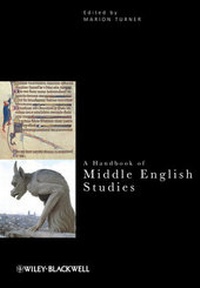
A Handbook of Middle English Studies
Description

Reviews / Votes
"This sharp-minded, coherent set of essays both maps andliberates: not only does it map the intellectual territory ofcontemporary cultural debate; it also liberates the extraordinarytexts of later medieval England to move across that contemporarycultural terrain."--James Simpson, HarvardUniversity "Marion Turner has skilfully choreographed an excitingensemble of fresh accounts of the English middle ages. We see theperiod in a new light that shows with compassion and imagination,as well as thoughtful scholarship, how the literature of the pastspeaks to contemporary preoccupations."--ArdisButterfield, Yale Unviersity "Strikingly original: theory-literate andmaterially-grounded ways of reading Middle Englishtexts."--David Wallace, University ofPennyslvaniaMore details
Other editions
Additional editions
Person
Content
Chapter 1
Imagination
Aranye Fradenburg
Imagynacion is a might thorow the whiche we portray alle ymages of absent and present thinges.
The Cloud of Unknowing
Two things cannot be rightly put together without a third; there must be some bond of union between them.
Plato, Timaeus
According to conventional wisdom, medieval understandings of the imagination lack imagination by comparison with Hamlet's “king of infinite space” and the Romantic sublime. It would take centuries, so the old story goes, for Coleridge's Biographia Literaria to elevate the imagination to the status of “the living Power and prime agent of all human perception.”1 But this narrative has problems. The dependence of thought on perception and imagination was axiomatic for premodern writers: the mind retained sense impressions in the form of images that could be further abstracted into concepts and propositions.2 Experiences and things did not enter the mind directly; “but the images of the perceived objects are available to the thought recalling them” (Augustine, Confessions, X.viii (13)). But while the insubstantiality of images was often lamented, it was by no means simply lamentable. It gave images their plasticity. The imagination had “thirdness”; it formed links between different kinds of mental phenomena.3 Without this plasticity the mind could not learn, hope, decide, and plan; it could not anticipate a future time. Augustine thought it marvelous: “I [can] combine with past events images of various things, whether experienced directly or believed on the basis of what I have experienced; and on this basis I reason about future actions and events and hopes, and again think of all these things in the present” (X.viii (14)). Not only did the imagination play a significant role in the process of thought; it was a sine qua non of our ontology, especially the qualities and dimensions of our sentience. It had a crucial role to play in our salvation and God's providential order.
Nicolette Zeeman describes Langland's allegorical character Ymaginatyf as a “capacious inner sense,” “a distinctive inclusiveness, with…inbuilt, etymological allusions to images, imaginative functions, and ‘seeing,’ as well as to hypothetical and speculative forms of cogitation” (84).4 The generosity of this conception does not lag much behind Coleridge's “living Power and prime agent.” True, Coleridge's further specification of the secondary imagination as “a repetition in the finite mind of the eternal act of creation in the infinite I AM” would have sounded a bit heterodox to premodern ears; and Piers Plowman is chiefly about psychological travail and the threat posed to salvation by the limitations of human understanding—a concern regarded by some scholars as consistent with the distressed fourteenth century's interest in negative theology and accompanying critiques of knowledge (Utz 129–130). Capacious though Ymaginatyf may be, Langland's poem is full of false starts and frustration. The Romantic imagination suffers little from frustration; however tiny the human figure standing on the verge of the abyss, its mind contains the very thing (the “eternal act of creation”) that seems to outstrip it. Arguably, the medieval imagination only translates “ineffable and therefore unknown forms of sentience” into truth tolerable by the human mind (S. Langer 39); it transmits divinity, rather than secreting it. But the notion of composition as re-creation of Creation was known to the Middle Ages; “high medieval authors…sometimes…stylize[d] themselves as werltgot (i.e., Lord of the fictional world created by them)” (Utz 131). Exceptionalist understandings of the imagination have a very long, if erratic, history. But even humbler notions of the imagination gave it reach; the medieval imagination mediated between different kinds of minds, powers, and worlds, between the past and the present, here and there. If not divine creativity, it was divine connectivity, responsible for extraordinary states of mind. How could we know God without solitary contemplation of the “ymages of…absent thinges”?
Humanist and new-critical histories of art commonly assign the values of preservation, craftsmanship, and communal experience to the Middle Ages, and creativity, inspiration and individual experience to the Renaissance or the nineteenth century. Ullrich Langer, for example, argues that medieval poets “celebrated the survival of human culture, not its original reinvention by an individual” (22; Utz 129). It is true that medieval poets often saw themselves as “makars” (makers), but no one doubted that prophetic dreams and visions were mediated by the imagination. And the cosmological deterritorializations of Bernardus Silvestris or Dante Alighieri, the summa-style expansiveness of the Roman de la Rose, the historical sweep of Laamon's Brut, are hardly modest efforts. Translatio did not simply preserve the past; it made it new again. But the point of this essay is not to reverse the charges on presentism's timor mortis. It is to explore the interdependence of individual and community, and the consequences thereof for our understanding of the richness and complexity of medieval understandings of the imagination.
There are, of course, different cultural and historical articulations of this interdependence, and we ought to attend to them. But we should also take care not to overstate the salience of these differences, or neglect common elements. Tradition grows, and creativity emerges, from networks constituted by intersecting histories. The “I,” like its mutually constitutive webs of relationships, is a unique combination of genetic potentialities, traditions, and experiences, many of which are also parts of other such combinations. The psychoanalytic term “intersubjectivity” designates this paradoxical dependence of subjective experience on relationality. The theory of “mentalization” also builds on the idea that we come to understand our “own” minds only by interacting with the minds of others (Fonagy et al.). Subjectivity is a process that occurs when relationships beckon to, and thereby help to design, the minds of those linked thereby. The social bond, that is to say, depends on feelings of understanding and being understood. Relationality is not groupthink; it enables self-process. However much they may have longed to soar like skylarks and wander lonely as clouds, Romantic writers always had to grapple with the embeddedness of imaginative activity in relationships, with family, friends, lovers, books, “nature” (Carlson). Indeed, in Frankenstein, the temptations of aloneness lead to disaster. Contemporary neuroscience, moreover, confirms the importance of relationality to imaginative process. Nancy Andreasen, for example, argues that “genius” emerges within and from the very communities whose patient labors and inside-the-box innovations might seem incapable of predicting it.
William Dunbar's “Lament for the Makars” is both an ambitious poetic genealogy and a melancholy catalog of memory-images of dead or dying predecessors, to which “facultie” he is linked by fear: “timor mortis conturbat me,” “the fear of death confounds me.” Death has taken all his “brethren”; and since he is himself a maker, “On forse I man [Death's] nyxt pray be” (l. 95). Does Dunbar present himself as the therapon, the companion/survivor who addresses us when we are in the state “in which there is no other to respond” but him? In the end, only the therapon's loyalty matters; since he will not run away from us, or put us away, or leave us for dead, only his interlocution can restore our “freedom of speech” (Davoine and Gaudillière 209–210). But perhaps Dunbar is not the therapon but the subject maddened by fear, who has no others left to respond to him. Or perhaps we can't distinguish the one from the other. This is intersubjectivity in the form of identification: “He has tane Roull of Aberdene,/ And gentill Roull of Corstorphin/ Two bettir fallowis did no man se” (ll. 77–79). Dunbar already knew what Freud would later argue, that we learn of our own death only through the death of the other, that such knowledge as we have of the solitary experience of dying is ironically relational. If Dunbar's catalog is a humble medieval registration of creaturely vulnerability, it is also, gravely, singularizing: the commonness of death does not make it any less traumatic; it is when we feel the hand that has touched so many other shoulders touch our own that we are at once singled out, and subject(ed) to the law of nature.
The imagination's role in processing the transformations necessary to life and death is repeatedly foregrounded in medieval narrative, certainly as important a “source” for medieval conceptions of the imagination as are treatises on the soul or on dreams (Kolve). The dream-vision genre in particular—a long-attested form, but explosively popular in the fourteenth century—has...
