

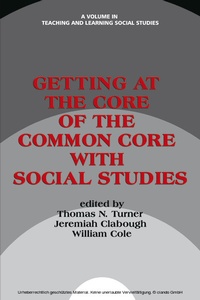
Getting at the Core of the Common Core with Social Studies
1st Edition
Published on 14. November 2014
308 pages
978-1-62396-876-2 (ISBN)
Description

For social studies teachers reeling from the buffeting of top-down educational reforms, this volume offers answers to questions about dealing with the Common Core State Standards (CCSS). Each chapter presents and reviews pertinent standards that relate to the social studies. Each chapter also deals with significant topics in the social studies from various social sciences to processes such as inquiry to key skills needed for success in social studies such as analysis and literacy.
The most important aspect of these chapters though is the array of adaptable activities that is included in each chapter. Teachers can find practical approaches to dealing with CCSS across the social studies panorama. The multiple authorships of the various chapters mean a variety of perspectives and viewpoints are presented. All of the authors have fought in the trenches of K-12 public education. Their activities reflect this in a way that will be useful to novice or veteran teachers.
The most important aspect of these chapters though is the array of adaptable activities that is included in each chapter. Teachers can find practical approaches to dealing with CCSS across the social studies panorama. The multiple authorships of the various chapters mean a variety of perspectives and viewpoints are presented. All of the authors have fought in the trenches of K-12 public education. Their activities reflect this in a way that will be useful to novice or veteran teachers.
All prices
More details
Series
Language
English
Place of publication
Greenwich
United States
Publishing group
Emerald Publishing Inc
Target group
Professional and scholarly
File size
5,64 MB
ISBN-13
978-1-62396-876-2 (9781623968762)
Copyright in bibliographic data and cover images is held by Nielsen Book Services Limited or by the publishers or by their respective licensors: all rights reserved.
Schweitzer Classification
Other editions
Additional editions
Thomas N. Turner | Jeremiah C. Clabough | William Cole
Getting at the Core of the Common Core with Social Studies
Book
11/2014
Information Age Publishing
€70.80
Shipment within 3-4 weeks
Content
Introduction, Jeremiah Clabough, Thomas N. Turner, and William Cole.
Chapter 1. How Did We Get Here? Common Core and the History of Standards in Social Studies Education, Joshua L. Kenna and William Benedict Russell III.
Chapter 2. What is Inquiry?: Giving the Hippopotamus Wings, Thomas N. Turner and Jeremiah Clabough.
Chapter 3. Getting to the Core of the Problem: Decision-Making Activities and Common Core State Standards, William G. Cole.
Chapter 4. Historical Thinking: Cultivating a Rich Garden of Autonomous Thinkers, Jennifer Summerlin.
Chapter 5. Building Global Citizens Through the Common Core, Dorothy E. Blanks.
Chapter 6. The Common Core State Standards: Implications for Students With Learning Disabilities, Tara Bezait and Timothy Lintner.
Chapter 7. Exploring Social Studies Through Digital Literacy, Debra Coffey.
Chapter 8. Linking Literacy and Social Studies Through Picture Books in K-12 Settings, Amy D. Broemmel, Seth Rayman, and Shannon A. Hancock.
Chapter 9. Historical Fiction: Reality Meets Imagination, Sarah Philpott.
Chapter 10. Disciplinary Literacy: Teaching Students to Read as Historians, Todd Cherner, Adam Kelley, and Mikel Norris.
Chapter 11. Drama in the Social Studies and Common Core: First the Apple, Then the Core, Thomas N. Turner.
Chapter 12. Climbing the Common Core Beanstalk With Primary Sources, Jeremiah Clabough.
Chapter 13. Seeing Is Believing: Visual Primary Sources Make Wide-Eyed Learners, Alicia Laffoon and Penny Boyd.
Chapter 14. "My Life Was Hard and I Had No Money in My Pocket": Doing Historical Research With Oral History, Gail Hickey.
Chapter 15. Get Cooking With Multimedia Social Studies and the Common Core, Lance McConkey.
Chapter 16. Connecting the Economic Way of Thinking to the Common Core, Ashley S. Harrison, J. R. Clark, and Mark C. Schug.
Chapter 17. Teaching Geography Education Within a Common Core Framework, Kenneth T. Carano.
Chapter 18. Citizenship Education: The Common Core Meets the Common Good, Jeremiah Clabough and Thomas N. Turner.
About the Authors.
Chapter 1. How Did We Get Here? Common Core and the History of Standards in Social Studies Education, Joshua L. Kenna and William Benedict Russell III.
Chapter 2. What is Inquiry?: Giving the Hippopotamus Wings, Thomas N. Turner and Jeremiah Clabough.
Chapter 3. Getting to the Core of the Problem: Decision-Making Activities and Common Core State Standards, William G. Cole.
Chapter 4. Historical Thinking: Cultivating a Rich Garden of Autonomous Thinkers, Jennifer Summerlin.
Chapter 5. Building Global Citizens Through the Common Core, Dorothy E. Blanks.
Chapter 6. The Common Core State Standards: Implications for Students With Learning Disabilities, Tara Bezait and Timothy Lintner.
Chapter 7. Exploring Social Studies Through Digital Literacy, Debra Coffey.
Chapter 8. Linking Literacy and Social Studies Through Picture Books in K-12 Settings, Amy D. Broemmel, Seth Rayman, and Shannon A. Hancock.
Chapter 9. Historical Fiction: Reality Meets Imagination, Sarah Philpott.
Chapter 10. Disciplinary Literacy: Teaching Students to Read as Historians, Todd Cherner, Adam Kelley, and Mikel Norris.
Chapter 11. Drama in the Social Studies and Common Core: First the Apple, Then the Core, Thomas N. Turner.
Chapter 12. Climbing the Common Core Beanstalk With Primary Sources, Jeremiah Clabough.
Chapter 13. Seeing Is Believing: Visual Primary Sources Make Wide-Eyed Learners, Alicia Laffoon and Penny Boyd.
Chapter 14. "My Life Was Hard and I Had No Money in My Pocket": Doing Historical Research With Oral History, Gail Hickey.
Chapter 15. Get Cooking With Multimedia Social Studies and the Common Core, Lance McConkey.
Chapter 16. Connecting the Economic Way of Thinking to the Common Core, Ashley S. Harrison, J. R. Clark, and Mark C. Schug.
Chapter 17. Teaching Geography Education Within a Common Core Framework, Kenneth T. Carano.
Chapter 18. Citizenship Education: The Common Core Meets the Common Good, Jeremiah Clabough and Thomas N. Turner.
About the Authors.

