

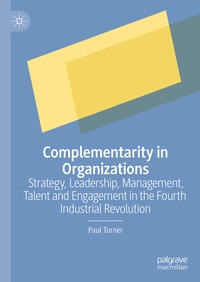
Complementarity in Organizations
Description

The Fourth Industrial Revolution will fundamentally alter the way we live, work, and relate to one another. Robotics, AI, neuro-technologies and autonomous vehicles will alter behaviours, relationships, and meaning. In this context, an important question that organizations must ask themselves is how can they adapt their business models and values to compete successfully?
In answering this question, this book applies the concept of complementarity to business areas that are often dealt with independently: strategy, leadership, management, talent and engagement. Organizational success will not only be achieved by singularity but also by organization wide interventions that connect each of the functions to a broader purpose. The author argues that whilst the factors of an organisation will continue to affect each other in one of three ways: independent, substitutive, and complementary, it will be towards the latter that a greater level of importance isattached. The book describes how complementarity has arisen in non- business fields and how an interpretation of it might be a useful paradigm for the modern business organisation. Finally, the book explores organisational and individual competences and how they might be applied in the complementarity model.
More details
Other editions
Additional editions
Person
Paul Turner has held Professorial appointments at Universities in Leeds, Birmingham, Nottingham and Cambridge. His business career included Executive and Director positions in FTSE and Fortune companies, and he was Vice President of the CIPD. He was Chair of Human Asset, People Innovation and the European Talent for Tomorrow Conferences as well as being a judge on the Middle East HR, European HR Excellence and the CIPD People Management Awards. Paul is the author or co- author of many books, including Employee Engagement in Contemporary Organizations (2020), Leadership in Healthcare (2018),and Talent Management in Healthcare (2017), all published by Palgrave Macmillan.
Content
Chapter 1 From Singularity to Complementarity.- Chapter 2 The Fourth Industrial Revolution.- Chapter 3 The Origins of Complementarity.- Chapter 4 Complementarity and Business Strategy.- Chapter 5 Complementarity in Leadership and Management.- Chapter 6 Complementarity in talent and workforce engagement.- Chapter 7 Complementarity in organisation.- Chapter 8 Complementarity and Competence-knowledge, Skills, Attitudes, and Behaviours.- Chapter 9 Complementarity in business organisations- 20 important conclusions.
