
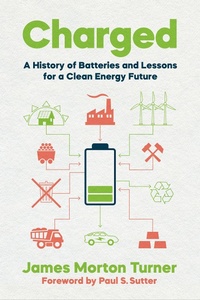
Charged
Description
Alles über E-Books | Antworten auf Fragen rund um E-Books, Kopierschutz und Dateiformate finden Sie in unserem Info- & Hilfebereich.
Winner of the 24th Annual Susanne M. Glasscock Humanities Book Prize
Finalist for the 2023 Cundill History Prize
Gold Medal Recipient, Nautilus Book Awards, Sustainability
The dirty work essential to a clean energy transition
To achieve fossil fuel independence, few technologies are more important than batteries. Used for powering zero-emission vehicles, storing electricity from solar panels and wind turbines, and revitalizing the electric grid, batteries are essential to scaling up the renewable energy resources that help address global warming. But given the unique environmental impact of batteries?including mining, disposal, and more?does a clean energy transition risk trading one set of problems for another?
In Charged, James Morton Turner unpacks the history of batteries to explore why solving "the battery problem" is critical to a clean energy transition. As climate activists focus on what a clean energy future will create?sustainability, resiliency, and climate justice?the history of batteries offers a sharp reminder of what building that future will consume: lithium, graphite, nickel, and other specialized materials. With new insight on the consequences for people and communities on the front lines, Turner draws on the past for crucial lessons that will help us build a just and clean energy future, from the ground up.
All prices
More details
Other editions
Additional editions
Person
James Morton Turner is professor of environmental studies at Wellesley College. He is author of The Promise of Wilderness: American Environmental Politics since 1964 and coauthor of The Republican Reversal: Conservatives and the Environment from Nixon to Trump.
Content
- Cover
- Title
- Copyright
- Contents
- Foreword: What's the Matter with Batteries, by Paul S. Sutter
- Acknowledgments
- Introduction: Batteries Included
- ONE: Lead-Acid Batteries and a Culture of Mobility
- TWO: AA Batteries and a Throwaway Culture
- THREE: Lithium-Ion Batteries, the Smartphone, and a Wireless Revolution
- FOUR: Electric Cars, Tesla, and a Zero-Emissions Future
- Conclusion: Building a Clean Energy Future from the Ground Up
- Notes
- Bibliography
- Index

System requirements
File format: ePUB
Copy protection: Adobe-DRM (Digital Rights Management)
System requirements:
- Computer (Windows; MacOS X; Linux): Install the free reader Adobe Digital Editions prior to download (see eBook Help).
- Tablet/smartphone (Android; iOS): Install the free app Adobe Digital Editions or the app PocketBook before downloading (see eBook Help).
- E-reader: Bookeen, Kobo, Pocketbook, Sony, Tolino and many more (not Kindle).
The file format ePub works well for novels and non-fiction books – i.e., „flowing” text without complex layout. On an e-reader or smartphone, line and page breaks automatically adjust to fit the small displays.
This eBook uses Adobe-DRM, a „hard” copy protection. If the necessary requirements are not met, unfortunately you will not be able to open the eBook. You will therefore need to prepare your reading hardware before downloading.
Please note: We strongly recommend that you authorise using your personal Adobe ID after installation of any reading software.
For more information, see our ebook Help page.
File format: PDF
Copy-Protection: Adobe-DRM (Digital Rights Management)
System requirements:
- Computer (Windows; MacOS X; Linux): Install the free reader Adobe Digital Editions prior to download (see eBook Help).
- Tablet/smartphone (Android; iOS): Install the free app Adobe Digital Editions or the app PocketBook before downloading (see eBook Help).
- E-reader: Bookeen, Kobo, Pocketbook, Sony, Tolino and many more (only limited: Kindle).
The file format PDF always displays a book page identically on any hardware. This makes PDF suitable for complex layouts such as those used in textbooks and reference books (images, tables, columns, footnotes). Unfortunately, on the small screens of e-readers or smartphones, PDFs are rather annoying, requiring too much scrolling.
This eBook uses Adobe-DRM, a „hard” copy protection. If the necessary requirements are not met, unfortunately you will not be able to open the eBook. You will therefore need to prepare your reading hardware before downloading.
Please note: We strongly recommend that you authorise using your personal Adobe ID after installation of any reading software.
For more information, see our eBook Help page.
File format: ePUB
Copy protection: without DRM (Digital Rights Management)
System requirements:
- Computer (Windows; MacOS X; Linux): Use a reader that can handle the file format ePUB, such as Adobe Digital Editions or FBReader – both free (see eBook Help).
- Tablet/Smartphone (Android; iOS): Install the free app Adobe Digital Editions or the app PocketBook (see eBook Help).
- E-reader: Bookeen, Kobo, Pocketbook, Sony, Tolino and many more (not Kindle).
The file format ePUB works well for novels and non-fiction books – i.e., 'flowing' text without complex layout. On an e-reader or smartphone, line and page breaks automatically adjust to fit the small displays.
This eBook does not use copy protection or Digital Rights Management
For more information, see our eBook Help page.
