

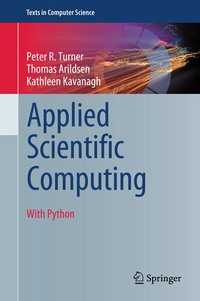
Applied Scientific Computing
Description

This easy-to-understand textbook presents a modern approach to learning numerical methods (or scientific computing), with a unique focus on the modeling and applications of the mathematical content. Emphasis is placed on the need for, and methods of, scientific computing for a range of different types of problems, supplying the evidence and justification to motivate the reader. Practical guidance on coding the methods is also provided, through simple-to-follow examples using Python.
Topics and features: provides an accessible and applications-oriented approach, supported by working Python code for many of the methods; encourages both problem- and project-based learning through extensive examples, exercises, and projects drawn from practical applications; introduces the main concepts in modeling, python programming, number representation, and errors; explains the essential details of numerical calculus, linear, and nonlinear equations, including the multivariable Newton method; discusses interpolation and the numerical solution of differential equations, covering polynomial interpolation, splines, and the Euler, Runge-Kutta, and shooting methods; presents largely self-contained chapters, arranged in a logical order suitable for an introductory course on scientific computing.Undergraduate students embarking on a first course on numerical methods or scientific computing will find this textbook to be an invaluable guide to the field, and to the application of these methods across such varied disciplines as computer science, engineering, mathematics, economics, the physical sciences, and social science.
Reviews / Votes
"This book is a valuable contribution, easily readable, in the field of computation of linear and nonlinear systems using Python. . The book will be very useful to a vast number of readers in various fields." (Nirode C. Mohanty, zbMATH 1411.65004, 2019)
More details
Other editions
Additional editions
Persons
Dr. Peter R. Turner
is the Founding Director of the Institute for STEM Education at Clarkson University, Potsdam, NY USA.
Dr. Thomas Arildsen is an Associate Professor in the Department of Electronic Systems at Aalborg University, Denmark.
Dr. Kathleen Kavanagh is a Professor in the Department of Mathematics at Clarkson University.
Content
Motivation and Background.- Number Representations and Errors.- Numerical Calculus.- Linear Equations.- Iterative Solution of Nonlinear Equations.- Interpolation.- Differential Equations.
