

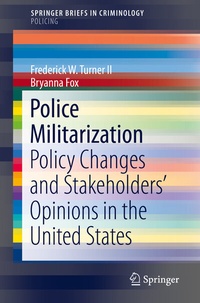
Police Militarization
Description

This Brief examines the "militarization" of law enforcement in the United States through the lens of the stakeholders primarily responsible for implementing, funding, and enacting the practice. Largely a result of policies such as the war on drugs, war on terror, and the 1033 program, there has been a gradual but dramatic rise in the use of military-grade weapons, equipment, and tactics used by police agencies across the United States. This Brief examines the level of support for various aspects of police militarization by lawmakers, police executives, and local police officers, and how their opinions may differ based upon their current position or demographic features using a series of analyses and propensity score matching techniques.
This Brief also provides an overview of some of the key policy changes responsible for police militarization, and provides insights into the views held by policymakers and law enforcement on various aspects of the practice. The results indicate that while many responsible for this shift are in favor of paramilitary procurement programs, there are differing opinions on key issues such as oversight and use of military-grade weapons, equipment and paramilitary tactics.
This work will be of interest to researchers in criminology and criminal justice, particularly those with an interest in policing studies, as well as related fields such as public policy, public administration, emergency management, and sociology.
More details
Other editions
Additional editions
Persons
Dr. Bryanna Fox is an Assistant Professor in the Department of Criminology and Courtesy Professor in the Department of Mental Health, Law, and Policy at the University of South Florida. Dr. Fox earned her Ph.D. in psychological criminology from the University of Cambridge in England. She is a former FBI Special Agent, former research consultant for the FBI's Field Investigation Group in Tampa, and former research fellow in the FBI's Behavioral Science Unit (BSU) in Quantico, Virginia. Her main research interests relate to the identification of psychological and developmental risk factors for criminal behavior, developing evidence-based tools for law enforcement, and conducting experimental field research.
Content
An Introduction to Police Militarization.- Blurring the Lines Between Policing and Militarization.- Public Perceptions and Support for Police Militarization.- Data Collection on Support for Police Militarization Among a Sample of Police Officers, Police Executives, and Members of the United States Congress.- Testing the Level of Support for Police Militarization in a Sample of Police Officers, Police Executives, and Members of the United States Congress.- Testing the Moderating Effects of Demographic Traits on Support for Police Militarization in a Sample of Police Officers, Police Executives, and Members of the United States Congress.- Conclusions on Support for Police Militarization by Police Officers, Police Executives, and Members of the United States Congress.
