

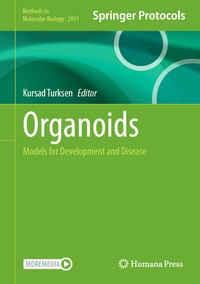
Organoids
Description

This volume explores the generation and characterization of organoids from different tissues, as these structures allow us to investigate questions about cell commitment and differentiation. Whether pursuing cell development or the genesis or treatment of diseases, organoid research, through the methods and techniques in this collection, aims to provide scientists with a way to regenerate different tissues or organs in their original form and function. Written for the highly successful Methods in Molecular Biology series, chapters include introductions to their respective topics, lists of the necessary materials and reagents, step-by-step and readily reproducible laboratory protocols, and tips on troubleshooting and avoiding known pitfalls.
Authoritative and practical, Organoids: Models for Development and Disease serves as an ideal guide for researchers investigating this vital area of study.
More details
Other editions
Additional editions
Person
Content
Microfluidic Chip Fabrication for Tumor Cell 3D Culture Based on Microwell Arrays.- A Simplified and Robust Immunofluorescence Labeling Method for Complex 3D Cell Cultures: Minimizing Manipulation and Maximizing Data in Whole-Mount Analysis of Organoids, Spheroids and Co-Culture Models.- A Co-Culture System for Modeling Intestinal Epithelial-Fibroblast Crosstalk.- Paraffin Embedding and Histological Staining of Intestinal Organoids.- Organoid Culture of Different Intestinal Segments from Human and Mouse.- Expansion and Maturation of Innate Lymphoid Cell Precursors Using Human iPSC-Derived Intestinal Organoids.- Mouse Small Intestinal Organoid Cultures.- Establishing Neural Organoid Cultures for Investigating the Effects of Microgravity in Low-Earth Orbit (LEO).- Production of Neuroepithelial Organoids from Human Induced Pluripotent Stem Cells for Mimicking Early Neural Tube Development.- Methods for Generating Self-Organizing Human Patterned Heart Organoids Using Pluripotent Stem Cells.- Generating Neuroimmune Assembloids Using Human Induced Pluripotent Stem Cell (iPSC)-Derived Cortical Organoids and Microglia.- Generation of Retinal Organoids Using Human Induced Pluripotent Stem Cells.- Transplantation of Islet Organoids into Brown Adipose Tissue in a Diabetic Mouse Model.- Spontaneous Efficient Differentiation of Human Pluripotent Stem Cells (hPSC) upon Co-Culture of hPSCs with Human Neonatal Foreskin Fibroblasts in 3D.- Neuromuscular Organoids to Study Spinal Cord Development and Disease.- A Robust Human Liver Organoid Model of Hepatitis B Virus Infection.- Establishment of Patient-Derived Organoids from Colorectal Cancer Resection Samples.- Complex Spheroids as an Alternative: In Vivo-Like 3D Model for Investigating the Impact of Stromal Cells on the Radiation Response of Tumors.- 3D Cell Culture Models as a Platform for Studying Tumor Progression, Testing Treatment Responses, and Discovering Biomarkers.
