

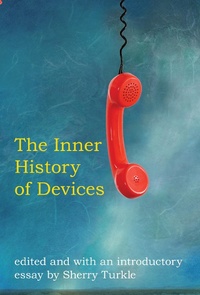
The Inner History of Devices
Description

For more than two decades, in such landmark studies as The Second Self and Life on the Screen, Sherry Turkle has challenged our collective imagination with her insights about how technology enters our private worlds. In The Inner History of Devices, she describes her process, an approach that reveals how what we make is woven into our ways of seeing ourselves. She brings together three traditions of listening—that of the memoirist, the clinician, and the ethnographer. Each informs the others to compose an inner history of devices. We read about objects ranging from cell phones and video poker to prosthetic eyes, from Web sites and television to dialysis machines.
In an introductory essay, Turkle makes the case for an "intimate ethnography” that challenges conventional wisdom. One personal computer owner tells Turkle: "This computer means everything to me. It's where I put my hope.” Turkle explains that she began that conversation thinking she would learn how people put computers to work. By its end, her question has changed: "What was there about personal computers that offered such deep connection? What did a computer have that offered hope?” The Inner History of Devices teaches us to listen for the answer.
In the memoirs, ethnographies, and clinical cases collected in this volume, we read about an American student who comes to terms with her conflicting identities as she contemplates a cell phone she used in Japan ("Tokyo sat trapped inside it”); a troubled patient who uses email both to criticize her therapist and to be reassured by her; a compulsive gambler who does not want to win steadily at video poker because a pattern of losing and winning keeps her more connected to the body of the machine. In these writings, we hear untold stories. We learn that received wisdom never goes far enough.
More details
Other editions
Additional editions
Person
Anita Say Chan is Assistant Research Professor of Communications in the Department of Media and Cinema Studies and the Institute of Communications Research in the College of Media at the University of Illinois at Urbana?Champaign.
