

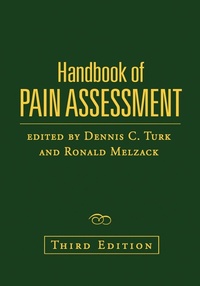
Handbook of Pain Assessment
Description

Clinical and health psychologists, psychiatrists, clinical social workers, counselors, and nurses; pain medicine and rehabilitation specialists; public health professionals; researchers in these fields. May serve as a text in graduate-level courses.
More details
Other editions
Additional editions
Persons
Dennis C. Turk, PhD, is the John and Emma Bonica Professor of Anesthesiology and Pain Research and Director of the Center for Pain Research on Impact, Measurement, and Effectiveness at the University of Washington School of Medicine. His research focuses on the assessment and treatment of a range of chronic pain conditions, clinical trial design, comparative effectiveness research, subgroup identification and treatment matching, and coping and adaptation. Dr. Turk is a recipient of the John C. Liebeskind Award for Career Contribution to Pain Research from the American Academy of Pain Management and the Wilbert E. Fordyce Clinical Investigator Award from the American Pain Society. Ronald Melzack, PhD, until his death in 2019, was Professor Emeritus of Psychology at McGill University in Québec, Canada. Dr. Melzack developed the McGill Pain Questionnaire, the world's most widely used measurement tool for research on pain in human subjects. In recognition of his breakthrough research on pain, Dr. Melzack was appointed an Officer of the Order of Canada and received the Prix du Québec for research in pure and applied science. Among numerous awards, he was elected a Fellow of the Royal Society of Canada, was honoured with a Killam Prize, and earned the Grawemeyer Award for Psychology. In 2009, he was inducted into the Canadian Medical Hall of Fame.
Content
Introduction1. The Measurement of Pain and the Assessment of People Experiencing Pain, Dennis C. Turk and Ronald MelzackI. Self-Report Measures of Pain2. Self-Report Scales and Procedures for Assessing Pain in Adults, Mark P. Jensen and Paul Karoly3. The McGill Pain Questionnaire: Development, Psychometric Properties, and Usefulness of the Long Form, Short Form, and Short Form-2, Joel Katz and Ronald Melzack4. Psychosocial Assessment: Comprehensive Measures and Measures Specific to Pain Beliefs and Coping, Douglas E. DeGood and Andrew J. Cook5. Assessment of Couples and Families with Chronic Pain, Joan M. Romano, Annmarie Cano, and Karen B. Schmaling II. Measures of Pain Not Dependent on Self-Report6. The Facial Expression of Pain, Kenneth D. Craig, Kenneth M. Prkachin, and Ruth E. Grunau7. Assessment of Pain Behaviors, Francis J. Keefe, Tamara J. Somers, David A. Williams, and Suzanne J. Smith8. Psychophysiological and Neuroimaging Measures in the Assessment of Patients with Chronic Pain, Herta Flor and Patric Meyer9. Quantification of Function in Chronic Low Back Pain, Peter B. Polatin, Whitney E. Worzer, Emily Brede, and Robert J. Gatchel10. Assessment of Patients with Chronic Pain: A Comprehensive Approach, Dennis C. Turk and James P. Robinson III. Assessment of Special Populations11. Assessment of Pain in Infants, Children, and Adolescents, Danielle A. Ruskin, Khush A. Amaria, Fay F. Warnock, and Patricia A. McGrath12. Assessment of Pain in Older Persons, Lynn R. Gauthier and Lucia Gagliese 13. Assessment of Pain in Adults and Children with Limited Ability to Communicate, Thomas Hadjistavropoulos, Lynn M. Breau, and Kenneth D. CraigIV. Assessment of Specific Pain Conditions and Syndromes14. Assessment of Acute Pain, Pain Relief, and Patient Satisfaction, Shawn T. Mason, James A. Fauerbach, and Jennifer A. Haythornthwaite15. Clinical Assessment of Low Back Pain, Paul J. Watson16. Assessment of Fibromyalgia Syndrome, Myofascial Pain Syndromes, and Whiplash-Associated Disorders, James P. Robinson and Dennis C. Turk17. Assessment of Neuropathic Pain, Ian Gilron, Nadine Attal, Didier Bouhassira, and Robert H. Dworkin 18. Assessment of Headaches, Frank Andrasik, Dawn C. Buse, and Alyssa Lettich19. Assessment of Patients with Cancer-Related Pain, Karen O. AndersonV. Special Issues and Applications20. Assessment of Psychiatric Disorders, Mark D. Sullivan and Jennifer Brennan Braden21. Disability Evaluation in Painful Conditions, James P. Robinson22. The Importance of Biopsychosocial Screening before Surgical Intervention or Opioid Therapy for Patients with Chronic Pain, Robert J. Gatchel23. Assessment of Chronic Pain in Epidemiological and Health Services Research: Empirical Bases and New Directions, Michael Von Korff24. Assessment of Pain and Health-Related Quality of Life in Chronic Pain Clinical Trials, Alec B. O'Connor and Robert H. DworkinConclusion25. Trends and Future Directions, Dennis C. Turk and Ronald Melzack
