

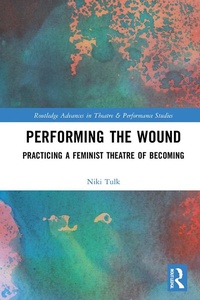
Performing the Wound
Practicing a Feminist Theatre of Becoming
1st Edition
Published on 15. May 2022
192 pages
978-1-000-58064-8 (ISBN)
Description

This book offers a matrixial, feminist-centered analysis of trauma and performance, through examining the work of three artists: Ann Hamilton, Renee Green, and Cecilia Vicuna.
Each artist engages in a multi-media, or "combination" performance practice; this includes the use of site, embodied performance, material elements, film, and writing. Each case study involves traumatic content, including the legacy of slavery, child sexual abuse and environmental degradation; each artist constructs an aesthetic milieu that invites rather than immerses-this allows an audience to have agency, as well as multiple pathways into their engagement with the art. The author Niki Tulk suggests that these works facilitate an audience-performance relationship based on the concept of ethical witnessing/wit(h)nessing, in which viewers are not positioned as voyeurs, nor made to risk re-traumatization by being forced to view traumatic events re-played on stage. This approach also allows agency to the art itself, in that an ethical space is created where the art is not objectified or looked at-but joined with. Foundational to this investigation are the writings of Bracha L. Ettinger, Jill Bennett and Diana Taylor-particularly Ettinger's concepts of the matrixial, carriance and border-linking. These artists and scholars present a capacity to expand and articulate answers to questions regarding how to make performance that remains compelling and truthful to the trauma experience, but not re-traumatizing.
This study will be of great interest to students and scholars of performance studies, art history, visual arts, feminist studies, theatre, film, performance art, postcolonialism, rhetoric and writing.
Each artist engages in a multi-media, or "combination" performance practice; this includes the use of site, embodied performance, material elements, film, and writing. Each case study involves traumatic content, including the legacy of slavery, child sexual abuse and environmental degradation; each artist constructs an aesthetic milieu that invites rather than immerses-this allows an audience to have agency, as well as multiple pathways into their engagement with the art. The author Niki Tulk suggests that these works facilitate an audience-performance relationship based on the concept of ethical witnessing/wit(h)nessing, in which viewers are not positioned as voyeurs, nor made to risk re-traumatization by being forced to view traumatic events re-played on stage. This approach also allows agency to the art itself, in that an ethical space is created where the art is not objectified or looked at-but joined with. Foundational to this investigation are the writings of Bracha L. Ettinger, Jill Bennett and Diana Taylor-particularly Ettinger's concepts of the matrixial, carriance and border-linking. These artists and scholars present a capacity to expand and articulate answers to questions regarding how to make performance that remains compelling and truthful to the trauma experience, but not re-traumatizing.
This study will be of great interest to students and scholars of performance studies, art history, visual arts, feminist studies, theatre, film, performance art, postcolonialism, rhetoric and writing.
Reviews / Votes
'Among the existing literature, Performing the Wound foregrounds the place of trauma at the core of performance. Tulk persuasively moves away from the framing of art as spectacle and a site of voyeurism towards her conception of an ethical, truthful encounter as a space of human connection, a site of wit(h)nessing. This book puts forward a valuable, widely relevant theoretical framework for contemporary performance that could significantly enrich future practice and scholarly work on artists such as Otobong Nkanga (b. 1974), Alberta Whittle (b. 1980), Adela Goldbard (b. 1979), Doris Salcedo (b. 1958), and many others. Tulk's case studies demonstrate the fundamental experience of art through feeling before thinking. Her writing reveals a way of knowing through the body that cares deeply about the work and preserves its unsettledness and ultimate unknowability.' Ana Sol Gonzalez Rueda, Sehepunkte''Tulk's feminist analysis of trauma and performance provides an efficient way to mend not only the broken spirit of trauma survivors but also wounded societies. It also broadens the definition of theatre, propels the conversation between visual arts and trauma studies, and suggests a new direction in theories and practices of trauma performance. This is undoubtedly an important resource for artists and researchers in theatre and performance, trauma psychologists and philosophers of aesthetics. It is also commendable for theatre-goers in general as the vivid descriptions of the performances should facilitate their appreciation of the healing power of performing/performance arts.'' - Daizhao Zou, Theatre Research International
More details
Series
Edition
1. Auflage
Language
English
Place of publication
London
United Kingdom
Publishing group
Taylor & Francis Ltd
Target group
College/higher education
Product notice
Reflowable
Illustrations
12 Halftones, black and white; 12 Illustrations, black and white
ISBN-13
978-1-000-58064-8 (9781000580648)
Copyright in bibliographic data and cover images is held by Nielsen Book Services Limited or by the publishers or by their respective licensors: all rights reserved.
Schweitzer Classification
Other editions
Additional editions
Book
01/2024
1st Edition
Routledge
€62.70
Shipment within 15-20 days
Book
05/2022
1st Edition
Routledge
€206.00
Shipment within 15-20 days
Person
Dr. Niki Tulk is an interdisciplinary artist and Director of Acting and Performance Studies at Plymouth State University. Her poetry book, O, won the 2021 Driftwood Poetry Prize (Driftwood Press). Find out more at www.nikitulk.com.
Content
Acknowledgements
List of Figures
Introduction
Reframing Performance within Trauma Studies Literature
The Textured Language of Rupture: Multimedia Installations by Ann Hamilton
Dreaming In-Between: Landscape, Trauma and Meaning-Making in the Work of Renee Green
Weaving Lament: Cecilia Vicuna's Poetry in Performance
Conclusion
List of Figures
Introduction
Reframing Performance within Trauma Studies Literature
The Textured Language of Rupture: Multimedia Installations by Ann Hamilton
Dreaming In-Between: Landscape, Trauma and Meaning-Making in the Work of Renee Green
Weaving Lament: Cecilia Vicuna's Poetry in Performance
Conclusion
