

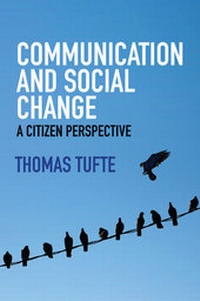
Communication and Social Change
Description

Reviews / Votes
"Tufte brings the significance of social change to life with eclectic and compelling illustrations across global contexts. This will be a classic text in conversations considering the importance of communication and the role of citizens in strategic social change. It is time for the field of communication for social change to take seriously the connections suggested in this book toward a more comprehensive framework. The attention here to social movements and political protests offers a welcome contribution to our scholarship and our practice." Karin Gwinn Wilkins, University of Texas at Austin "The ever-relevant Tufte has reinvented himself. With sensitivity he has crafted a coruscating and masterly book. The tight post-disciplinary synthesis solidifies the claim that communication study has such a key role in the reinvention of the humanities. Anyone interested in communication, humanity, democracy and change must read this book!" Colin Tinei Chasi, University of JohannesburgMore details
Other editions
Additional editions
Person
Content
2
Changing Contexts and Conceptual Stepping Stones
Societal Processes Influencing Communication for Social Change
The prospects for citizen engagement in social change processes have radically changed in recent years. When examining contemporary challenges for communication for social change, a myriad of new contexts, stakeholders and societal dynamics can be identified. These are observable and concrete societal processes that can be broadly structured around four meta-processes in society: the emergence of a new generation of social movements; the substantial growth and expansion of civil society organizations across the globe; the increasing critique of Western development paradigms and the substantiation and circulation of significant alternatives; and, finally, new media developments, especially in digital media. This section discusses the way in which these societal processes constitute 'game-changers' for research in and the practice of communication for social change.
Informed and affected by these meta-processes, but also influenced by the significant limitations of previous communication for social change outcomes, a growing critique and self-critique have emerged within research in and the practice of communication for social change. The following section outlines this growing awareness of the complexities tied to the practice of communicating for social change. This awareness has gathered around three challenges that it is important to make explicit in our pursuit of conceptual ground on which to position citizens' needs, rights and responsibilities at the heart of communication for social change. These challenges are linked to reclaiming the political, cultural and 'mediatic' in communication for social change.
The third section provides a deeper analysis of the theoretical perspectives and challenges associated with a so-called pro-poor approach to communication for social change. This discussion is informed by Colin Sparks' proposal for a pro-poor and social-justice-focused communication based on 'radical participation'. The fourth section goes a step further by providing a similar analysis and discussion of what a post-colonial and culture-centred approach to development implies for communication for social change. A relevant framework to spark this debate is Mohan Dutta's culture-centred post-colonial development discourse. His points and argument are put in perspective by ideas on the same issue from several other post-colonial and post-development scholars. They confirm that Dutta's refreshing analysis echoes long-standing insights that local knowledge and popular culture are cornerstones of any sustainable social change process.
The fifth section explores the notion of media, which is conceived differently in the different schools of thought within communication for social change. Using Martin Scott's and Linje Manyozo's critical analyses of media development, as well as Manyozo's distinction between media as content, as structure and as process, proves extremely useful. Both these scholars help us to navigate conceptually within the different communication for social change debates, while also connecting communication for social change to some of the contemporary debates about the role of digital media and social movements in processes of social change. As we shall see, we cannot discuss the role of media development in communication for social change processes without also discussing issues of power, policy and participation. The concluding section outlines the preliminary contours of a conceptual framework for a citizens' perspective on communication for social change, a framework that is further elaborated in chapters 3, 4 and 5. First, however, I turn to the societal processes that configure the new contexts, stakeholders and dynamics which currently challenge communication for development.
The emergence of a new generation of social movements
The social movements that have emerged in recent years have sent shock waves through many societies across the globe. Many examples illustrate this, from the popular participation in writing a new constitution in Iceland in 2009, to the overthrow of presidents in Tunisia and Egypt in 2011, massive student protests in Chile in 2012, popular revolts in Brazil, Spain and Thailand over several years and the protests by South African students in 2015. Today's social movements share some traits with the identitybased post-material social movements that emerged in the 1960s and 1970s (Inglehart 1977; Melucci 1985; Touraine, Duff and Sennett 1981). However, the current wave is also articulating highly material demands for jobs, an income, housing, food and education. The students in South Africa took to the streets due to increases in tuition fees at their universities, while Brazilian protests were sparked by rising bus fares and the Spanish population came on to the streets with a polyphony of demands, most notably on jobs and affordable housing. In this way, the social and economic demands of the new generation of social movements resonate more with the social movements of the industrial era. It is perhaps fair to say that the new generation of social movements is characterized by its multi-vocal narrative.
Some of these narratives are unpacked in what follows, where I echo Kevin McDonald (2006) by claiming that they are 'experience movements' that have moved beyond traditional political claims of representation and instead touch on a fundamental emotional need to feel included in processes of change, especially processes that affect people's own lives. First, however, it is useful to look back at previous social movements.
The post-material social movements of the 1960s and 1970s put a heavy emphasis on specific social groups with specific social and cultural claims, often tied up with questions of identity and universal human rights. They thereby distinguished themselves from the first generation of social movements, which emphasized more material demands and rights. In the 1990s a wave of insurgency across the globe saw the emergence of the Zapatistas, the global social justice movement, the anti-globalization movement, and other similar uprisings with strong transnational networking features.
Transcending the old boundaries of 'North' and 'South' in the Western development paradigm, the most recent wave of social movements is less specific in its demands than the classic industrial movements, more material than the post-material movements, and, despite the intense transnational networking of some, possibly more national than the global movements of the 1990s and 2000s. This local orientation is manifest, for example, in the way each country named its social uprising in a way relevant to the local or national context, such as Occupy Wall Street in New York in 2011, the Gezi Park uprising in Istanbul in 2013 or the Umbrella revolution in Hong Kong in 2014. Their national features and characteristics notwithstanding, however, today's social movements have come together as a wave of worldwide social mobilizations. Despite their many variations, they resonate with each other in their fundamental critique of the marginalization of large sectors of society and in arguing for the right to be included in defining the direction of and participating in their nation's and region's, but also global, development processes.
The Italian theorist of social movements Mario Diani maintains that social movements are distinct social processes that are characterized by conflictual relations with clearly identified opponents, are linked by dense informal networks and share a distinct collective identity (Della Porta and Diani 2006, 20ff). Diani's characteristics cut across the generations of social movements outlined here, and also resonate with the current wave of insurgency. However, Lisa Thompson and Chris Tapscott rightly remind us to be cautious about our understanding of social movements being too caught up in Western paradigms, as their 'genesis, form and orientation are likely in many, but not all, instances to be significantly different' (Thompson and Tapscott 2010, 2). There may be some generalizable traits in the mechanisms through which social actors engage in collective action, but it is essential to localize these dynamics and understand the concrete departure point that gives rise to collective action and social movements.
As my generational approach to social movements suggests, each time and age has its own features, challenges and opportunities, but underlying these generational generalizations and global trends is a world of variations. With regard to the most recent wave of social movements, several studies have shown the many differing features of their objectives, participants and forms of mobilization, as well as the specific local historical trajectories that led to insurgency in each case (Galindo Cáceres and González-Acosta 2013; Gerbaudo 2012; Juris 2008; 2012; Kavada 2014; Treré 2011; Wildermuth 2013; 2014). This is analysed in more detail in chapters 6 and 7.
The growth and expansion of civil society
The period since the early 1990s has seen a significant development of civil society locally, nationally and transnationally (Gaventa and Tandon 2010; Jordan and van Tuijl 2006. Drawing on Scholte (2001), Lisa Jordan and Peter van Tuijl define civil society as 'the realm (that is, the public sphere) where citizens associate voluntarily, outside families or businesses, to advance their interests, ideas or...
