

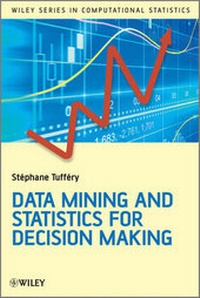
Data Mining and Statistics for Decision Making
Description

Reviews / Votes
"Business intelligence analysts and statisticians, compliance andfinancial experts in both commercial and government organizations across all industry sectors willbenefit from this book." (Zentralblatt MATH, 2011)More details
Other editions
Additional editions
Person
Dr Stephane Tuffery teaches Data Mining and statistics, University Rennes 1, Paris, France.
Translator, Rod Riesco, UK.
Content
Foreword.
Foreword from the French language edition.
List of trademarks.
1. Oveview of data mining.
1.1 What is data mining?
1.2 What is data mining used for?
1.3 Data mining and statistics.
1.4 Data mining and information technology.
1.5 Data mining and protection of persona; data.
1.6 Implementation of data mining.
2. The development of a data mining study.
2.1 Defining the aims.
2.2 Listing the existing data.
2.3 Collecting the data.
2.4 Exploring and preparing the data.
2.5 Population segmentation.
2.6 Drawing up and validating predictive models.
2.7 Synthesizing predictive models of different segments.
2.8 Iteration of the preceding steps.
2.9 Deploying the models.
2.10 Training the model users.
2.11 Monitoring the models.
2.12 Enriching the models.
2.13 Remarks.
2.14 Life cycle of a model.
2.15 Costs of a pilot project.
3. Data Exploration and preparation.
3.1 The different types of data.
3.2 Examining the distribution of variables.
3.3 Detection of rare or missing values.
3.4 Detection of aberrant values.
3.5 Detection of extreme values.
3.6 Tests of normality.
3.7 Homoscedasticity and heteroscedasticity.
3.8 Detection of the most discriminating variables.
3.9 Transformation of variables.
3.10 Choosing ranges of values of binned variables.
3.11 Creating new variables.
3.12 Detecting interactions.
3.13 Automatic variable selection.
3.14 Detection of collinearity.
3.15 Sampling.
4. Using commercial data.
4.1 Data used in commercial applications.
4.2 Special data.
4.3 Data used by business sector.
5. Statistical and data mining software.
5.1 Types of data mining and statistical software.
5.2 Essential characteristics of the software.
5.3 The main software packages.
5.4 Comparison of R, SAS and IBM SPSS.
5.5 How to reduce processing time.
6. An outline of data mining methods.
6.1 Classification of the methods.
6.2 Comparison of the methods.
7. Factor analysis.
7.1 Principal component analysis.
7.2 Variants of principal component analysis.
7.3 Correspondence analysis.
7.4 Multiple correspondence analysis.
8. Neural networks.
8.1 General information on neural networks.
8.2 Structure of a neural network.
8.3 Choosing the learning sample.
8.4 Some empirical rules for network design.
8.5 Data normalization.
8.6 Learning algorithms.
8.7 The main neural networks.
9. Cluster analysis.
9.1 Definition of clustering.
9.2 Applications of clustering.
9.3 Complexity of clustering.
9.4 Clustering structures.
9.5 Some methodological considerations.
9.6 Comparison of factor analysis and clustering.
9.7 Within-cluster and between-cluster sum of squares.
9.8 Measurements of clustering quality.
9.9 Partitioning methods.
9.10 Agglomerative hierarchical clustering.
9.11 Hybrid clustering methods.
9.12 Neural clustering.
9.13 Clustering by similarity aggregation.
9.14 Clustering of numeric variables.
9.15 Overview of clustering methods.
10. Association analysis.
10.1 Principles.
10.2 Using taxonomy.
10.3 Using supplementary variables.
10.4 Applications.
10.5 Example of use.
11. Classification and prediction methods.
11.1 Introduction.
11.2 Inductive and transductive methods.
11.3 Overview of classification and prediction methods.
11.4 Classification by decision tree.
11.5 Prediction by decision tree.
11.6 Classification by discriminant analysis.
11.7 Prediction by linear regression.
11.8 Classification by logistic regression.
11.9 Developments in logistic regression.
11.10 Bayesian methods.
11.11 Classification and prediction by neural networks.
11.12 Classification by support vector machines.
11.13 Prediction by genetic algorithms.
11.14 Improving the performance of a predictive model.
11.15 Bootstrapping and ensemble methods.
11.16 Using classification and prediction methods.
12. An application of data mining: scoring.
12.1 The different types of score.
12.2 Using propensity scores and risk scores.
12.3 Methodology.
12.4 Implementing a strategic score.
12.5 Implementing an operational score.
12.6 Scoring solutions used in a business.
12.7 An example of credit scoring (data preparation).
12.8 An example of credit scoring (modeling by logistic regression).
12.9 An example of credit scoring (modeling by DISQUAL discriminant analysis).
12.10 A brief history of credit scoring.
13. Factors for success in a data mining project.
13.1 The subject.
13.2 The people.
13.3 The data.
13.4 The IT systems.
13.5 The business culture.
13.6 Data mining: eight common misconceptions.
13.7 Return on investment.
14. Text mining.
14.1 Definition of text mining.
14.2 Text sources used.
14.3 Using text mining.
14.4 Information retrieval.
14.5 Information extraction.
14.6 Multi-type data mining.
15. Web mining.
15.1 The aims of web mining.
15.2 Global analyses.
15.3 Individual analyses.
15.4 Personal analysis.
Appendix A. Elements of statistics.
Appendix B. Further reading.
Index.
