

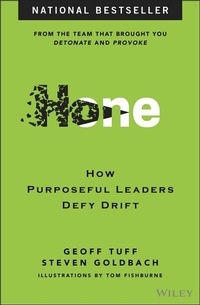
Hone
Description

A clarion call to business leaders to recast their conception of leadership and strategy execution to meet the demands of the modern world
Have a problem with your organization's strategy in an era of accelerating, exponential change? Modern business orthodoxy has an easy answer: transform it. Hone: How Purposeful Leaders Defy Drift argues this thinking is itself in need of an overhaul. Rather than devote time to expensive, long, and often unsuccessful transformations, leaders should instead focus on holistically designing and honing the management systems that are the nervous systems of their businesses. They can take a cue from chefs and other artisans and hone their organizations. After all, honing doesn't sharpen knives; it realigns a knife's steel to its original position. Choosing and honing the set of management systems that promote an organization's desired outcomes (and uninstalling them when they are past their prime) is one of the most important things a business leader can do-and is just as much art as science.
The third in a trilogy of business strategy books written by renowned strategists and two-time Thinkers50-nominated authors Steven Goldbach and Geoff Tuff, this book explains why and how to optimally hone your organization's execution of its strategy, with highlights including:
- The importance of recognizing and taking action to defy the drift that often afflicts organizations undergoing massive transformation
- Guidelines on how to design and continually reshape effective management systems to influence organizational and individual behaviors
- Reframing the job of CEOs to be Chief System Designers for their organizations
- Reflections on how honing principles within organizations can be used on broader societal challenges such as addressing climate change via the energy transition
Engaging, pragmatic, and inspiring, Hone: How Purposeful Leaders Defy Drift earns a well-deserved spot on the bookshelves of all private, public, and nonprofit sector professionals seeking to bring new sources of advantage to their organizations in a time of accelerating uncertainty and exponential change.
More details
Other editions
Additional editions

Persons
GEOFF TUFF is Deloitte's global and U.S. leader for sustainability work with energy, resources, and industrials clients.
STEVEN GOLDBACH is Deloitte's sustainability practice leader in the U.S. after serving nearly a decade as Deloitte's Chief Strategy Officer.
Together, Tuff and Goldbach are co-authors of the national bestsellers Detonate (2018) and Provoke (2021), and co-hosts of the monthly podcast Provocateurs: Profiles in Leadership. They have been nominated twice for Thinkers50 awards.
TOM FISHBURNE is a marketing strategist and the creator of Marketoonist, a weekly cartoon series exploring the foibles of business since 2002.
Content
Part I What It Means to Hone 1
Chapter 1 The Chef 3
Chapter 2 The Problem with Drift 19
Chapter 3 The Nervous System of Strategy 29
Chapter 4 The Craftsman 49
Chapter 5 Wiring the Nervous System 61
Part II Hone Your Organization 77
Chapter 6 Chief System Designer 79
Chapter 7 The Director 91
Chapter 8 Principles of System Design 99
Chapter 9 A Recipe for Change 113
Chapter 10 Walking the Talk 129
Chapter 11 The Rock Band 139
Part III Hone Our Collective Challenges 151
Chapter 12 Widening the Lens 153
Chapter 13 Minimally Viable Thoughts: Honing Our Future 163
Chapter 14 Reflections on a Trilogy 181
Notes 191
Acknowledgments 195
About the Authors 199
Index 201
Chapter 2
The Problem with Drift
The capability to combine a learning mindset with hands-on precision is the hallmark of great leaders who have accomplished extraordinary things with their organizations. Looking beyond all the tech founders-turned-billionaires who display these qualities, consider visionaries like Howard Schultz, who turned a local coffee wholesaler with a handful of retail locations into the global coffee juggernaut Starbucks; Sara Blakely, who spent years perfecting the design of Spanx before launching her company; or Henry Ford, who innovated as much around production methods and work schedules as he did around engineering of the automobile. Their ability to dream big while mastering the details has been key to their success.
Yet somewhere along the way we seem to have collectively decided that our most senior leaders should be grand visionaries, not detail people. Their job is to see the opportunity, declare a bold vision, rally the troops, and designate responsibility for execution. They should keep their eyes firmly fixed on the horizon and not dirty themselves with any concerns about the details or mechanics of the ship propelling them forward. They should be confident and inspirational, not dissuaded by day-to-day setbacks. Right? No, not at all.
A leader who focuses only on the big picture won't necessarily lead her organization to catastrophe, at least not right away. But she can set in motion the foundation for a more common and insidious cause of organizational failure: drift.
As readers of our previous books will know, we both enjoy being on boats (although only one of us - Geoff - is obsessed with them). It's easy for a boat to drift off course. Subtle shifts in wind, currents, or sailor error can cause the boat to head in the wrong direction. It's usually not a big deal. If we notice that waves, wind, or tide are impacting our route, we can adjust using the controls of the craft, compensating for unforeseen environmental factors. From the smallest dinghy to the largest cargo vessel, this is the discipline of boating.
But sometimes the "drift" is so slight as to barely be perceived. If it goes on long enough, the boat can end up significantly astray. On larger vessels, this might be noticed by crew members who don't want to bother the captain by calling attention to it. So it persists longer than it should. This is the most dangerous type of drift: small, imperceptible changes in vector that steadily pull the vessel off course over the long haul. When the boat finds itself in uncharted waters, it needs to massively adjust course to return to its original path or even to avoid disaster.
Organizations drift, too. Small deviations from a set strategy may add up over time and then require massive adjustments (transformations) to bring the organization back on track. Just like in boating, the role of the leader in an organization should be to captain the organization through its strategic journey, regardless of whether she's leading a small startup, a large conglomerate, or a governmental agency.
In many ways, it's easier for organizations than for boats to drift off course. Boats have a very clear, usually observable destination they are sailing toward. They often have sophisticated instruments that allow the captain to immediately see their position, direction, and velocity. Organizational drift is harder to notice because the destination is often less precise than a specific set of coordinates. For example, a business might be aiming to be the market leader in its industry. What it means to be the leader and how the markets are defined are not as clear as lines of longitude and latitude. Further, in boating, the vector of travel is easily measured. In businesses and large organizations, the question of whether we may be heading in the right direction is not always clear. Finally, and most confoundingly, in boating, the destination stays static. Drift only happens because the boat's vector changes. In organizational leadership, drift can happen either because the direction of travel changes or because the "right" destination shifts over time.
THE CAUSES OF ORGANIZATIONAL DRIFT
In complex, large-scale organizations, there are myriad possible causes of drift. In fact, we don't think a complete list could ever be compiled. Pretty much anything that impacts the direction of an organization or its destination could be on that list. That said, there are a few causes of drift that we observe most frequently. For ease of organization, we separate those causes into external factors and internal factors.
External Factors Driving Drift
On the external front, the most frequent causes of drift tend to be actions by competitors, changes in technology, changes in regulations, and evolving customer needs. Actions by competitors are often the most obvious: We see them impacting strategies in nearly every industry, by changing pricing decisions, entering new markets, and acting and reacting to each other. Actions by competitors clearly have the potential to impact both the direction in which a company is heading and their desired destination. Consider the actions by Uber when faced with different entrants. Upon Lyft's original entry on the lower end of the market, Uber added UberX. When Gett entered some of its markets with the ability to reserve cars in advance, Uber added the same capability. In short, when faced with unique competitive threats, Uber added equivalent features to their platforms to protect their market share. Unlike many companies facing similar challenges, though, they broadened - instead of entirely changing - what they offered their customers. Their services still result in users being able to get where they want on-demand without their own vehicles. They combatted drift by staying true to the elemental purpose of their business (more on this later).
Changes in technology have the potential to materially change the potential economic viability of different business models. Technology can quickly make some business models an order of magnitude better or an order of magnitude cheaper, facilitating entry into the market by new competitors. With that comes a constant need to adjust on the part of the organizations already in the industry. Consider the explosion in the wellness industry enabled by the intersection of biometric tracking and advances in understanding human longevity. We now see businesses devoted to providing customers with regular bloodwork, new supplements, exercise routines, and physical examinations. There is an entire ecosystem of podcasters devoted to the topic. This field is clearly going to change the economics of traditional healthcare organizations and the healthcare insurance industry, so leaders of those businesses will need to examine if they have been pushed off course and whether the destination they were heading toward still makes sense.
Government regulations have the potential to materially change the context for virtually all organizations. When new policies are enacted, they change the vector and destination for nearly any business in the impacted market. Indeed, government regulations and laws are among the most powerful forces shaping how organizations function (more on this in Chapter 12).
Finally, changes in customer behavior can shake up a market and lead to meaningful organizational drift. When's the last time you were in a long line and wished there were a simple, technology-driven way to avoid the wait? If you are such a person, you're in good company: Both of us proudly seek out technology to help us skip lines in daily life. Whether it's mobile ordering at coffee shops, expedited processing options at borders, or depositing a check via an app, today's world abounds with options to meet the universal customer desire for increased convenience. Of course, these changes also cause companies to respond haphazardly to updated customer expectations - and risk drifting off course.
The good thing about exogenous causes of drift is that they are pretty easy to see and tend to be easier to rally support to address. More insidious causes of drift happen inside the organization - often driven by human tendencies - and sadly tend to go unnoticed for far too long.
Internal Factors Driving Drift
To understand internal forces that push organizations off course, consider the widespread practice of changing people's roles every few years. This happens in many organizations because human beings have strong desires to grow and make their mark. As a result, leaders have a natural inclination when they come into new roles to undertake a partial or complete rewrite of what existed before. If you multiply that by the number of leaders across a large organization, that's a lot of pivoting over time. Without a meaningfully constant long-term direction, it becomes impossible to determine what it means to be on-course. And the more senior the leader who is changing, the more broadly the knock-on effects are felt. We should challenge the orthodoxy that everything needs to change when leadership changes, but it's hard to overcome the personal need for the new leader to show they are having an impact by doing things differently.
A second major internal cause of drift is that many senior leaders focus almost entirely on setting strategy, yet neglect the...
