

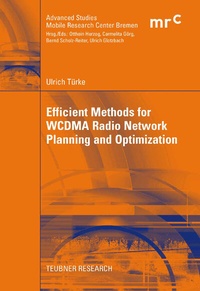
Efficient Methods for WCDMA Radio Network Planning and Optimization
1st Edition
Published on 8. December 2007
XXV, 165 pages
978-3-8350-5456-1 (ISBN)
Description

When joining Siemens in 2001, I also extended my research interest towards radio net work planning methodologies. This area of research brought together my personal interest in mobile communications and in the design of ef?cient algorithms and data structures. Between 2001 and 2003, I participated in the EU project Momentum, which was target ing the performance evaluation and optimization of UMTS radio networks. In this project my main focus was on Monte Carlo snapshot techniques, shortly after I broadened my research scope towards network optimization techniques. Both constitute the basis of this thesis. Later I got the chance to bring in the ideas and methods of my thesis into a Siemens internal planning and optimization tool, the development of which I guided over the last two years. First of all I would like to thank Professor Dr. Carmelita Görg for supervising this thesis, for her guidance, and her encouragement. I very much appreciate that she although I, as an external Ph. D. student, was not part of her department at the University of Bremen was always very open for discussions and provided me with a large amount of useful suggestions over the past years. I without a doubt greatly bene?ted from this, both in my scienti?c work and personally. I am also deeply grateful for the comments and suggestions by Professor Dr. Thomas Kürner, who is also the second examiner of this thesis.
More details
Other editions
Additional editions
Book
09/2007
1st Edition
Deutscher Universitätsverlag
€53.49
Shipment within 10-15 days
Person
Dr. Ulrich Türke promovierte bei Prof. Dr. Carmelita Görg am Fachbereich für Physik und Elektrotechnik der Universität Bremen. Er ist als Experte für Funknetzplanung und -optimierung bei der atesio GmbH in Berlin tätig.
Content
The WCDMA Air Interface.- Modeling the Wireless Transmission Channel.- Monte-Carlo Snapshot Analysis.- Monte-Carlo Snapshot Analysis for WCDMA Network Performance Evaluation.- Analytical Performance Evaluation.- Automated Network Optimization.- Conclusions and Outlook.
Chapter 2 The WCDMA Air Interface (p. 5)
WCDMA is the most widely adopted air interface standard for third generation (3G) mobile networks. 3G networks have been designed to supersede second generation (2G) networks, i.e. GSM (Europe and large parts of the world), cdmaOne (Americas), D-AMPS (Americas), and PDC (Japan). The main advances of 3G systems compared with 2G systems are [HT04]:
Higher user peak data rates (several Mbps).
Dynamic adaptation of user data rates ("bandwidth on demand").
Asymmetric uplink and downlink data rates to fit usual Packet-Switched (PS) traffic characteristics, e.g. web browsing, ftp downloads.
Support of Quality of Service (QoS) differentiation, e.g. in terms of error rates and delay.
Multiplexing of services with different quality and data rate requirements on a single connection.
Improved spectrum efficiency (higher system throughput per unit of allocated frequency spectrum).
Work on the development of 3G systems started in 1992 by the International Telecommunications Union (ITU). Original target of the ITU activities was to define one global International Mobile Telecommunications-2000 (IMT-2000) standard that operates in a common frequency band around 2 GHz in the largest world markets for mobile communication, namely USA, Europe, and Asia. In the USA, however, the frequency band considered by the ITU for IMT-2000 was already occupied by 2G networks (GSM 1900) and for satellite communication (in the 2.1 GHz band).
The 3G networks currently being deployed in the USA hence partly reuse the frequency spectrum originally auctioned for GSM 1900 but in particular utilize different frequencies bands. This drives the need for several types of base station equipment and costly multi-band user equipment to provide global handsets. This is similar to the present situation in 2G networks that ITU intended to overcome with 3G.
Several competing standards have been defined by the standardization bodies in the IMT- 2000 framework. In 1999 the ITU approved five air interfaces for IMT-2000. The most relevant of these are WCDMA, CDMA2000, TD-SCDMA, and EDGE as a direct successor of GSM. CDMA2000 is the successor of cdmaOne in the USA. CDMA2000 utilizes a smaller frequency band than WCDMA to simplify the usage of the fragmented spectrum. TD-SCDMA is a standard to be deployed in China.
WCDMA is the air interface used by the Universal Mobile Telecommunications System (UMTS), which is specified and brought into ITU by the 3rd Generation Partnership Project (3GPP). The most important standardization bodies contribute to 3GPP, i.e. ARIB (Japan), ATIS (USA), CCSA (China), ETSI (Europe), TTA (Korea), and TTC (Japan). WCDMA is called Universal Terrestrial Radio Access (UTRA) within 3GPP. It covers two modes of operation, that is UTRA-FDD (Frequency Division Duplex) and UTRATDD (Time Division Duplex).
UTRA-FDD uses paired frequency bands for Uplink (UL) and Downlink (DL) data transmission, whereas UTRA-TDD utilizes a common frequency band for both directions and adjusts the time domain portion assigned for UL and DL transmission dynamically.
WCDMA is the most widely adopted air interface standard for third generation (3G) mobile networks. 3G networks have been designed to supersede second generation (2G) networks, i.e. GSM (Europe and large parts of the world), cdmaOne (Americas), D-AMPS (Americas), and PDC (Japan). The main advances of 3G systems compared with 2G systems are [HT04]:
Higher user peak data rates (several Mbps).
Dynamic adaptation of user data rates ("bandwidth on demand").
Asymmetric uplink and downlink data rates to fit usual Packet-Switched (PS) traffic characteristics, e.g. web browsing, ftp downloads.
Support of Quality of Service (QoS) differentiation, e.g. in terms of error rates and delay.
Multiplexing of services with different quality and data rate requirements on a single connection.
Improved spectrum efficiency (higher system throughput per unit of allocated frequency spectrum).
Work on the development of 3G systems started in 1992 by the International Telecommunications Union (ITU). Original target of the ITU activities was to define one global International Mobile Telecommunications-2000 (IMT-2000) standard that operates in a common frequency band around 2 GHz in the largest world markets for mobile communication, namely USA, Europe, and Asia. In the USA, however, the frequency band considered by the ITU for IMT-2000 was already occupied by 2G networks (GSM 1900) and for satellite communication (in the 2.1 GHz band).
The 3G networks currently being deployed in the USA hence partly reuse the frequency spectrum originally auctioned for GSM 1900 but in particular utilize different frequencies bands. This drives the need for several types of base station equipment and costly multi-band user equipment to provide global handsets. This is similar to the present situation in 2G networks that ITU intended to overcome with 3G.
Several competing standards have been defined by the standardization bodies in the IMT- 2000 framework. In 1999 the ITU approved five air interfaces for IMT-2000. The most relevant of these are WCDMA, CDMA2000, TD-SCDMA, and EDGE as a direct successor of GSM. CDMA2000 is the successor of cdmaOne in the USA. CDMA2000 utilizes a smaller frequency band than WCDMA to simplify the usage of the fragmented spectrum. TD-SCDMA is a standard to be deployed in China.
WCDMA is the air interface used by the Universal Mobile Telecommunications System (UMTS), which is specified and brought into ITU by the 3rd Generation Partnership Project (3GPP). The most important standardization bodies contribute to 3GPP, i.e. ARIB (Japan), ATIS (USA), CCSA (China), ETSI (Europe), TTA (Korea), and TTC (Japan). WCDMA is called Universal Terrestrial Radio Access (UTRA) within 3GPP. It covers two modes of operation, that is UTRA-FDD (Frequency Division Duplex) and UTRATDD (Time Division Duplex).
UTRA-FDD uses paired frequency bands for Uplink (UL) and Downlink (DL) data transmission, whereas UTRA-TDD utilizes a common frequency band for both directions and adjusts the time domain portion assigned for UL and DL transmission dynamically.
