

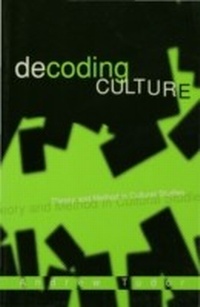
Decoding Culture
Theory and Method in Cultural Studies
1st Edition
Published on 24. September 1999
224 pages
978-1-84920-690-7 (ISBN)
Description

`This book represents a significant intervention and, as such, should be used on numerous cultural studies courses. In its intellectual honesty and clarity Tudor's book will stand as an authoritative basis for further developments in the coming years' - David Chaney
Decoding Culture offers a concise and accessible account of the development of cultural studies from the late 1950s to the 1990s. Focusing on the significant theoretical and methodological assumptions that have informed the cultural studies project - the text: covers the key thinkers and key perspectives including, structuralism and post-structuralism, Screen theory, the Birmingham School, and audience analysis; offers a timely corrective to anti-sociological interpretations of cultural change; and invites readers to contest the standard 'text-book' accounts of the developement of cultural studies.
Through its fair and accessible account of complex ideas, Decoding Culture provides a more analytic understading of the theoretical and methodological dynamics of cultural studies than has been hitherto available. It will be welcomed by all students of cultural studies, sociology and media studies.
Decoding Culture offers a concise and accessible account of the development of cultural studies from the late 1950s to the 1990s. Focusing on the significant theoretical and methodological assumptions that have informed the cultural studies project - the text: covers the key thinkers and key perspectives including, structuralism and post-structuralism, Screen theory, the Birmingham School, and audience analysis; offers a timely corrective to anti-sociological interpretations of cultural change; and invites readers to contest the standard 'text-book' accounts of the developement of cultural studies.
Through its fair and accessible account of complex ideas, Decoding Culture provides a more analytic understading of the theoretical and methodological dynamics of cultural studies than has been hitherto available. It will be welcomed by all students of cultural studies, sociology and media studies.
Reviews / Votes
`This book represents a significant intervention that should be used on a wide range of courses concerned with the study of contemporary culture. In its intellectual honesty and clarity Tudor's book will stand as an authoritative basis for further developments in the coming years' - David Chaney, University of DurhamAll prices
More details
Language
English
Place of publication
London
United Kingdom
Target group
College/higher education
ISBN-13
978-1-84920-690-7 (9781849206907)
Copyright in bibliographic data and cover images is held by Nielsen Book Services Limited or by the publishers or by their respective licensors: all rights reserved.
Schweitzer Classification
Other editions
Additional editions
Book
09/1999
1st Edition
SAGE Publications Inc
€90.67
Shipment within 15-20 days

Book
09/1999
1st Edition
SAGE Publications Inc
€224.70
Shipment within 15-20 days
Person
I began my academic life at the University of Leeds as a student in chemical engineering, but then moved into sociology in which subject I graduated in 1965. After four years teaching at the University of Essex I joined the Department of Sociology at the University of York in 1970, becoming successively Senior Lecturer, Reader and Professor in that department. I was Head of the Sociology department for six years from 1988 to 1995.
Content
The Story So Far
The Way We Are
Enter Structuralism
Situating Subjects
Resisting the Dominant
Gendered Subjects, Women's Texts
The Rise of the Reader
The Way We Are
Enter Structuralism
Situating Subjects
Resisting the Dominant
Gendered Subjects, Women's Texts
The Rise of the Reader
