

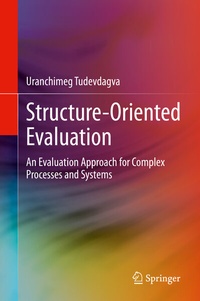
Structure-Oriented Evaluation
Description

This book introduces a new branch of evaluation theory, where evaluation and score calculation is embedded into general measure theory, as is typical in geometry, probability theory and reliability theory. The author describes the theoretical background of new evaluation model for complex processes, where interests of involved groups are considered as multi-players of evaluation process. Readers will learn how the logical structure of a process/system can be included into an evaluation. The author applies these techniques not only to the visualization of evaluation goals, but also the designed logical structure becomes the basis for calculation of evaluation scores. Various examples are provides to demonstrate the implementation of the methods.
More details
Other editions
Additional editions
Person
Uranchimeg Tudevdagva was born in 1969, graduate of Novosibirsk State Technical University and Mongolian University of Science and Technology, holds doctorates from Novosibirsk State Technical University and Technische Universität Chemnitz.
Content
Introduction.- Evaluation approaches for complex systems.- Theoretical foundation of structure oriented evaluation.- Early examples with e-learning.- Examples for complex systems with simulated data.- Guideline for use of structure oriented evaluation model.
