

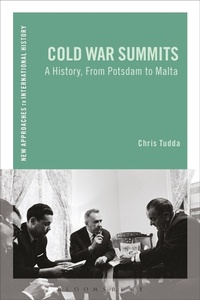
Cold War Summits
A History, from Potsdam to Malta
1st Edition
Published on 29. October 2015
256 pages
978-1-4725-2974-9 (ISBN)
Description

CHOICE Outstanding Academic Title 2016
This book examines six summits spanning the beginning and the end of the Cold War. Using declassified documents from U.S., British, and other archives, Chris Tudda shows how the Cold War developed from an ideological struggle between capitalism and communism into a truly global struggle. From Potsdam in 1945, to Malta in 1989, the nuclear superpowers met to determine how to end World War II, manage the arms race, and ultimately, end the Cold War. Meanwhile, the newly independent nations of the "Third World," including the People's Republic of China, became active and respected members of the international community determined to manage their own fates independent of the superpowers.
The six summits - Potsdam (1945), Bandung (1955), Glassboro (1967), Beijing (1972), Vienna (1972), and Malta (1989) - are here examined together in a single volume for the first time. An introductory essay provides a historiographical analysis of Cold War summitry, while the conclusion ties the summits together and demonstrates how the history of the Cold War can be understood not only by examining the meetings between the superpowers, but also by analyzing how the developing nations became agents of change and thus affected international relations.
This book examines six summits spanning the beginning and the end of the Cold War. Using declassified documents from U.S., British, and other archives, Chris Tudda shows how the Cold War developed from an ideological struggle between capitalism and communism into a truly global struggle. From Potsdam in 1945, to Malta in 1989, the nuclear superpowers met to determine how to end World War II, manage the arms race, and ultimately, end the Cold War. Meanwhile, the newly independent nations of the "Third World," including the People's Republic of China, became active and respected members of the international community determined to manage their own fates independent of the superpowers.
The six summits - Potsdam (1945), Bandung (1955), Glassboro (1967), Beijing (1972), Vienna (1972), and Malta (1989) - are here examined together in a single volume for the first time. An introductory essay provides a historiographical analysis of Cold War summitry, while the conclusion ties the summits together and demonstrates how the history of the Cold War can be understood not only by examining the meetings between the superpowers, but also by analyzing how the developing nations became agents of change and thus affected international relations.
More details
Series
Edition
1. Auflage
Language
English
Place of publication
London
United Kingdom
Publishing group
Bloomsbury Publishing PLC
Target group
Professional and scholarly
College/higher education
ISBN-13
978-1-4725-2974-9 (9781472529749)
Copyright in bibliographic data and cover images is held by Nielsen Book Services Limited or by the publishers or by their respective licensors: all rights reserved.
Schweitzer Classification
Other editions
Additional editions
Book
10/2015
Bloomsbury Academic
€112.70
Shipment within 15-20 days
Book
10/2015
Bloomsbury Academic
€36.50
Shipment within 15-20 days
Person
Chris Tudda is a historian in the Department of State and Adjunct Professor at The George Washington University, USA.
Content
1. Introduction
2. Potsdam: How the Cold War Began
3. Bandung: The Former Colonies Declare their Independence (Again)
4. Glassboro: The Beginning of Detente
5. Beijing: Sino-U.S. Rapprochement and the Cold War
6. Vienna: Carter, Brezhnev, and Détente's Last Breath
7. Malta: Ending the Cold War
8. Conclusion
Bibliography
Index
2. Potsdam: How the Cold War Began
3. Bandung: The Former Colonies Declare their Independence (Again)
4. Glassboro: The Beginning of Detente
5. Beijing: Sino-U.S. Rapprochement and the Cold War
6. Vienna: Carter, Brezhnev, and Détente's Last Breath
7. Malta: Ending the Cold War
8. Conclusion
Bibliography
Index
